
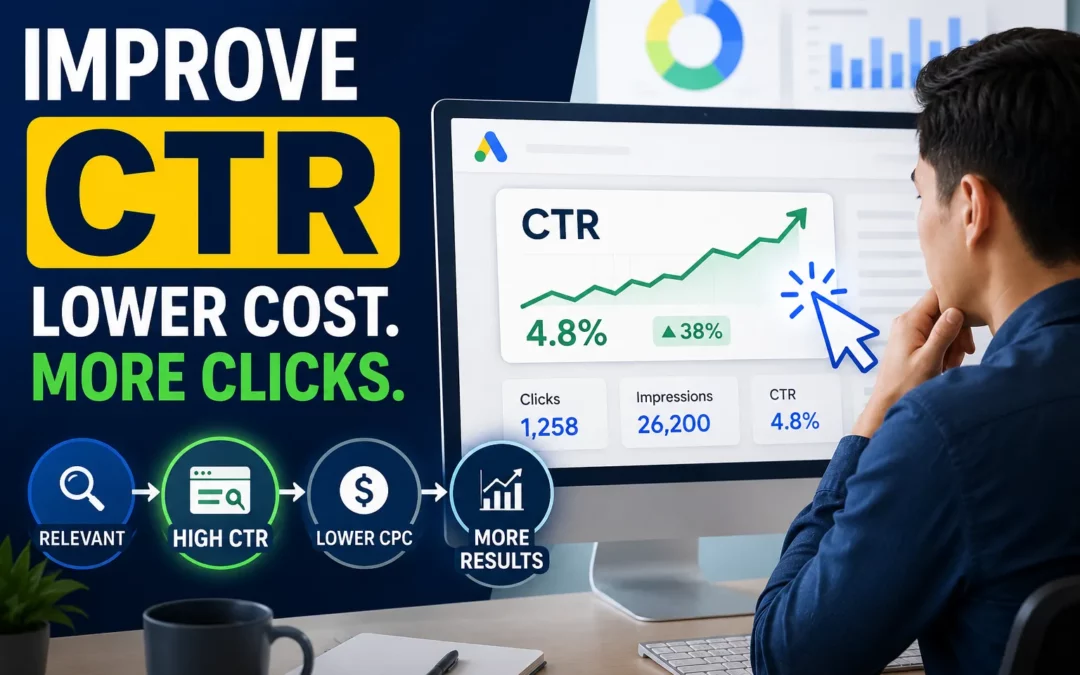
CTR, or Click-Through Rate, is the percentage of users who click your ad after seeing it in search results. It is calculated by dividing the number of clicks your ad receives by the number of times it was shown (impressions), then multiplying by 100. A higher CTR means your ad is compelling and relevant to the users who see it a lower CTR suggests your ad is failing to connect with searchers even when it appears.
In SEM, CTR is far more than a vanity metric. It is a direct input into your Quality Score, which determines both your Ad Rank and your actual Cost Per Click. This means CTR improvements create a compounding chain of benefits: better Quality Score leads to better Ad Rank, which leads to lower CPC and higher positions, which leads to more clicks at lower cost. Understanding CTR and knowing how to improve it is one of the highest-leverage skills in any SEM practitioner’s toolkit. Want to benchmark your CTR and get copy feedback from real practitioners? Our community reviews actual ads and identifies what’s holding performance back join us here.
What Is CTR and How Is It Calculated?
Click-Through Rate (CTR) measures the ratio of ad clicks to ad impressions in other words, how often people who see your ad actually click on it.
CTR Formula:
CTR = (Clicks ÷ Impressions) × 100
Example: Your ad appears 10,000 times in a week and receives 450 clicks.
CTR = (450 ÷ 10,000) × 100 = 4.5%
This metric appears at every level of your Google Ads account — campaign level, ad group level, keyword level, and individual ad level. Each level tells you something different:
- Campaign CTR shows overall how well your campaign messaging resonates
- Ad group CTR reveals whether specific keyword themes are performing
- Keyword CTR identifies which individual terms drive engagement vs. wasted impressions
- Ad CTR shows which specific copy variations users respond to most
Reviewing CTR at the keyword and ad level gives you the most actionable data for optimization.
Why CTR Matters So Much in SEM
CTR is central to SEM performance because it feeds directly into Quality Score — the metric that controls your CPC and Ad Rank. Specifically, Expected CTR is one of the three components Google uses to calculate Quality Score.
Here is the cascade of consequences CTR creates:
High CTR → Better Expected CTR → Higher Quality Score → Lower CPC + Better Ad Rank → More clicks at lower cost
Low CTR → Worse Expected CTR → Lower Quality Score → Higher CPC + Worse Ad Rank → Fewer clicks at higher cost
This means CTR is not just about measuring popularity of your ads. It is about managing the economics of your entire SEM account. A 1% improvement in CTR across your campaigns can reduce CPC by 10–20% while simultaneously improving your ad positions — generating more traffic from the same budget.
CTR is also a signal of ad-to-keyword alignment. When users see your ad and do not click, they are effectively voting that your ad did not deliver what they were looking for. A persistently low CTR on a keyword is often a signal that your ad copy does not match the intent of that keyword — which connects directly to how the ad auction evaluates relevance through Ad Rank.
What Is a Good CTR in Google Ads?
CTR benchmarks vary significantly by industry, keyword type, ad position, and device. There is no single universal “good” CTR — but these ranges provide useful context:
Google Search Ads — General Benchmarks:
| Position | Typical CTR Range |
|---|---|
| Position 1 (top of page) | 6% to 15%+ |
| Position 2 | 3% to 8% |
| Position 3 | 2% to 5% |
| Position 4 (bottom of top ads) | 1% to 3% |
By industry (approximate 2026 averages for Search):
- Dating and personals: 6%+
- Legal services: 4% to 7%
- E-commerce: 2% to 5%
- B2B services: 2% to 4%
- Technology and software: 2% to 4%
- Health and medical: 3% to 6%
Key context: A CTR of 3% in a highly competitive B2B software category may be excellent performance. The same CTR in a branded search campaign — where users are specifically looking for your company would be poor. Always benchmark against your own historical performance and your specific keyword type before comparing to industry averages.
Branded vs. non-branded keywords: Branded keywords (searches containing your company or product name) almost always have higher CTR — typically 10% to 30%+ — because users are specifically looking for you. Non-branded keyword CTR is typically 2% to 8% for well-optimized ads.
The 5 Most Impactful Ways to Improve CTR
1. Match Your Headline Directly to the Search Intent
The most reliable CTR improvement: write Headline 1 to mirror exactly what the user searched for. When users see their own words reflected in your headline, the psychological relevance is immediate and powerful.
If a user searches “project management software for remote teams,” your Headline 1 should be “Project Management Software for Remote Teams” — not “Streamline Your Team’s Workflow” or “The #1 Business Productivity Tool.”
Google’s Responsive Search Ads (RSAs) allow you to provide up to 15 headlines and 4 descriptions. Google tests combinations and prioritizes those generating the highest CTR. Provide a range of headline types:
- Keyword-mirroring headlines (exact or close match to the search query)
- Benefit-focused headlines (“Manage Projects 40% Faster”)
- Social proof headlines (“Trusted by 50,000 Teams Worldwide”)
- Urgency or offer headlines (“Start Free — No Credit Card Required”)
- Question headlines (“Struggling to Meet Project Deadlines?”)
2. Use Ad Extensions to Expand Your Ad’s Footprint
Ad extensions sitelinks, callouts, structured snippets, and others increase the physical size of your ad on the search results page. A larger ad captures more visual attention and provides more clickable entry points, both of which improve CTR.
Sitelinks in particular create multiple click paths within a single ad, allowing users with different intents to find their most relevant destination. An ad with four sitelinks is essentially four mini-ads presented simultaneously each one a potential CTR driver.
3. Leverage Numbers, Specificity, and Social Proof
Generic claims reduce CTR because they apply to every advertiser in your category. Specific, credible details increase CTR because they stand out and signal that your offer is real and differentiated.
Generic (lower CTR): “Save Time and Money on HR Software” Specific (higher CTR): “Cut HR Admin by 12 Hours Per Week Starts at $29/Month”
Numbers, percentages, customer counts, award mentions, and year-in-business signals all improve CTR by providing evidence rather than assertion.
4. Include a Strong, Action-Oriented Call to Action
Your ad should tell users exactly what to do next and what they will get when they do it. Passive descriptions reduce urgency; direct calls to action increase it.
Weak CTA: “Learn More About Our Software” Strong CTA: “Start Your Free 30-Day Trial Today” Stronger CTA: “Get a Custom Demo Set Up in 5 Minutes”
The best CTAs are specific about the action, honest about what follows, and reduce perceived friction (“No Credit Card Required,” “Cancel Anytime,” “Set Up in Minutes”).
5. Tighten Ad Group Structure for Higher Relevance
If a single ad group contains keywords with different intents, no single ad can be fully relevant to all of them — resulting in lower average CTR across the group. Keyword match type management and ad group tightening work together here: the more closely related the keywords in an ad group, the more precisely you can write ad copy that resonates with every keyword’s intent.
Split ad groups that contain diverse keyword themes into separate, tightly focused groups with dedicated ads for each. This is one of the most reliable structural improvements for CTR.
CTR Traps to Avoid
Optimizing for CTR at the expense of conversion rate. A clickbait headline might generate very high CTR but if users arrive on your landing page and immediately leave because expectations were not met, your conversion rate collapses. High CTR with low conversion rate indicates a messaging mismatch between ad and landing page. Aim for CTR that attracts genuinely interested users, not just curious ones.
Comparing CTR across different keyword types. Branded keyword CTR is structurally higher than non-branded. Exact match CTR is typically higher than phrase match CTR because the search query is more tightly aligned. Comparing CTR across these fundamentally different keyword types is misleading. Segment your CTR analysis by keyword type and campaign type for meaningful comparisons.
Ignoring CTR at the keyword level. Campaign-level CTR hides critical keyword-level variation. A campaign averaging 3.5% CTR might contain some keywords at 8% and others at 0.8%. Keywords with persistently low CTR are damaging your Quality Score and should be paused, rewritten, or restructured.
Not testing ad variations systematically. Many advertisers write one set of headlines and never test alternatives. Google’s RSA format makes systematic testing easy — provide diverse headline options and let Google’s data identify which combinations drive the highest CTR. Review asset performance ratings (Best, Good, Low) in your RSA performance breakdown.
CTR vs. Conversion Rate: Understanding the Difference
CTR and conversion rate are related but distinct metrics that measure different stages of the user journey:
CTR measures the journey from impression to click how effectively your ad convinces users to visit your site.
Conversion rate measures the journey from click to action how effectively your landing page convinces visitors to complete your goal.
Both matter for campaign profitability, but they require different optimization approaches:
| Metric | What It Measures | How to Improve |
|---|---|---|
| CTR | Ad effectiveness | Better headlines, extensions, ad copy relevance |
| Conversion Rate | Landing page effectiveness | Better UX, message matching, offer clarity, form simplification |
A campaign with high CTR and low conversion rate has a strong ad but a weak landing page. A campaign with low CTR and high conversion rate reaches fewer people but converts them well — suggesting the ad message is underselling an offer that genuinely resonates.
Understanding how search intent shapes what users expect when they click helps align both CTR optimization and landing page design around the same user intent — because ads and landing pages that both reflect the same intent produce the best outcomes at both stages.
CTR Benchmarks Across Campaign Types
CTR expectations differ significantly across Google Ads campaign types:
Search campaigns: Highest CTR because ads are directly triggered by user intent. Average 3% to 7% for non-branded, well-optimized campaigns.
Display campaigns: Much lower CTR (0.05% to 0.5%) because ads interrupt users rather than responding to expressed intent. A 0.1% display CTR can be excellent performance for brand awareness goals.
Shopping campaigns: Typically 1% to 3% for well-optimized product listings. Product image quality and price competitiveness are the primary CTR drivers in Shopping.
Remarketing campaigns: Variable, but typically higher than cold traffic Display campaigns (0.3% to 2%) because audiences have prior brand exposure.
This means comparing the CTR of a Search campaign to a Display campaign is meaningless — they operate in fundamentally different user attention environments with different baseline expectations.
FAQs
What is CTR in Google Ads?
CTR in Google Ads is Click-Through Rate the percentage of users who click your ad after seeing it. Calculated as Clicks ÷ Impressions × 100. It appears at the campaign, ad group, keyword, and individual ad level in your Google Ads dashboard.
What is a good CTR for Google Search Ads?
For Google Search Ads, a CTR of 3% to 7% is generally considered solid for non-branded keywords. Above 7% is excellent. Below 2% on high-intent commercial keywords typically signals a relevance problem worth investigating. Branded keyword CTR is structurally higher (often 10% to 30%+) and should be measured separately.
Does a higher CTR always mean better performance?
Not always. CTR measures clicks relative to impressions it does not measure conversions. An extremely high CTR generated by misleading or clickbait headlines can produce high traffic but poor conversion rates, resulting in wasted spend. The goal is a CTR that reflects genuine user interest that translates into conversions.
How does CTR affect my CPC?
CTR feeds into the Expected CTR component of Quality Score. A higher CTR history improves Expected CTR, which raises Quality Score, which reduces actual CPC in the auction. The relationship is indirect but consistent — improving CTR over time lowers the cost you pay per click.
Why is my CTR so different across keywords?
CTR varies naturally across keywords based on intent type, competition, ad position, and how well your ad copy matches each keyword’s specific intent. Branded keywords have higher CTR than non-branded. Exact match keywords typically have higher CTR than phrase or broad match. Keywords where your ad copy closely mirrors the search query outperform generic messaging.
Should I pause keywords with low CTR?
Low CTR keywords should be investigated before pausing. First, check whether the CTR is low because of poor ad copy, wrong match type, or structural mismatch between the keyword and your ad group’s theme. Often, the issue is fixable without pausing the keyword. Pause after confirming: the keyword has sufficient impression volume for a meaningful CTR reading and ad copy improvements have not moved the needle.
How long should I wait before judging a keyword’s CTR?
Statistical significance requires sufficient data. A keyword with 50 impressions and 1 click has a 2% CTR that is not yet reliable. Wait until a keyword has at least 200 to 500 impressions before drawing conclusions from its CTR. For very low-volume keywords, this may take several weeks.
Conclusion
Click-Through Rate is the connective tissue between your ad copy and your campaign economics. It is where user psychology whether your ad resonates with a searcher’s intent translates into the Quality Score that determines your costs, positions, and ultimately your profitability.
Improving CTR is not about writing flashier or more provocative ads. It is about understanding exactly what users are looking for when they type a specific query and crafting ad copy that directly, specifically, and honestly reflects that intent. When users see themselves in your headline when your ad feels like it was written for exactly their search — they click. And those clicks, from genuinely interested users, are the ones that convert.
The full SEM performance chain runs from how you choose and structure your keywords through CTR and Quality Score to the CPC you ultimately pay for each visit. CTR sits at the center of that chain improving it improves everything downstream. Have ads with low CTR you cannot figure out how to fix? Share them with our community for honest, specific feedback join us here.