
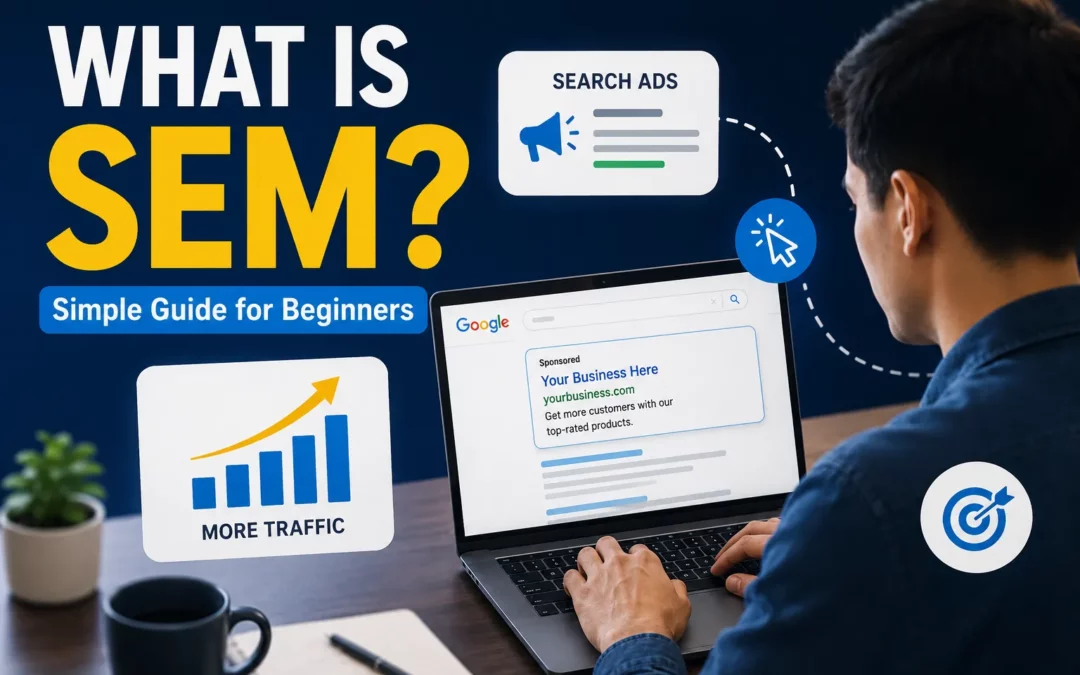
Search Engine Marketing (SEM) is the practice of paying search engines like Google to display your ads at the top of search results when users type specific keywords. It gives businesses immediate visibility on the most visited pages on the internet, right at the moment someone is actively looking for what you offer.
Unlike organic traffic that takes months to build, SEM puts your brand in front of high-intent users within hours. Therefore, it is one of the fastest and most measurable ways to drive traffic and generate leads online. New to SEM and digital marketing? Join our community of marketers who share real strategies, campaign tips, and hands-on feedback every week start learning with us here.
What Is Search Engine Marketing?
Search Engine Marketing (SEM) is a form of digital advertising where businesses bid on keywords to show paid ads on search engine results pages (SERPs). In 2026, SEM refers almost exclusively to paid search advertising primarily through Google Ads and Microsoft Advertising (Bing Ads).
When someone searches for “running shoes near me” or “best project management software,” the results at the very top — marked “Sponsored” — are SEM ads. Advertisers pay a fee each time someone clicks on those ads, which is why SEM is also called Pay Per Click (PPC) advertising.
SEM is built on three core principles:
- Relevance: Your ad must match what the user is searching for
- Bidding: You compete in a real-time auction for ad placement
- Quality: Search engines reward well-structured, relevant ads with better positions at lower costs
SEM vs SEO: What Is the Difference?
SEM and SEO are both strategies for appearing on search engine results pages, but they work in fundamentally different ways.
SEO (Search Engine Optimization) earns organic rankings through content quality, backlinks, and technical website health. Results take 3 to 6 months to build but generate free, compounding traffic over time. Understanding what SEO is and how organic traffic works helps clarify why most businesses need both channels.
SEM delivers immediate paid visibility at the top of results. You pay per click, results appear within hours, and traffic stops the moment your budget runs out.
| Factor | SEM (Paid) | SEO (Organic) |
|---|---|---|
| Speed | Immediate (hours) | Slow (3–6 months) |
| Cost model | Pay per click | Free clicks, cost of content |
| Placement | Top of SERP (labeled Sponsored) | Below ads, organic positions |
| Sustainability | Stops when budget stops | Compounds over time |
| Best for | Quick wins, product launches | Long-term brand authority |
Most successful businesses use both together — SEM for immediate traffic and SEO for long-term growth.
How Does SEM Work?
SEM works through a real-time auction system that happens every time someone performs a search. When a user types a query, Google instantly runs an auction among all advertisers who have bid on that keyword. The winner gets their ad displayed — but winning is not just about the highest bid.
Google determines your ad position using a formula called Ad Rank, which considers:
- Your bid amount (how much you are willing to pay per click)
- Your Quality Score (a 1–10 rating of your ad’s relevance and landing page quality)
- The expected impact of your ad extensions
- The context of the search (device, location, time of day)
This means a highly relevant ad with a strong Quality Score can outrank a competitor who bids more but has lower-quality ads. Therefore, SEM rewards both budget and strategy in equal measure.
Key SEM Terms Every Beginner Must Know
Understanding the vocabulary of SEM is essential before running your first campaign. Here are the most important terms:
PPC (Pay Per Click): The model where you pay only when someone clicks your ad. You do not pay for impressions (views).
CPC (Cost Per Click): The actual amount you pay each time someone clicks. This is determined by the auction and your Quality Score.
CTR (Click-Through Rate): The percentage of people who see your ad and click on it. Formula: Clicks ÷ Impressions × 100.
Quality Score: Google’s rating (1–10) of your keyword, ad, and landing page relevance. A higher score lowers your costs and improves your position.
Ad Rank: The formula Google uses to determine where your ad appears on the page.
Conversion Rate: The percentage of ad clicks that result in a desired action (purchase, signup, form submission).
CPA (Cost Per Acquisition): How much you spend to acquire one customer or lead. Formula: Total Ad Spend ÷ Total Conversions.
ROAS (Return on Ad Spend): Revenue generated for every dollar spent on ads. Formula: Revenue ÷ Ad Spend.
Impression Share: The percentage of eligible impressions your ads actually received, showing how much of the available market you are capturing.
Negative Keywords: Words you add to your campaign to prevent your ads from showing for irrelevant searches.
The SEM Auction: Why Bidding Is Only Half the Battle
Every time a user searches, Google runs a lightning-fast auction. However, many beginners mistakenly believe the highest bidder always wins. That is not how it works.
Google uses Ad Rank which heavily weighs Quality Score to decide both ad position and actual CPC. A well-structured ad with strong relevance often pays less per click than a poorly optimized competitor bidding higher. In addition, Google’s system is designed to reward advertisers who genuinely serve users well.
This creates an important strategic principle: improving your Quality Score is often more cost-effective than increasing your bids. Brands that focus on ad relevance, landing page experience, and expected CTR consistently outperform those that simply throw more budget at their campaigns.
Types of Search Ads in SEM
SEM covers several ad formats, all appearing within search results pages:
Text Ads: The standard search ad with a headline, description, and URL. These appear at the top and sometimes bottom of Google’s search results.
Responsive Search Ads (RSAs): You provide up to 15 headlines and 4 descriptions, and Google automatically tests combinations to find what performs best.
Shopping Ads (Product Listing Ads): Image-based ads that appear for product searches, showing the product photo, price, and store name.
Dynamic Search Ads: Google automatically generates ad headlines based on your website content, useful for large e-commerce sites.
Call-Only Ads: Ads designed specifically to generate phone calls, showing only a phone number and minimal text.
Why SEM Matters in 2026
Search engine marketing continues to be one of the highest-ROI digital marketing channels for a straightforward reason: it targets users with active purchase intent. When someone types “buy noise cancelling headphones” into Google, they are not passively scrolling — they are actively looking to make a decision.
In 2026, SEM has evolved in several important ways. AI-powered bidding strategies (Smart Bidding) automate bid adjustments based on thousands of real-time signals. Google’s AI Overviews now appear above ads in some search results, changing how users interact with SERPs. And privacy-first targeting — following the deprecation of third-party cookies — means first-party data and contextual targeting matter more than ever.
Understanding how search intent works in digital marketing is foundational to building SEM campaigns that match what users actually want at the moment they search.
SEM
A well-organized SEM campaign follows a three-level hierarchy:
Campaign Level: Sets the overall goal, budget, geographic targeting, and bidding strategy. One campaign might focus on “Product A — Brand Keywords” while another focuses on “Product A Competitor Keywords.”
Ad Group Level: Within each campaign, ad groups cluster related keywords together with shared ad copy. Each ad group should have a tight, specific theme.
Keyword and Ad Level: Individual keywords trigger specific ads. Each ad has a headline, description, display URL, and destination URL (landing page).
This structure ensures that your keywords, ads, and landing pages all align tightly — which directly improves your Quality Score and reduces your cost per click. Building your first SEM campaign and want expert eyes on it? Our community includes practitioners who run campaigns across industries and budgets join the conversation here.
How to Start with SEM: The Essential First Steps
Starting SEM correctly from the beginning prevents costly mistakes that are harder to fix later. Here is the essential sequence:
- Define your goal clearly. Are you driving website traffic, generating leads, or making direct sales? Your goal determines your bidding strategy and success metrics.
- Do keyword research first. Identify what your ideal customers are searching for. Focus on high-intent keywords that indicate readiness to act, not just information-seeking.
- Set a realistic starting budget. Industry recommendation for beginners is $500–$1,500 per month to generate enough data for meaningful optimization.
- Write tightly relevant ad copy. Your headline should mirror the keyword intent. Your description should highlight your unique value and include a clear call to action.
- Build dedicated landing pages. Never send paid traffic to your homepage. Create landing pages that directly match the promise of your ad.
- Set up conversion tracking before launching. Without conversion tracking, you cannot measure what is working. Google Ads + Google Analytics 4 is the standard setup.
- Start with 10–15 high-intent keywords. Resist the urge to target everything. Focus and refine before expanding.
For a deeper foundation before diving into paid campaigns, reviewing how to do keyword research for SEO gives you the keyword thinking skills that transfer directly to SEM research.
SEM Metrics You Must Track
Running SEM without tracking the right metrics is like driving with your eyes closed. The essential metrics every SEM beginner should monitor are:
- Impressions: How many times your ad was shown
- Clicks: How many times users clicked your ad
- CTR: Clicks ÷ Impressions measures ad relevance
- CPC: Average cost per click measures bidding efficiency
- Conversions: Actions completed (purchases, signups, calls)
- Conversion Rate: Conversions ÷ Clicks measures landing page effectiveness
- CPA: Total spend ÷ Conversions measures cost efficiency
- ROAS: Revenue ÷ Ad Spend measures campaign profitability
- Quality Score: Google’s 1–10 rating of ad relevance
- Impression Share: Your captured share of total eligible impressions
Each metric tells a different part of the campaign story. Therefore, you should review them in combination rather than looking at any single number in isolation.
FAQs
What does SEM stand for?
SEM stands for Search Engine Marketing. It refers to the practice of placing paid advertisements on search engines like Google or Bing to appear at the top of search results pages when users search for specific keywords.
Is SEM the same as Google Ads?
Not exactly. SEM is the broader strategy of paying for search engine visibility. Google Ads is the most widely used platform for running SEM campaigns. Microsoft Advertising (Bing Ads) is another major SEM platform. Google Ads dominates with roughly 90% of global search ad spend.
How much does SEM cost?
SEM costs vary widely by industry, competition, and keyword. Average CPC across Google Ads is approximately $1–$2 for most industries, but competitive niches like legal services or insurance can cost $50–$100+ per click. Monthly budgets typically range from $500 for small local businesses to tens of thousands for enterprise advertisers.
How is SEM different from display advertising?
SEM targets users who are actively searching for something — they have expressed intent. Display advertising (banner ads on websites) reaches users who are browsing passively. SEM typically delivers higher conversion rates because of this intent alignment.
Do I need SEM if I already do SEO?
SEM and SEO serve complementary purposes. SEO builds long-term organic authority. SEM delivers immediate paid visibility. Most businesses benefit from both — SEM for new product launches, competitive keywords, and quick wins; SEO for sustained, cost-free traffic growth.
How long does it take to see results from SEM?
SEM delivers near-immediate visibility your ads can appear within hours of launching a campaign. However, optimizing campaigns to be consistently profitable typically takes 4–8 weeks as you gather data, refine targeting, and improve Quality Scores.
What is a good CTR for SEM?
On Google Search, a CTR of 3–5% is generally considered acceptable. Above 7% is excellent. CTR benchmarks vary significantly by industry, keyword type, and ad position. Always compare against your own historical performance rather than relying solely on industry averages.
Can small businesses compete with large brands in SEM?
Yes. SEM’s auction system means small businesses can outrank large brands by achieving higher Quality Scores through better ad relevance and landing page experience. Smart keyword selection targeting niche, long-tail, high-intent terms instead of broad competitive keywords allows small budgets to compete effectively.
Conclusion
Search Engine Marketing gives any business the ability to appear at the top of Google results immediately, targeting users who are actively searching for exactly what you offer. When combined with a strong keyword strategy, relevant ad copy, optimized landing pages, and disciplined measurement, SEM consistently delivers among the highest ROI of any digital marketing channel.
The foundation of SEM success is understanding how the auction works, how Quality Score affects your costs and positions, and how to track the metrics that actually matter for your business goals. Start small, track everything, and optimize based on data — not assumptions.
In the articles that follow this guide, we cover every major SEM concept in depth: from Quality Score and Ad Rank to ROAS, Impression Share, Bid Strategy, and how to build your first complete campaign from scratch. Ready to build your SEM knowledge alongside a community of digital marketers? Get answers, share results, and grow faster together join our community here.