
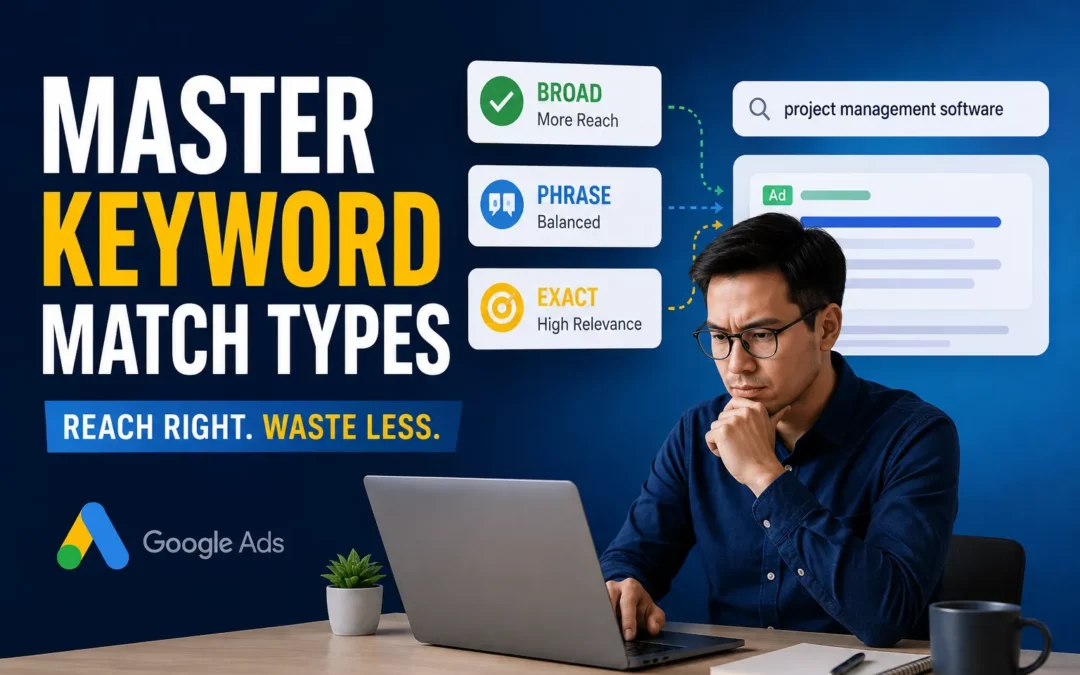
Keyword match types are settings in Google Ads that control how closely a user’s search query must match your keyword before your ad is triggered. Choosing the wrong match type is one of the most common and most costly mistakes beginners make in SEM, because it determines whether your ads appear in front of highly relevant, ready-to-convert users or in front of people searching for something entirely unrelated.
There are three match types in Google Ads: broad match, phrase match, and exact match. Each represents a different trade-off between reach and relevance. Understanding when to use each and how they work together in a well-structured campaign is a foundational SEM skill that directly affects Quality Score, CPC, conversion rate, and ultimately campaign profitability. Confused about which match types to use in your campaigns? Bring your questions to our community — experienced practitioners share real campaign setups weekly join us here.
Why Match Types Matter So Much in SEM
Every time someone searches on Google, the search triggers an auction among advertisers whose keywords match that query. Your match type determines exactly which queries are considered a match for your keyword and therefore which auctions your ads enter.
Get match types wrong and your ads appear for irrelevant searches, wasting budget on clicks from users who will never convert. Your CTR drops, Quality Score falls, CPC rises, and conversion rate suffers a cascade that makes every campaign metric worse.
Get match types right and your ads reach the users most likely to act, with messages tailored to their specific intent. CTR improves, Quality Score rises, CPC falls, and conversion rates increase. The entire campaign becomes more efficient without a single dollar of additional spend.
Because Ad Rank and Quality Score are driven substantially by relevance, match type selection is inseparable from Quality Score optimization. Broad keywords that trigger irrelevant searches directly damage the Expected CTR component of Quality Score — increasing costs across your entire ad group.
The Three Keyword Match Types Explained
1. Broad Match
What it is: The default match type. Your ad can appear for searches that are related to your keyword in any way — including synonyms, related concepts, and queries that share implied meaning with your keyword even if they contain none of the same words.
How to set it: Enter the keyword with no formatting: running shoes
Example keyword: running shoes
Triggers include:
- running shoes
- jogging trainers
- best shoes for marathon
- athletic footwear for runners
- trail running sneakers
Does not automatically exclude:
- dress shoes (unrelated shoe type)
- running shorts (different product category)
- how to clean running shoes (informational, no purchase intent)
Pros:
- Maximum reach — your ad can appear for the widest range of searches
- Discovers search queries you had not considered
- Works well with Smart Bidding when conversion data is sufficient
Cons:
- Many irrelevant searches, especially without strong negative keyword lists
- Lower average CTR drags down Quality Score
- Highest risk of wasted spend for beginners
Best for: Advertisers with Smart Bidding strategies (Target CPA or Target ROAS), strong negative keyword infrastructure, and at least 30–50 monthly conversions providing sufficient data for Google’s algorithm. Not recommended for new campaigns or limited budgets without careful monitoring.
2. Phrase Match
What it is: Your ad shows when the search query contains the meaning of your keyword phrase — the words can appear in any order as long as the core meaning is preserved. Words can appear before or after your keyword phrase.
How to set it: Wrap the keyword in quotation marks: "running shoes"
Example keyword: “running shoes”
Triggers include:
- running shoes
- best running shoes for flat feet
- buy running shoes online
- affordable running shoes for beginners
- women’s running shoes size 8
Does not trigger:
- shoes for running people (different structure, different implied meaning)
- run shoe shop (fragmented, different meaning)
Pros:
- Good balance between reach and relevance
- Allows natural language variations while maintaining core intent
- More manageable than broad match for most budgets
Cons:
- Still requires active negative keyword management
- Can occasionally trigger less relevant queries
- Lower volume than broad match
Best for: Core campaign keywords where you want meaningful discovery beyond exact variations. Phrase match is the workhorse match type for most mid-level SEM campaigns. Pairs well with exact match for your highest-value terms.
3. Exact Match
What it is: Your ad shows only when the search query exactly matches your keyword or is a very close variant — which includes plural forms, common misspellings, abbreviations, and reordered words that have the same meaning.
How to set it: Wrap the keyword in square brackets: [running shoes]
Example keyword: [running shoes]
Triggers include:
- running shoes (exact)
- running shoe (singular)
- runnung shoes (common misspelling)
- shoes for running (reordered, same meaning)
Does not trigger:
- best running shoes (has additional modifier)
- cheap running shoes online (has additional modifiers)
- running shoes for women (has additional qualifier)
Pros:
- Maximum control over which searches trigger your ads
- Highest relevance = highest CTR = best Quality Score contribution
- Most predictable spend and conversion rate
Cons:
- Lowest volume you miss many valid search variations
- Requires broader match types to capture full demand
- Can miss high-value searches that use different but equivalent phrasing
Best for: Your highest-value, highest-converting keywords where you want complete control. Every campaign should have a set of exact match keywords around its most important terms.
How Match Types Work Together: The Tiered Strategy
Experienced SEM practitioners rarely rely on a single match type. Instead, they use all three in a coordinated strategy that balances reach with control:
The tiered match type framework:
Exact match captures the highest-intent, most precisely defined searches. These get the most budget attention because they convert most reliably.
Phrase match expands reach to capture meaningful variations and longer-tail queries around the same core intent. Generates discovery data that reveals new high-value exact match candidates.
Broad match (when used) operates at the widest exploration layer, often in separate campaigns with Smart Bidding, to discover entirely new search patterns. Requires robust negative keyword lists and conversion tracking.
Practical example for a SEM campaign around “project management software”:
| Match Type | Keyword | Purpose |
|---|---|---|
| Exact | [project management software] | Core high-intent term |
| Exact | [project management tool for teams] | Specific variation |
| Phrase | “project management software” | Capture modifiers |
| Phrase | “best project management” | Capture comparison intent |
| Broad | project management software | Discovery and expansion |
Running exact and phrase match in the same ad group for the same keyword is intentional. Exact match captures the precise query and phrase match captures the surrounding variations — together they cover the full intent spectrum for that keyword theme.
Negative Keywords: The Fourth Dimension of Match Type Control
Negative keywords work alongside positive match types to define exactly which searches do and do not trigger your ads. They use their own match type logic:
Negative broad match (default): Blocks any search containing the negative keyword term in any order: free blocks “free project management software,” “project management software free,” “best free tools.”
Negative phrase match: Blocks searches containing the exact phrase: -"project management certification" blocks searches containing that exact phrase but not searches containing individual words separately.
Negative exact match: Blocks only searches matching exactly that term: -[project management] blocks only searches for exactly “project management” but not “project management software.”
Building a negative keyword list before launching any campaign is non-negotiable. The most common negative keyword categories to add immediately:
- Informational terms: how, what is, tutorial, guide, learn, course, definition, example
- Price-sensitivity signals: free, cheap, discount, coupon, low cost (unless you offer these)
- Job-related terms: jobs, careers, salary, hiring, internship
- Competitor brand names you are not actively targeting
- Irrelevant industry terms that share vocabulary with your keywords
Understanding how to find and eliminate irrelevant keyword triggers through negative keyword management is as important as selecting your target keywords — because every irrelevant click wastes budget and damages the CTR metrics that feed your Quality Score.
Match Type Impact on Quality Score
Match types have a direct but often overlooked impact on Quality Score. Here is how:
Exact match tends to produce the highest Quality Scores because every triggered search is tightly aligned with the keyword. CTR is predictably high, ad relevance is strong, and the user experience is consistent.
Phrase match produces moderate Quality Scores that vary based on what modifier terms surround the phrase. Longer phrase match triggers with specific modifiers often convert better than shorter ones.
Broad match frequently produces lower Quality Scores because it triggers irrelevant searches that users do not click — or click and immediately bounce from the landing page. Both behaviors damage Quality Score components.
This Quality Score impact translates directly into CPC differences. Broad match keywords often have lower Quality Scores and therefore higher actual CPCs than the same keyword set to exact or phrase match. When understanding how the full auction system determines what you pay, the match type effect on Quality Score is one of the most direct cost levers available.
Changes to Match Types in Recent Years
Google has significantly changed how match types behave over the past several years. Understanding these changes matters for interpreting older SEM advice:
Broad Match Modified (BMM) was discontinued in 2021. BMM, which allowed advertisers to require specific words within a broad match query using a + modifier, was absorbed into phrase match. Modern phrase match now behaves more like the old BMM in many cases.
Exact match is no longer truly exact. Since 2017, Google has allowed “close variants” of exact match keywords — including plurals, abbreviations, accents, and reordered words with the same meaning. This gives slightly more reach than the old strict exact match but remains the most controlled option.
Phrase match absorbed more traffic from BMM. Since the BMM deprecation, phrase match handles a broader range of queries than it historically did. This makes phrase match more powerful than it was several years ago and more important as a primary strategy match type.
FAQs
Which keyword match type should beginners use?
Beginners should start with phrase match and exact match. These provide meaningful reach while maintaining relevance control. Broad match requires Smart Bidding and conversion data to work efficiently — neither of which new campaigns typically have. Start with phrase and exact, build conversion data, then consider broad match expansion once campaigns are profitable.
Can I use all three match types for the same keyword?
Yes, and it is often recommended. Running the same keyword in exact, phrase, and broad match — ideally in separate ad groups with distinct budgets — allows you to capture searches at different levels of specificity while controlling spend allocation. Google’s system prioritizes the most specific match type when multiple match types could trigger for the same query.
Does match type affect my bid?
Match type itself does not set bids — you set bids independently. However, because match types produce different Quality Scores and different conversion rates, optimal bids are usually different across match types. Exact match keywords typically justify higher bids because of their superior conversion predictability.
How do I know which match type a search used to trigger my ad?
In Google Ads, go to Keywords → Search Terms. This report shows every actual query that triggered an impression or click, along with the keyword and match type that triggered it. This is the essential optimization report for managing match types and identifying negative keyword opportunities.
What replaced Broad Match Modified after it was discontinued?
Phrase match now covers most of the use cases that BMM previously served. Google’s update in 2021 expanded phrase match to include queries where the meaning of the keyword is central to the search, similar to how BMM worked with required words. Most advertisers transitioned BMM keywords directly to phrase match.
Is broad match ever the right choice?
Yes, in specific circumstances: when running Smart Bidding with sufficient conversion data (30+ monthly conversions), when you want to maximize discovery of new keyword opportunities, and when your negative keyword list is comprehensive enough to filter irrelevant traffic. In these conditions, broad match can significantly expand profitable reach. Without these prerequisites, it primarily wastes budget.
How do negative keywords interact with positive match types?
Negative keywords override positive match types. If a search would be triggered by a phrase match keyword but contains a word you have added as a negative keyword, the negative keyword prevents the ad from showing. Negative keywords take priority in all cases they are absolute exclusions regardless of how well the positive keyword might match.
Conclusion
Keyword match types are not a technical detail they are the architecture of your SEM relevance strategy. They determine who sees your ads, how much you pay for each click, and how efficiently your budget converts into qualified traffic.
The right approach for most campaigns: anchor your strategy with exact match on your highest-value keywords, use phrase match to capture intent-aligned variations, and treat broad match as an optional expansion layer that requires Smart Bidding and strong negative keyword infrastructure to use safely.
Review your Search Terms report weekly. Every irrelevant query you add as a negative keyword improves your CTR, protects your Quality Score, and redirects budget toward searches that actually convert. This ongoing hygiene work is what separates campaigns that gradually improve from ones that stagnate.
The broader SEM context matters too. Match type strategy connects to how the complete SEM system works from keyword to auction to click understanding that full picture makes every individual optimization decision, including match type selection, significantly more effective.Want to audit your match type strategy with help from experienced practitioners? Our community reviews real campaigns and gives direct, actionable feedback join us here.