
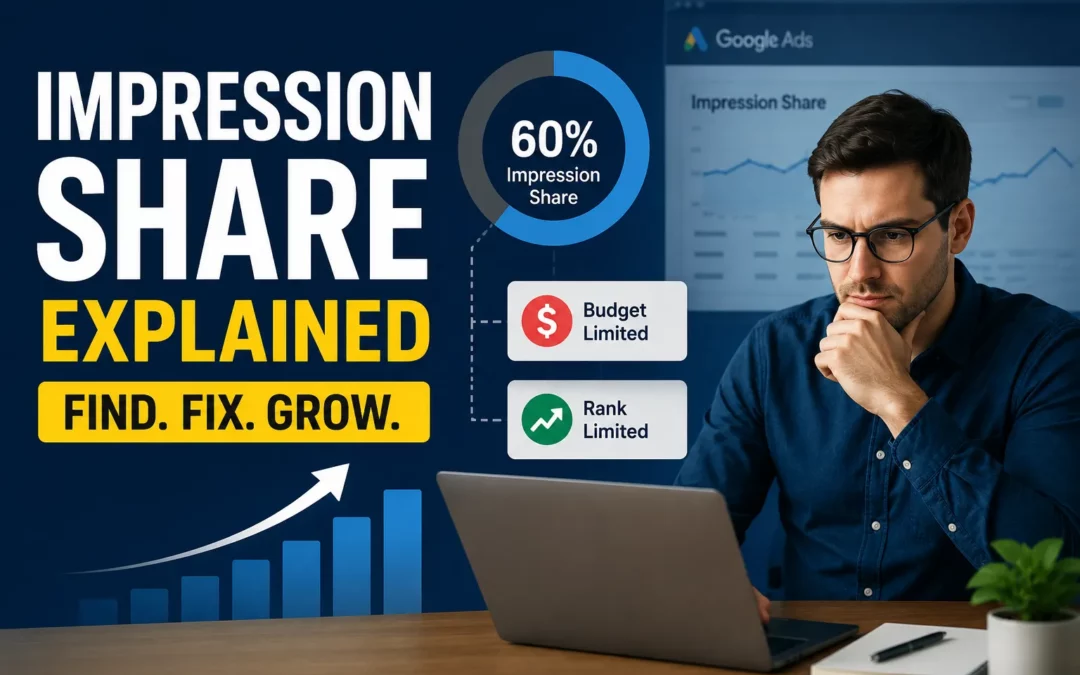
Impression Share (IS) is the percentage of total eligible impressions that your ads actually received compared to the maximum number of impressions they could have received if every auction your keywords qualified for had shown your ad. It is the metric that tells you how much of the available search market you are actually capturing versus how much you are missing.
If your Impression Share is 40%, your ads appeared in 40% of the auctions you were eligible for and were absent from the other 60%. That 60% represents potential customers searching for your keywords who never saw your ad. Understanding why you are missing those impressions and which of the two root causes is responsible budget constraints or quality/rank constraints determines which lever to pull to improve campaign reach. Trying to diagnose low Impression Share in your campaigns? Our SEM community helps practitioners identify and fix the specific root causes join us here.
What Is Impression Share?
Impression Share is one of Google Ads’ most valuable diagnostic metrics. It answers a fundamental question that standard metrics cannot: not “how many impressions did we get?” but “how many impressions were we supposed to get and did we?”
Impression Share Formula:
Impression Share = Impressions Received ÷ Total Eligible Impressions × 100
Example: Your campaign was eligible to appear in 10,000 auctions last week but only appeared in 5,500 of them.
Impression Share = 5,500 ÷ 10,000 × 100 = 55%
You captured 55% of your potential market presence and missed 45%.
Google reports several variants of this metric:
Search Impression Share — your share of eligible impressions on the Google Search Network. Most commonly referenced for search campaigns.
Search Top IS — the percentage of your impressions that appeared in the top positions above organic results. Indicates premium ad placement frequency.
Search Absolute Top IS — the percentage of your impressions that appeared in the very first ad position. The most competitive placement metric.
Display Impression Share — your share of eligible impressions on the Google Display Network. Calculated and interpreted separately from Search IS.
Why Impression Share Matters for SEM Strategy
Impression Share matters because it reveals the gap between what you are achieving and what is theoretically achievable with your current keywords and targeting. It also reveals competitive dynamics if a competitor increases their budget or improves their Quality Score, your Impression Share may drop even if your campaigns are unchanged.
Key strategic uses of Impression Share data:
Identifying growth opportunities. A 40% Impression Share means you have significant room to grow within your existing keyword set before needing to expand to new keywords. Improving IS toward 70–80% is often more cost-effective than adding new campaigns.
Diagnosing campaign health. A sudden drop in Impression Share signals a problem either your budget ran out earlier in the day, a competitor increased bids, or your Quality Score declined. IS changes prompt investigation before the issue compounds.
Setting realistic expectations. A campaign targeting highly competitive keywords may achieve 20–30% IS even with strong performance. Understanding IS in competitive context prevents misinterpreting low IS as campaign failure.
Connecting to profitability metrics. Impression Share connects directly to campaign volume — lower IS means fewer clicks, fewer conversions, lower total revenue. For campaigns already achieving target ROAS and CPA, increasing IS is often the fastest path to scaling profitable volume.
The Two Root Causes of Lost Impression Share
Google provides specific diagnostic data explaining why your Impression Share is below 100%. There are exactly two causes, and identifying the right one is essential before deciding how to respond:
Cause 1: Lost Impression Share (Budget)
IS Lost (Budget) tells you the percentage of eligible impressions you missed because your daily budget ran out before all eligible auctions occurred.
What it means: Your campaign is competitive enough to win the auction your Ad Rank is sufficient — but you have run out of money to bid. This typically manifests as budget exhaustion in the early afternoon or evening, after which your ads go dark for the rest of the day.
The fix: Increase your daily budget. This is a straightforward scaling decision if your campaigns are hitting target CPA or ROAS, spending more budget to capture more eligible impressions should generate proportionally more profitable conversions.
Before increasing budget: Verify that your current campaign performance is profitable. Scaling budget on an unprofitable campaign amplifies losses. Confirm CPA is below your maximum profitable threshold and conversion rate is adequate before committing to higher spend.
Cause 2: Lost Impression Share (Rank)
IS Lost (Rank) tells you the percentage of eligible impressions you missed because your Ad Rank was insufficient to win placement in those auctions — either falling below Google’s minimum quality threshold or being outranked by competitors.
What it means: Your campaign has budget to spend but is not winning enough auctions. This is a quality and competitiveness problem, not a budget problem.
The fix: Improve Ad Rank which means improving Quality Score, increasing bids, or both. Throwing more budget at a Rank-based IS problem does not help — the campaign has money to spend but is not winning the auctions it is eligible for.
The right approach: Focus on Quality Score improvement through better ad copy, tighter ad groups, and improved landing page experience. Selectively increase bids on high-priority keywords. The relationship between Quality Score, Ad Rank, and Impression Share is direct — every Quality Score improvement expands the auctions your campaign can win without increasing bids.
Impression Share Benchmarks and Targets
There is no universal “good” Impression Share appropriate targets depend on campaign goals, competitive intensity, and whether the focus is efficiency or scale:
Branded campaigns (your own brand keywords): Target 90%+ IS. You should dominate your own brand terms. IS below 80% on branded keywords typically indicates either budget constraints or competitors bidding on your brand.
High-intent non-branded campaigns: Target 60–80% IS for mature, profitable campaigns. Capturing 100% IS on competitive keywords is often prohibitively expensive — the final increments of IS require disproportionate bid increases.
Discovery and research campaigns: 30–50% IS may be acceptable if CPA and ROAS targets are being met efficiently. These campaigns serve awareness goals where complete market saturation is not the objective.
Competitor keyword campaigns: 20–40% IS is typical and acceptable. Competitor keywords are expensive and convert at lower rates — high IS on competitor terms often means overspending on low-converting traffic.
How to Increase Impression Share: Step-by-Step
Step 1: Identify Which Cause Is Responsible
In Google Ads: Click Campaigns → select your campaign → click Columns → Modify Columns → Competitive Metrics → add Search Impr. Share, Search Lost IS (Budget), and Search Lost IS (Rank).
Review the data. If Search Lost IS (Budget) is high, budget is your constraint. If Search Lost IS (Rank) is high, quality and bidding are your constraints. Many campaigns have both — prioritize the larger contributor.
Step 2: Address Budget-Constrained Lost IS
Option A — Increase daily budget. The direct solution. Only do this if current campaign performance is profitable.
Option B — Improve campaign efficiency to lower CPA. Achieving the same or more conversions within the existing budget means the budget goes further — indirectly improving IS by reducing the cost of each impression won.
Option C — Use ad scheduling to concentrate budget. If your budget runs out midday, restricting spend to peak-performing hours concentrates impressions when conversion probability is highest — improving effective IS for high-value windows even if total IS remains limited.
Option D — Reduce bids on low-priority keywords. Shifting budget from marginal keywords toward top-performing terms concentrates IS where it matters most.
Step 3: Address Rank-Constrained Lost IS
Improve Quality Score. Write ad headlines that directly mirror keyword intent. Tighten ad groups so one ad serves highly relevant keywords. Improve landing page speed and relevance. Even small Quality Score improvements across multiple keywords compound into meaningful IS gains across the account.
Increase bids on high-priority keywords. For specific keywords where IS is low due to competitive rank pressure, selective bid increases can recapture lost impressions. Calculate the maximum profitable bid based on CPC and conversion economics before increasing.
Add ad extensions. Ad extensions improve Ad Rank through their expected impact on ad quality. Adding sitelinks, callouts, and structured snippets can improve IS on auctions where you are currently losing by a narrow rank margin without any bid increase.
Refine keyword targeting. Broad match keywords entering irrelevant auctions distribute your budget across many low-quality impressions. Shifting to phrase and exact match concentrates budget on auctions you are most likely to win with competitive quality — improving IS for your priority search queries.
Impression Share and Competitive Intelligence
Google’s Auction Insights report extends Impression Share analysis to show how your performance compares to specific competitors bidding on the same keywords. This report shows:
- Impression Share — your share vs. each competitor’s share
- Overlap Rate — how often you and a competitor appear in the same auction
- Position Above Rate — how often a competitor’s ad appeared above yours when both showed
- Top of Page Rate — how often each advertiser appears at the top of the page
- Outranking Share — how often your ad appeared above a specific competitor’s (or theirs above yours)
Auction Insights reveals the competitive landscape driving your IS losses. If one competitor consistently outranks you with high Overlap Rate, their campaign is the primary driver of your IS losses and understanding their likely bid and quality signals helps inform your response.
Impression Share in the Context of Full Campaign Optimization
Impression Share connects to every major SEM metric:
IS and CTR: Higher IS means more impressions more opportunities for clicks. If IS increases but CTR holds constant, click volume grows proportionally. If IS increases while CTR drops, you may be winning lower-quality auctions where your ad is less relevant.
IS and CPA: Impression Share improvements should translate to proportionally more conversions — if CPA stays constant, higher IS means lower total cost per additional acquisition at scale. If CPA rises as IS increases, the newly won auctions have lower conversion intent than your existing traffic.
IS and ROAS: For campaigns hitting Target ROAS, higher IS means more revenue at the same return rate. IS is the volume dial for profitable campaigns — once you have proven the unit economics, IS determines how much volume you can generate.
IS and keyword match types: Exact match keywords have lower IS than broad match because they enter fewer auctions. However, the auctions they enter are higher quality. Evaluating IS in the context of match type prevents misinterpreting intentionally tight exact match targeting as an IS problem.
FAQs
What is Impression Share in Google Ads?
Impression Share is the percentage of total eligible ad impressions that your campaigns actually received. A 60% Impression Share means your ads appeared in 60% of the auctions your keywords qualified for and were absent from the remaining 40%. Google also reports what percentage of lost IS was due to budget constraints versus rank constraints.
What is a good Impression Share to aim for?
It depends on campaign type and goals. Branded campaigns should target 90%+. High-performing non-branded campaigns typically target 60–80%. Discovery campaigns may accept 30–50% if CPA and ROAS targets are met. Complete 100% IS is rarely cost-effective on competitive non-branded terms because the final increments require disproportionate bid increases.
How do I find Impression Share in Google Ads?
In Google Ads, go to Campaigns or Ad Groups view, click the Columns icon, select Modify Columns, navigate to Competitive Metrics, and add Search Impression Share, Search Lost IS (Budget), and Search Lost IS (Rank). These columns then appear in your main reporting view.
Why did my Impression Share suddenly drop?
Sudden IS drops have three common causes: your daily budget is now being exhausted earlier (check IS Lost Budget), a competitor increased bids or improved Quality Score (check IS Lost Rank and Auction Insights), or you made changes to bids, keywords, or targeting that reduced your eligibility or competitiveness.
Should I focus on maximizing Impression Share or maximizing conversions?
Maximize conversions within your target CPA or ROAS — Impression Share is a means to that end, not the end itself. High IS at poor CPA is worse than moderate IS at excellent CPA. Once CPA and ROAS targets are consistently met, increasing IS is the natural next step to scale profitable volume.
Does Quality Score affect Impression Share?
Yes, directly. Quality Score is a primary component of Ad Rank, and Ad Rank determines whether your ad meets the threshold to appear in any given auction. Higher Quality Score means you win more auctions at any given bid level — directly increasing Search Lost IS (Rank) performance.
Can Impression Share be above 100%?
No. IS is capped at 100%. However, Search Top IS and Search Absolute Top IS which measure the proportion of impressions appearing in premium positions can both be tracked and optimized independently of total IS.
Conclusion
Once your SEM campaigns are generating profitable returns hitting CPA and ROAS targets consistently Impression Share becomes the primary growth metric. It shows you how much additional profitable volume is available within your existing keyword set before you need to expand targeting or add new campaigns.
The diagnostic power of IS lies in its two root causes. Budget-constrained IS loss is a scaling decision spend more to capture more. Rank-constrained IS loss is a quality improvement problem improve Quality Score and bidding efficiency to win more auctions at the same or lower cost. Treating both as identical problems and simply increasing budget for rank-constrained campaigns is one of the most common and costly mistakes in SEM management.
Diagnose the root cause first, then apply the right lever. That sequenced approach understand before acting is what separates systematic campaign improvement from expensive trial and error. Seeing low Impression Share and not sure whether it’s budget or rank causing it? Share your campaign metrics with our community for a diagnostic conversation join us here.