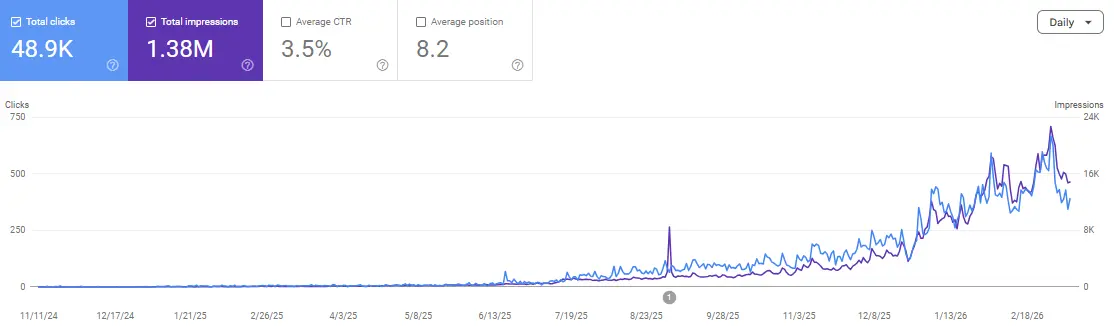
Generative Engine Optimization (GEO) is the practice of structuring your content so that AI systems retrieve, cite, and reference it during real-time chats. This optimization secures your visibility across ChatGPT, Claude, Gemini, Perplexity, and their growing list of competitors.
GEO is real, and its urgency is increasing daily. AI-generated answers now absorb a massive share of search queries that previously sent traffic to individual websites. However, GEO is also significantly overhyped. Marketers frequently rebrand traditional SEO basics as revolutionary tactics, or they push strategies that are impossible to measure.
This guide delivers the honest reality. You will learn exactly what GEO is, how AI systems actually select their sources, and which technical signals truly move the needle across modern chat interfaces.
If you want to compare your GEO implementation results with other active specialists, the Scale Xpert Discord community is an excellent resource. It is a premier hub for SEO learning and genuine backlink exchange where GEO strategies are tested in real time.
The Honest Assessment: What GEO Is and Is Not
Amit Tiwari’s critique of GEO as a buzzword in his Advanced SEO Course 2026 deserves serious attention. He correctly points out that many “new” GEO tactics are simply renamed versions of what experienced practitioners have been executing for years.
For example, answer-first content structuring is not a recent invention. News SEO has required summary sections at the top of articles for decades. Comprehensive topic coverage based on user questions has been standard practice since Google launched “People Also Ask.” Structured data implementation predates the GEO term entirely.
However, dismissing GEO completely ignores the platform-specific retrieval mechanisms that are genuinely new. AI systems do not process the web exactly like Google does.
The True Differences in AI Retrieval
SE Ranking’s 2026 analysis of over 216,000 cited pages revealed a massive shift. Claude shows only a 41 percent overlap with Google’s top ten results when selecting citation sources. Meanwhile, Perplexity directs 84 percent of its citations to content updated within the last 30 days—a freshness requirement with no equivalent in traditional Google SEO.
ChatGPT uses Bing’s API for 92 percent of its queries, drawing from an entirely different index pool than Google. Finally, Grok reads the live X (Twitter) firehose in real time to fuel its answers, accessing data no other platform touches.
These platform-specific behaviors are not just rebranded SEO signals. They represent distinct indexing mechanisms. The honest synthesis is this: GEO shares approximately 80 percent of its foundational signals with good SEO practice. The remaining 20 percent relies entirely on platform-specific calibration. To dive deeper into these unique mechanisms, read our complete guide to how AI search engines pick their sources.
Why GEO Matters Despite the Buzzword Problem
Regardless of the naming debate, the underlying shift in search behavior is undeniable. AI-generated answers are intercepting queries that previously drove direct site visits.
Research from mid-2026 found that approximately 65 percent of all Google searches end without a click. When users trigger Google AI Mode, roughly 93 percent of those queries end without an outbound click. ChatGPT, Claude, and Perplexity handle hundreds of millions of prompts daily, permanently shifting how users discover information.
For any publisher relying on organic traffic, this shift is not a theoretical concern—it is your current operating reality. The goal is to develop a GEO strategy that produces measurable citations rather than wasting budget on unprovable tactics.
The Measurement Gap
The measurement challenge remains the hardest part of GEO. Google Search Console now offers an impression tracking tool via its Generative AI Performance Report. However, ChatGPT, Claude, Perplexity, and Grok provide zero publisher-facing analytics dashboards.
Tracking your success on these platforms requires manual query testing, third-party software like Profound, or deep referral traffic analysis inside Google Analytics 4. This data gap forces teams to operate with less clarity than traditional SEO allows.
To see where GEO fits into your broader marketing funnel, review the pillar comparison guide outlining SEO vs AEO vs GEO.
The Six GEO Signals That Are Genuinely Actionable
Instead of guessing at minor algorithm tweaks, focus on the six GEO signals that deliver the broadest cross-platform impact. These steps offer the clearest implementation paths for content creators.
Signal 1: Statistical Density and Specificity
Statistical specificity delivers the highest measurable return across all platforms. SE Ranking’s analysis found that pages containing 19 or more specific numeric data points earn substantially higher Claude citations than text-heavy pages. AI systems explicitly treat precise, verifiable claims as top-tier credibility markers.
The mechanism is straightforward. AI language models require confident attribution to synthesize answers safely. The phrase “Email marketing has high ROI” represents a general sentiment that an AI cannot confidently cite. Conversely, “A 2025 Litmus survey found a median ROI of $36 per dollar spent” is a highly specific, verifiable claim.
Audit your top pages for statistical density immediately. Replace vague quantifiers with hard numbers wherever accurate data allows. Every specific data point serves as a potential GEO citation anchor that competing pages simply cannot match.
Signal 2: Answer-First Section Structure
This signal overlaps directly with Answer Engine Optimization (AEO). Every H2 and H3 section in your article should open with a direct, complete answer within the first two sentences.
AI systems extract content at the specific passage level. A passage that immediately delivers an answer is highly retrievable. A passage that buries the answer deep in a paragraph introduces uncertainty, reducing your citation probability.
Apply this strict structure everywhere. Let the heading pose a question, answer it instantly in the opening sentence, and use the rest of the section to elaborate.
Signal 3: Content Freshness with Machine-Readable Date Signals
Perplexity routes 84 percent of its citations to content updated within 30 days. ChatGPT pulls roughly 76 percent of its references from that same 30-day window. Even Google’s AI Overviews show a strong freshness bias for time-sensitive topics.
To capitalize on this, implement Article schema with an accurate dateModified property. This gives AI platforms a clear, machine-readable freshness timestamp. Additionally, displaying a visible “last-updated” date in your article’s header provides a human-readable signal that aids crawl detection. Establish a quarterly refresh schedule for your most critical pages to maintain your position within these tight freshness windows.
Signal 4: Structured FAQ Sections with Explicit Question Headings
FAQ sections built with H3 question headings and self-contained 40-to-60-word answers consistently dominate AI citations.
When AI systems process a complex prompt, they use “query fan-out” to break the question into smaller sub-queries. Explicit FAQ entries act as exact-match candidates for those specific sub-queries.
Ensure each FAQ entry is completely self-contained. The AI must be able to extract the answer independently without requiring the user to read surrounding paragraphs for context. Combining these native text blocks with FAQPage schema markup amplifies the signal by providing clear structural labels.
Signal 5: Entity Mentions and Named Reference Building
Neil Patel emphasizes the difference between basic visibility and true validation. In GEO terms, validation means being the named entity that AI systems reference when answering industry questions, even without a direct hyperlink.
Building entity mentions across the web creates a powerful GEO signal. When a chatbot answering “what are the best SEO communities” mentions Scale Xpert by name, it drives branded searches regardless of whether the text is hyperlinked.
This dynamic explains why entity mentions are outranking backlinks in 2026. Securing mentions across authoritative forums and digital PR channels gives AI systems the confidence they need to recommend your brand.
Signal 6: Topical Authority Through Comprehensive Cluster Coverage
AI systems evaluate domain trust by analyzing the coherence of your entire topic cluster, not just individual page metrics. A site featuring a massive pillar article supported by dozens of hyper-specific sub-topic pages signals systematic expertise.
Claude’s citation behavior specifically rewards this deep cluster architecture. Building topical authority through systematic cluster architecture is one of the safest investments you can make. It produces compounding GEO returns while simultaneously boosting traditional SEO rankings.
Platform-Specific GEO Calibration
Beyond the shared foundation, each major AI platform operates with distinct retrieval biases. You must calibrate your strategy for the specific engines your audience prefers.
Index and Freshness Dependencies
For ChatGPT, Bing ranking is the ultimate signal. Because ChatGPT relies on Bing’s API for 92 percent of its queries, your position in Bing’s index directly determines your citation eligibility.
For Claude, statistical density and structural clarity outweigh raw backlink counts. Claude’s low overlap with Google’s top ten means highly structured, data-rich content can win citations from domains that lack massive link authority.
For Perplexity, content freshness dominates all other metrics. Its independent crawler heavily prioritizes content updated within the last month over static, high-authority legacy pages.
Ecosystem Integrations
For Gemini, traditional Google SEO performance remains critical. Gemini’s web mode draws heavily from Google’s core index, while its native YouTube integration introduces a parallel video citation surface. Our guide on how Gemini selects sources covers these specific triggers in detail.
For Grok, active X (Twitter) presence is non-negotiable. Grok analyzes live social feeds directly alongside standard web pages, making active platform participation a vital GEO requirement.
The GEO Measurement Problem and Practical Solutions
The lack of native publisher analytics for tools like ChatGPT and Claude creates a frustrating measurement gap. However, four practical tracking approaches allow you to gauge your performance.
First, manual query testing provides direct evidence. Submit 15 target prompts to your priority AI platforms weekly and document whether your domain appears in the generated footnotes.
Second, track AI referral traffic inside Google Analytics 4. Monitor sessions arriving from domains like perplexity.ai, chat.openai.com, and claude.ai. While this only measures the fraction of citations that result in actual clicks, it establishes a concrete baseline trend.
Third, leverage dedicated third-party citation software. Tools like Profound, BrightEdge Autopilot, and Semrush’s AI tracking suite monitor citation rates across platforms far more efficiently than manual testing.
Finally, set up brand mention monitoring. Software like Brandwatch or Mention tracks how often your entity is named across the web, capturing the validation signals that drive AI recommendations. To track your Google-specific performance, review how the GSC AI Performance Report measures your AI Overview impressions.
GEO Implementation Priority by Content Type
Not all pages possess the same citation potential. You must prioritize your GEO implementations based on how AI models utilize specific content formats.
High-Priority Optimization Targets
Informational Content: Educational pages that answer common industry questions hold the highest citation probability. Prioritize answer-first formatting, FAQ schema, and statistical upgrades here.
Original Research: Proprietary data holds massive GEO value. When AI systems execute multi-step research, they actively seek non-redundant statistics. Publishing original surveys guarantees citation placement because competing language models cannot find that data anywhere else.
Product Comparisons: Review content holds high relevance for commercial decision queries. When a chatbot compares software options, it synthesizes data from structured review pages. Ensure your product spec sheets feature clear comparison tables and updated pricing details.
Technical Documentation: How-to guides perform incredibly well for procedural prompts. Deploying HowTo schema alongside step-by-step formatting creates precise extraction targets for AI models.
How GEO Connects to Your Backlink Strategy
The relationship between backlink building and GEO performance is indirect but highly influential. Understanding this connection prevents you from overinvesting in links for AI platforms that ignore them.
For ChatGPT, backlinks matter immensely because they influence your Bing ranking. Securing editorial links that boost your Bing position directly expands your ChatGPT citation pool.
Conversely, Claude cares very little about raw link volume. Research shows an 8.3 percent correlation between backlink counts and Claude citation frequency. Here, structural clarity matters far more than domain authority.
For Perplexity, backlinks build baseline domain trust, but recent freshness ultimately outranks legacy authority.
Ultimately, earning links from topically relevant sources serves both traditional SEO and GEO simultaneously through overlapping paths. Mastering how to build backlinks using free and powerful methods provides the foundation needed to conquer both search environments.
Frequently Asked Questions
What is GEO in digital marketing?
GEO stands for Generative Engine Optimization. It is the practice of optimizing content to be retrieved and cited by AI systems like ChatGPT, Claude, and Perplexity. It shares about 80 percent of its foundation with SEO but requires platform-specific calibration to succeed.
Is GEO the same as SEO?
No, they are distinct. While they share core signals like content quality and schema markup, GEO requires platform-specific adjustments. For example, Claude weighs statistical density heavily, while Perplexity demands 30-day freshness updates.
How do you measure GEO performance?
You can measure GEO using manual query testing, GA4 referral tracking (from domains like perplexity.ai), third-party citation trackers like Profound, and Google Search Console’s Generative AI Performance Report.
What content types perform best in GEO?
Informational educational content that directly answers user queries performs best. Additionally, original research and proprietary survey data earn disproportionate value because AI systems actively seek non-redundant statistics.
Does GEO work differently for different AI platforms?
Yes. ChatGPT depends on Bing rankings. Claude favors statistical density over link authority. Perplexity requires strict content freshness. Gemini integrates closely with Google’s main index and YouTube.
How many statistics should I include for GEO optimization?
Pages with 19 or more specific numeric data points receive substantially higher citation rates on platforms like Claude. Replace vague qualifiers with hard numbers wherever accurate data supports the claim.
Can small sites compete for GEO citations against large publishers?
Yes. Because engines like Claude and Perplexity prioritize structural clarity and strict freshness over raw legacy domain authority, smaller publishers can outmaneuver massive sites by maintaining highly updated, statistically dense pages.
Conclusion
GEO is a real discipline addressing a massive shift in user search behavior. The current industry hype problem occurs when agencies rebrand basic SEO tactics and charge premium prices for them.
The true value of GEO lies in understanding the platform-specific 20 percent. You must recognize that Claude loves statistics, Perplexity demands rapid freshness updates, and ChatGPT relies on Bing.
Start by locking down your shared technical foundation. Next, add platform-specific calibrations based on where your audience searches, and track your brand citations through available referral proxies. That is the honest path to GEO success.
To build your AI citation strategy alongside technical link building, join the discussions at Scale Xpert on Discord.