Gemini draws its citations from a richer and more varied set of sources than any other major AI search platform. It pulls from Google’s search index, YouTube video transcripts, Google News, multimodal content including images and PDFs, and personalized data through NotebookLM and Gems when users have configured those connections. For content creators trying to earn Gemini citations, the good news is that strong Google SEO fundamentals transfer directly. The more nuanced reality is that Gemini’s multimodal architecture and deep research mode create citation surfaces that purely text-focused optimization strategies miss entirely. This guide covers exactly how Gemini’s source selection works across its different modes, which signals matter most for standard web citation, and how YouTube and structured content create additional citation opportunities beyond what traditional SEO alone captures.
If you want to share your Gemini citation data and compare optimization approaches with other practitioners, Scale Xpert’s Discord community is where that conversation is happening. It is a community for SEO learning and genuine backlink exchange.
How Gemini’s Architecture Shapes Its Source Selection
Understanding Gemini’s source selection requires understanding that Gemini is not a single retrieval system. It operates across several distinct modes, each with different source selection behavior.
Standard Gemini web search draws from Google’s search index using the same quality evaluation infrastructure that determines organic search rankings. This means Gemini’s standard web citation behavior is more tightly coupled to Google SEO performance than any other AI platform except Google’s own AI Overviews. According to research from Signals.sh, Gemini’s standard web citations show strong overlap with Google’s organic rankings, reflecting this infrastructure sharing.
Gemini’s Deep Research mode operates differently. When a user activates Deep Research for a complex question, Gemini functions as an autonomous research agent that plans a multi-step research process, executes multiple web searches, evaluates the retrieved sources, and synthesizes a comprehensive report. As Futurepedia’s analysis documented, Deep Research can autonomously adjust its search strategy based on what it finds, meaning it may discover and cite sources several search iterations deep that would not appear in a standard single-query retrieval.
Gemini Advanced with NotebookLM integration and the Gems system operates on user-provided sources rather than general web retrieval. When users upload documents, connect data sources, or create specialized Gem configurations, Gemini’s responses draw from those specific sources rather than the open web. This mode is outside the scope of standard web content optimization.
For YouTube specifically, Gemini has direct integration that allows it to pull transcript and content data directly from YouTube videos when they are linked or when video content is relevant to a query. This creates a citation surface that text-based web content does not cover.
The Google SEO Foundation for Gemini Citations
Because Gemini’s standard web mode draws from Google’s index, the relationship between Google organic ranking and Gemini citation is closer for Gemini than for any platform except AI Overviews. The E-E-A-T signals that Google’s quality evaluation systems assess, Experience, Expertise, Authoritativeness, and Trustworthiness, are the same signals that Gemini’s standard retrieval system evaluates when selecting citation sources.
This means the traditional SEO investments that improve your Google ranking directly improve your Gemini citation probability for standard queries. Building editorial backlinks from relevant, authoritative sources improves both your Google position and your presence in the source pool from which Gemini draws citations. Publishing content that demonstrates genuine expertise and first-hand experience builds the E-E-A-T signals that Google’s quality raters assess and that Gemini’s retrieval system inherits.
The content freshness preference that characterizes most AI platforms also applies to Gemini. Google’s index favors recently updated content for queries where recency is relevant, and Gemini inherits this preference through its use of Google’s index signals. Maintaining current statistics, accurate dates, and up-to-date information on your most important pages contributes to Gemini citation probability in the same way it contributes to Google organic ranking.
One distinction worth noting is that Gemini’s deep integration with Google’s ecosystem means it is particularly sensitive to Google News inclusion for news and current events content. Content from publishers in Google News receives additional visibility in Gemini’s retrieval for news-adjacent queries. If your content covers topics that overlap with news coverage, Google News inclusion is worth pursuing as a Gemini citation multiplier.
Understanding how AI search optimization connects to traditional SEO gives you the foundation for seeing why Google SEO fundamentals are your most direct lever for Gemini citation.
YouTube as a Parallel Citation Surface
Gemini’s YouTube integration is one of the most distinctive and underutilized citation surfaces in AI search. According to Futurepedia’s analysis of Gemini’s capabilities, Gemini can pull transcripts and analyze content directly from YouTube videos when they are linked in queries or when video content is relevant to the answer being generated. This means YouTube presence is not just a supplementary brand channel for creators with written content. It is an independent Gemini citation surface that operates in parallel with web content citation.
For content creators who already produce written articles, creating corresponding YouTube videos covering the same topic provides a second point of Gemini citation eligibility for the same query. A user asking Gemini about email marketing strategy may receive citations from both your web article and your YouTube video on the same topic, amplifying your brand presence within a single Gemini response.
The optimization implications for YouTube as a Gemini citation surface mirror those for text content. Well-structured videos with clear chapter markers and descriptive sections are easier for Gemini to extract specific information from than unstructured, chapter-free videos. Transcripts that include specific statistics, named methodologies, and concrete examples match the same extraction criteria that improve text content citation.
YouTube video descriptions that include the key topics covered, timestamps for major sections, and relevant links create additional indexing context that helps Gemini’s integration identify when a video is relevant to a specific query. Treating YouTube video descriptions as structured metadata rather than afterthoughts directly improves Gemini’s ability to match your video content to relevant queries.
Gemini Deep Research: How to Get Cited in Comprehensive Reports
Gemini’s Deep Research mode creates a distinctly different citation context from standard web search. When a user activates Deep Research for a complex research question, Gemini executes multiple search iterations, evaluates source quality across iterations, and synthesizes findings into a comprehensive report with citations. This mode tends to cite fewer but higher-quality sources than standard retrieval, with each cited source contributing a specific, substantive component to the report.
Getting cited in Deep Research requires content that can contribute something specific and non-redundant to a multi-source synthesis. When Gemini’s Deep Research agent has already retrieved general overview content from several sources, it is looking for content that provides a specific data point, a unique methodology, a concrete case example, or an expert perspective that the general sources do not cover.
This makes original research, case studies, and expert-perspective content particularly valuable for Deep Research citation. A post reporting original survey data, a detailed case study with specific outcomes, or an in-depth expert analysis covers content that is not duplicated across general overview articles. Deep Research actively seeks this kind of non-redundant specificity.
The practical implication is that for Deep Research citation specifically, the investment in original data collection and first-hand expertise documentation pays off most clearly. A content piece backed by original research data that no other article has is a high-confidence Deep Research citation candidate because it provides something genuinely irreplaceable in a multi-source synthesis context.
Understanding how to build backlinks with original data research gives you both the link building and the content creation framework for producing the kind of original data content that earns Deep Research citations alongside editorial backlinks.
Structured Data and Schema Markup for Gemini
Gemini’s use of Google’s index means that schema markup has the same indirect but real benefit for Gemini citation that it has for Google AI Overviews. FAQ schema, Article schema, and HowTo schema all help Google’s indexing systems understand your content’s structure and purpose, which feeds into how Gemini’s retrieval system matches your content to specific queries.
Gemini’s multimodal capabilities add an additional dimension to schema’s relevance. ImageObject schema that accurately describes your images, VideoObject schema for embedded videos, and structured data for data tables all help Gemini’s multimodal processing correctly interpret the full content of your pages, not just their text.
For pages that include data visualizations, charts, or embedded video content alongside text, implementing the corresponding schema types ensures that Gemini’s retrieval system fully understands what your page contains. A page with a chart showing email marketing benchmark data, properly marked up with ImageObject schema describing the chart’s topic and data source, is a more complete Gemini citation candidate than the same page without the schema context.
The guide on whether structured data helps AI search and Google’s official position for 2026 covers the specific schema types with the clearest evidence for AI citation impact.
The Google Ecosystem Advantage: News, Discover, and Beyond
Gemini’s deep integration with Google’s ecosystem extends beyond standard web search to include Google News, Google Discover, and Google’s broader content surfaces. Publishers with Google News inclusion have additional Gemini citation eligibility for current events and news-adjacent queries. Publishers whose content regularly appears in Google Discover have additional visibility signals that feed into Gemini’s understanding of which sources its users engage with.
This ecosystem breadth means that Gemini citation optimization is not purely a one-dimensional task of improving a single ranking signal. A comprehensive strategy involves web content quality for standard retrieval, YouTube presence for video query surfaces, Google News inclusion for timely topics, and schema markup for multimodal content parsing. Each of these represents a parallel citation surface that Gemini can draw from depending on the specific query and mode.
For most content creators, the priority order is: web SEO fundamentals first (since standard Gemini web mode is the most common usage context), YouTube presence second (for topics where video content is naturally relevant), and schema markup third (for improved multimodal content parsing). Google News inclusion is relevant for creators covering timely topics and worth pursuing as a fourth priority where applicable.
Content Comprehensiveness and Multi-Angle Coverage
Gemini’s Deep Research mode is specifically designed to synthesize multiple perspectives rather than simply presenting the top result’s viewpoint. This design preference extends into standard Gemini responses, which often reflect a multi-dimensional treatment of complex topics rather than a single authoritative summary.
Content that covers a topic from multiple angles within a single resource is therefore a stronger Gemini citation candidate than narrowly focused content that addresses only one dimension of a topic. An article about remote team management that covers communication strategies, productivity tools, performance evaluation, cultural cohesion, and legal considerations is more likely to be cited across multiple components of a Gemini response about remote team management than five separate articles each covering one of those dimensions.
This comprehensive coverage preference aligns with the topical authority building that benefits traditional Google SEO, making them mutually reinforcing strategies. Building comprehensive pillar content that covers an entire topic area from multiple angles, connected to a cluster of supporting articles with deeper treatment of individual sub-topics, serves both Google organic ranking and Gemini citation eligibility simultaneously.
Understanding why deep content matters more in the AI search era explains the theoretical foundation for why comprehensiveness is increasingly the decisive variable in both traditional and AI search visibility.
Monitoring Gemini Citation Performance
Gemini citations in standard web mode that involve visible links create measurable referral traffic from Gemini’s domains. Monitoring traffic from Google AI-related referral sources in Google Analytics 4 provides the clearest signal of whether your Gemini citation strategy is producing actual user exposure.
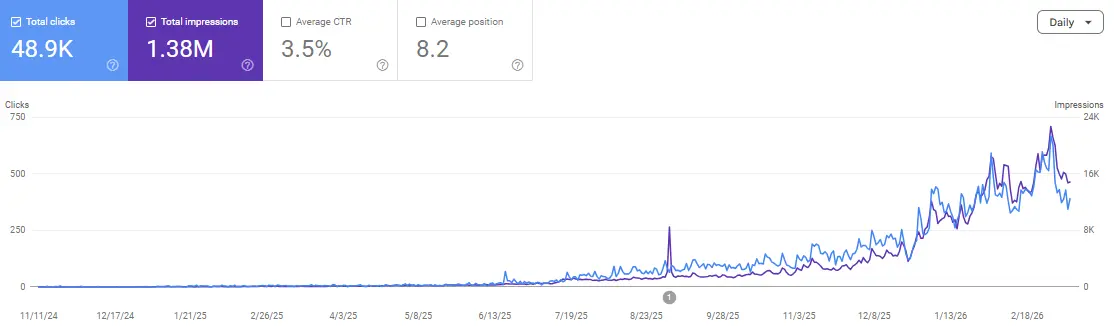
Google Search Console’s standard Performance Report also provides indirect Gemini visibility measurement through organic impressions for queries that frequently trigger AI Mode and Gemini responses. Tracking impressions and position data for these queries over time reveals whether your content is in the retrieval pool even when it is not generating clicks.
For YouTube content, YouTube Analytics provides view data and traffic source breakdowns that reveal whether views are coming from Gemini-related referral paths. YouTube’s direct integration with Gemini means that view spikes correlating with the publication of relevant Gemini AI responses may appear in traffic source data.
Third-party citation monitoring tools including Profound and Semrush’s AI citation monitoring features began tracking Gemini citations in 2025 and 2026. These tools provide more systematic measurement of your Gemini citation rate than manual query testing but require subscription access.
Priority Actions for Gemini Citation
The analysis above points to a clear priority sequence for improving Gemini citation probability.
Your first priority is Google SEO fundamentals. Since Gemini’s standard web mode draws from Google’s index, building the content quality, E-E-A-T signals, and backlink authority that improve your Google ranking directly improves your Gemini citation pool membership.
Your second priority is YouTube presence development. For topics in your niche where video content is naturally relevant to user queries, creating YouTube videos covering the same topics as your most important written articles provides a parallel Gemini citation surface. Structure videos with clear chapters and include specific data points in transcripts.
Your third priority is schema markup completeness. Implement FAQ schema, Article schema, and where relevant VideoObject and ImageObject schema on your most important pages. This improves Gemini’s ability to parse your content’s full structure and match it to specific sub-queries.
Your fourth priority is original research and case study content. For Deep Research citation eligibility specifically, content with original data, specific case outcomes, and first-hand expertise contributes something non-redundant that Deep Research agents actively seek when building comprehensive reports.
Frequently Asked Questions
How does Gemini select its sources for web search responses?
Gemini’s standard web mode draws from Google’s search index using the same quality signals that determine organic search rankings, including E-E-A-T signals, link authority, content freshness, and technical accessibility. This makes Gemini the AI platform most closely correlated with Google organic ranking performance after Google’s own AI Overviews.
Does Gemini cite YouTube videos as sources?
Yes. Gemini has direct YouTube integration that allows it to pull transcript and content data from YouTube videos when they are relevant to a query. Creating YouTube videos covering the same topics as your written content provides a parallel Gemini citation surface that text-only optimization does not cover.
What is Gemini Deep Research and how does it select sources?
Gemini Deep Research is an agentic mode where Gemini autonomously plans and executes a multi-step research process across multiple web search iterations before synthesizing a comprehensive report. Deep Research tends to cite fewer but more specific sources, actively seeking content that provides non-redundant, unique information including original data, case studies, and expert analysis.
Does schema markup affect Gemini citation?
Yes, indirectly. Schema markup improves how Google’s indexing systems understand your content’s structure, which feeds into how Gemini’s retrieval matches your content to specific sub-queries. FAQ schema, HowTo schema, and Article schema are most directly relevant for citation optimization. VideoObject and ImageObject schema help Gemini’s multimodal processing correctly interpret non-text content.
Is Gemini citation primarily a Google SEO problem?
For standard web mode, yes. Gemini’s standard citations heavily overlap with Google organic rankings because it draws from the same index. However, YouTube integration and Deep Research mode create additional citation surfaces that extend beyond traditional web SEO. A comprehensive Gemini strategy addresses all three surfaces.
How does Gemini’s multimodal capability affect source selection?
Gemini can process and cite text, PDFs, images, audio, and video content. This means content creators with diverse content formats, particularly YouTube videos and well-structured PDFs, have additional citation surfaces compared to text-only publishers. Gemini’s multimodal retrieval creates opportunities for citation that platforms processing only text cannot offer.
Can connecting to NotebookLM improve Gemini citation of my content?
NotebookLM and Gems configurations are personalized by individual users who upload their own documents and sources. These modes cite the sources users have specifically uploaded rather than public web content. Standard web content optimization does not influence Gemini’s behavior in these personalized modes.
Conclusion
Gemini’s citation behavior rewards the same foundational investments as Google organic SEO, making it the most natural extension of traditional SEO strategy into AI search territory. The meaningful additions beyond standard SEO are YouTube content development as a parallel citation surface, schema markup completeness for multimodal content parsing, and original research for Deep Research citation eligibility. These additions are not replacements for strong Google SEO fundamentals but multipliers on top of them. A content creator who builds strong Google SEO foundations and then adds YouTube presence and schema completeness captures Gemini citation opportunities across the standard, video, and deep research surfaces simultaneously.
Connect with SEOs building this kind of multi-surface strategy at Scale Xpert on Discord.