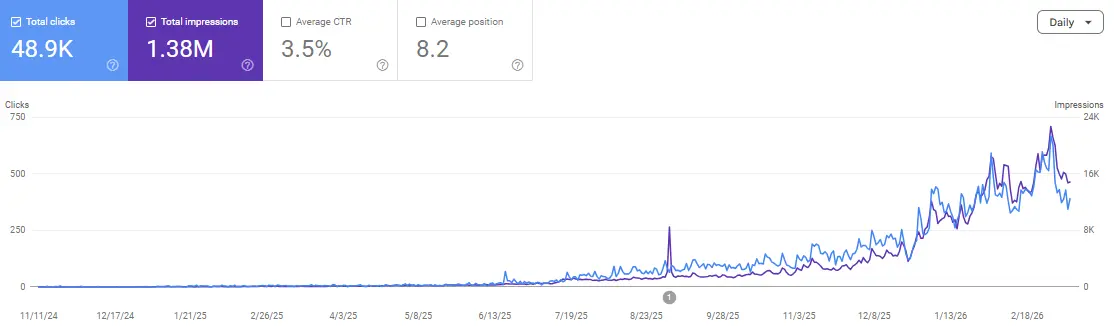
Google Search Console now features a dedicated report that reveals how your content performs inside AI Overviews and AI Mode. Launched in June 2026, this feature initially rolled out to a select group of UK website owners. This release marks the first time Google has provided publishers with direct data regarding their visibility inside AI-generated search results.
The interface tracks impressions, pages, countries, devices, and dates. Crucially, it does not track clicks. This guide explains exactly what the report measures, what it omits, and how to read the data correctly. We will also explore how to use these metrics to boost your AI search footprint and analyze the new opt-out controls that Google launched alongside it.
Want to discuss this new report with SEOs who are already digging into the data? The Scale Xpert Discord community is a great place to start. Our members share audits, exchange optimization tips, and break down new search tools daily.
What Is the Google Search Console AI Performance Report?
The Generative AI Performance Report shows how often your pages appear within AI-generated features on Google Search. Specifically, it tracks your visibility across two primary surfaces: AI Overviews and AI Mode.
An impression means a user saw a link to your site within a generative AI snippet. It does not mean the user clicked through to your website. Google explicitly confirmed that click data is missing from the current version. A company spokesperson noted that they are still working with website owners to understand what insights help most before introducing additional metrics.
[User Search Query] ──► [Google AI Engine] ──► [AI Overview Impression] (Tracked)
                                           └──► [User Click to Website]   (Not Tracked)
You can access the report directly via Google Search Console at [search.google.com/search-console/performance/search-analytics/ai](https://search.google.com/search-console/performance/search-analytics/ai). If the dashboard shows no data, your property either lacks sufficient AI impressions or has not joined the rollout group yet. The initial UK rollout will expand to global properties over the coming months.
Why This Report Disrupts SEO Strategy
The launch of the AI Performance Report represents a massive shift in how Google interacts with publishers. Ever since AI features began expanding, site owners lacked direct diagnostic tools. Marketers could only guess at AI visibility by tracking drops in traditional organic click-through rates.
Now, you can see exactly which URLs gain visibility inside AI answers. This data reveals a new reality: traditional search rankings do not always mirror AI search success. A page that ranks first in standard organic results might log zero AI impressions. Meanwhile, a highly structured resource page might win consistent citations.
To maximize this data, you must understand the core engineering behind these systems. Learning Why RAG is the Foundation of AI SEO Visibility explains how Google’s retrieval systems select specific pages. Furthermore, seeing How Google AI Search at I/O 2026 Changes SEO Strategy Forever helps you align your brand with Google’s long-term product direction.
What the Report Measures: The 5 Dimensions
The AI Performance Report organizes data across five distinct pillars. Each metric requires a specific diagnostic approach.
1. Impressions
Impressions track how often a URL from your site appears within a generative search feature or an AI element in Google Discover. The main chart pools this data at the property level. If Google pulls three separate links from your root domain to build a single AI response, it counts as one property-level impression. The Pages tab breaks these URLs down individually.
2. Pages
The Pages dimension groups your data by specific URLs. This area is highly valuable for content auditing because it shows exactly which articles Google’s algorithms trust. By default, Google attributes data to the canonical URL. Clean up redirect chains and technical duplicate content issues to avoid data attribution gaps.
3. Countries
The Countries tab outlines the geographical location of your viewers. Google has not deployed AI Overviews uniformly across all global markets. Because of this, a heavy concentration of impressions in a single country often reflects Google’s regional rollouts rather than a flaw in your international content.
4. Devices
This dimension breaks your AI impressions down by desktop, tablet, and mobile. Note that device tracking only applies to standard Search results, not Discover data. Use this information to pinpoint whether your visibility favors a specific viewport, which can help you prioritize mobile performance tweaks.
5. Dates
The Dates dimension charts your visibility trends over time. This timeline helps you gauge the immediate impact of major content updates. If you refresh a guide and notice a spike in AI impressions two weeks later, the date graph confirms the optimization success even if your traditional traffic remains flat.
What the Report Omits (And Why It Matters)
The complete absence of click data is the most significant limitation of this new dashboard. This omission reflects a structural change in user behavior. In AI search, the link between visibility and traffic behaves differently than in traditional organic search.
When Google cites your page in an AI Overview, the user often reads the synthesized answer directly on the results page. Your content fulfills the user’s intent, but your website receives zero traffic. This dynamic creates a environment where high impressions and low click-through rates regularly coexist.
This behavior stems from a shift toward Agentic Search: When AI No Longer Just Reads Web Pages. Because the search engine acts as an executive assistant that synthesizes information, traditional clicks drop. Treat your AI impressions as a brand awareness metric and an authority signal, not as a direct traffic predictor.
The New AI Opt-Out Control Explained
Alongside this report, Google launched a Search Console toggle that allows site owners to block their content from appearing in AI search features. This rule applies to AI Overviews, AI Mode, and generative elements within Discover.
“Sites that opt out will not receive traffic or impressions from our generative AI features. Opting out will not be used as a ranking signal for search results outside of these generative AI Search features.”
— Google Official Statement
Google launched this toggle in the UK first to satisfy a fairness agreement with the UK’s Competition and Markets Authority (CMA). The CMA requires Google to give publishers clear control over their intellectual property.
Before choosing to opt out, you must audit your business model. Ask yourself if your content falls under Commodity Content vs Non-Commodity Content: What Kind of Content Does AI Actually Want?. Informational publishers who rely entirely on display ad pageviews might choose to opt out to protect their margins. Conversely, transactional and subscription-based brands usually benefit from staying indexed.
Step-by-Step Data Analysis Plan
When you first gain access to the report, use this quick checklist to audit your performance:
| Action Item | Analytical Focus | Strategic Goal |
| Check Top Pages | Compare high-impression AI URLs against top traditional organic URLs. | Find optimization gaps where traditional rankings fail to convert into AI wins. |
| Review Country Spread | Cross-reference international impressions with your core audience locations. | Identify if regional AI rollouts are distorting your global traffic metrics. |
| Track Date Trends | Map impression changes against your recent content updates and site refreshes. | Verify how quickly Google’s AI index adapts to your technical structural changes. |
Using the Data to Optimize Your Content
The AI Performance Report works best as an active optimization tool. Use these three strategies to upgrade your content based on your live report findings:
1. Uncover Retrieval Patterns
Examine your highest-performing URLs to see how Google crawls your site. Look at how Google pulls answers from multiple sources simultaneously. Reading our guide on Query Fan-Out: How Google AI Search Finds Answers From Many Pages at Once explains how the engine connects these disparate data points.
2. Upgrade Low-Impression Pages
Target pages that rank well in traditional search but lag in AI impressions. These URLs usually lack structural clarity or deep expertise. Fix this by learning Why Deep Content Is More Important Than Ever in the AI Search Era and reviewing How to Create Non-Commodity Content That Is Genuinely Hard for AI to Replicate.
3. Deploy Technical Signals
Ensure your pages use clean code that AI crawlers can easily digest. To see how backend code influences your dashboard trends, read our analysis on Does Structured Data Help AI Search? Google’s Official Answer for 2026.
FAQs
Is the AI Performance Report available globally?
No. Google started a gradual rollout in June 2026, starting with a subset of webmasters in the United Kingdom. The feature will expand to more countries over the coming months.
Why does my report show impressions but zero clicks?
The current report does not track clicks. Google designed this version to focus entirely on visibility. Furthermore, AI answers often satisfy users directly on the search page, reducing overall click actions.
Does opting out of AI features hurt my regular search rankings?
No. Google confirmed that using the opt-out toggle will not lower your traditional organic search rankings. It only removes your URLs from AI Mode and AI Overviews.
Do backlinks affect my AI impressions?
Yes, indirectly. Google’s AI retrieval systems use authority metrics like backlink profiles to select sources. Building clean links helps improve your AI visibility. Learn more about these signals by reading our guide on how search engines evaluate backlinks.
Conclusion
The Google Search Console AI Performance Report offers an invaluable window into modern search behavior. Even without click data, it gives you a clear quality signal from Google’s newest discovery algorithms. Use this data to refine your structured markup, track content refreshes, and future-proof your digital footprint.
Want to compare your AI impression trends with other webmasters? Join the Scale Xpert Discord to trade optimization strategies and analyze the rollout with a community of technical SEO professionals.