
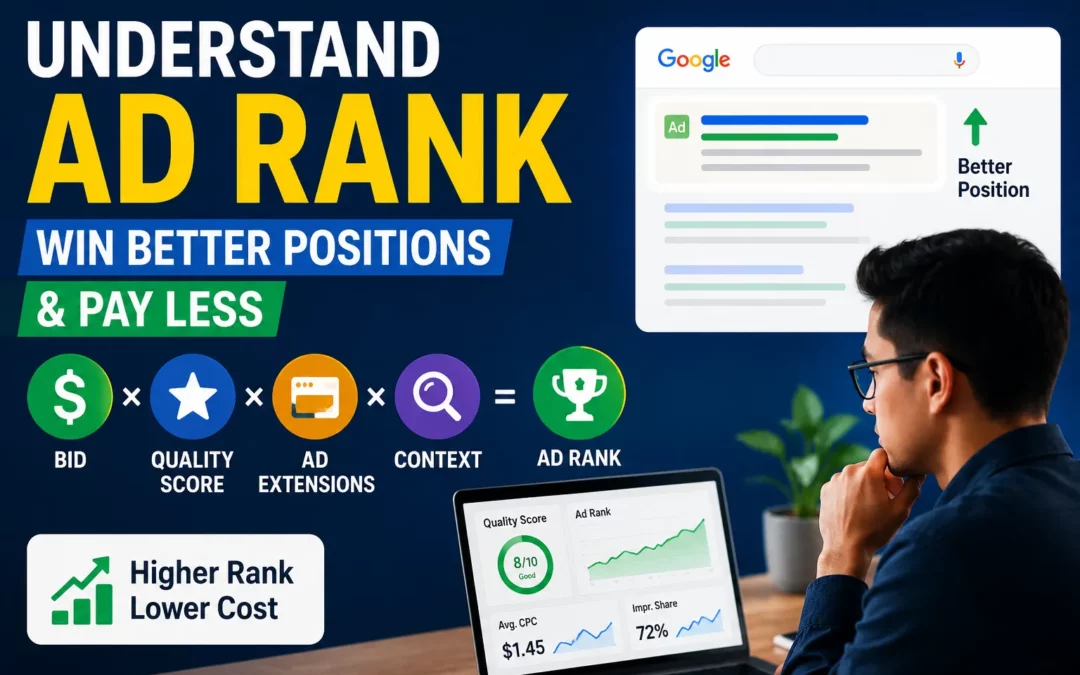
Ad Rank is the score Google calculates for every ad in every auction to determine where that ad appears on the search results page — or whether it appears at all. A higher Ad Rank wins a better position. A lower Ad Rank means your ad falls further down the page or does not show up at all, regardless of how much you are willing to bid.
Understanding Ad Rank is not optional for anyone running Google Ads. It is the mechanism behind every position you earn, every price you pay, and every click you receive. Most importantly, Ad Rank reveals why throwing more money at your campaigns is often the wrong strategy — because relevance and quality are equally powerful inputs into the formula. Want to understand Ad Rank through real campaign examples? Our community of SEM practitioners shares auction insights and optimization strategies weekly join us here.
What Is Ad Rank?
Ad Rank is the value Google calculates for each ad eligible to appear in a given auction, used to determine ad position and actual cost per click. It is recalculated in real time for every single search meaning your position is not fixed and can vary between individual searches depending on who else is bidding and what contextual signals are present.
Ad Rank was designed by Google to balance advertiser interests with user experience. Rather than a pure bidding war that would reward only the wealthiest advertisers, the system rewards relevance. An advertiser with a smaller budget and a highly relevant, well-crafted ad can consistently outrank a larger competitor spending more money but delivering poorer user experience.
This is one of the most important concepts in all of SEM. If you are new to how Google’s auction functions overall, the full explanation of how the ad auction and ranking system works provides the broader context within which Ad Rank operates.
What Factors Determine Ad Rank?
Google uses five main factors to calculate Ad Rank for each auction:
Factor 1: Your Bid Amount
Your maximum CPC bid — the most you are willing to pay for a single click — is the most obvious input. A higher bid increases your Ad Rank potential. However, bid amount alone never guarantees a winning position if other factors are weak.
Factor 2: Quality Score
Quality Score is Google’s 1–10 rating of your ad’s overall relevance and quality. It is the single most powerful lever in improving Ad Rank without increasing spend. Quality Score is composed of three sub-components:
- Expected Click-Through Rate (CTR): How likely users are to click your ad given the keyword. Based on historical performance of your ad and the keyword.
- Ad Relevance: How closely your ad copy matches the intent and meaning of the keyword being searched.
- Landing Page Experience: How relevant, useful, and user-friendly your landing page is relative to the ad and keyword.
A Quality Score of 1 means your ad is largely irrelevant to the keyword. A Quality Score of 10 means your ad, keyword, and landing page are highly aligned and deliver strong user experience. Moving from a Quality Score of 5 to 8 can reduce your actual CPC by 30–50% while improving your position simultaneously.
Factor 3: Expected Impact of Ad Formats and Extensions
Ad extensions — sitelinks, callout extensions, structured snippets, phone numbers, location extensions, price extensions, and others — add information and visual real estate to your ad. Google’s system estimates how much these extensions will improve the usefulness of your ad for a given search and factors this into Ad Rank.
Advertisers who use relevant, well-configured extensions consistently earn higher Ad Ranks than those running bare ads with no extensions, even at identical bids.
Factor 4: Ad Rank Thresholds
Google sets minimum quality thresholds that ads must exceed to appear in any given auction. These thresholds exist to maintain search result quality for users. Even if you are the only advertiser bidding on a keyword, your ad will not show if it falls below the minimum quality threshold.
Thresholds are not fixed they vary by search query, user context, and competition. Highly competitive queries have higher thresholds.
Factor 5: Context of the Search
The same keyword can produce different Ad Ranks for different searches depending on contextual signals:
- Device type: Mobile vs. desktop vs. tablet
- Geographic location: City, region, country
- Time of day: Morning, evening, weekend
- The exact search query: Minor wording differences carry different intent signals
- User signals: Prior search behavior, demographics, audience membership
This context sensitivity is why Smart Bidding strategies — which adjust bids in real time based on these signals — often outperform manual bidding for campaigns with sufficient conversion data.
The Ad Rank Formula Simplified
While Google does not publish the exact mathematical formula, Ad Rank can be understood as:
Ad Rank = Bid × Quality Score × Expected Extension Impact × Context Adjustment
Because Quality Score multiplies your bid, the practical implication is dramatic:
| Advertiser | Bid | Quality Score | Ad Rank Estimate | Position |
|---|---|---|---|---|
| Advertiser A | $2.00 | 10 | 20 | 1st |
| Advertiser B | $3.00 | 6 | 18 | 2nd |
| Advertiser C | $4.00 | 4 | 16 | 3rd |
| Advertiser D | $5.00 | 3 | 15 | 4th |
Advertiser A with the lowest bid wins first position because their Quality Score is highest. This is not theoretical. It reflects real auction outcomes experienced by advertisers every day.
The strategic implication: improving Quality Score delivers more Ad Rank improvement per dollar than increasing bids. For most advertisers, especially those with limited budgets, optimizing quality is more efficient than outbidding competitors.
How Ad Rank Determines What You Actually Pay
Here is a nuance that surprises many beginners: you almost never pay your maximum bid. Google uses a second-price auction model where your actual CPC is determined by what the advertiser below you would need to pay to take your position — not by your own maximum bid.
The actual CPC formula:
Actual CPC = (Ad Rank of advertiser below you ÷ Your Quality Score) + $0.01
Using the table above, Advertiser A’s actual CPC would be based on Advertiser B’s Ad Rank (18) divided by Advertiser A’s Quality Score (10), plus one cent — resulting in approximately $1.81, not the $2.00 maximum bid.
This means:
- Advertisers with higher Quality Scores pay less than their maximum bid more often
- Advertisers with lower Quality Scores often pay close to or at their maximum bid
- The gap between maximum bid and actual CPC is largest for high-Quality Score advertisers
This pricing mechanism rewards quality optimization with direct cost savings — making it one of the highest-ROI activities in all of SEM.
Why Your Ad Rank Is Not Fixed
A common misconception is that Ad Rank establishes a stable position for your ad. In reality, Ad Rank is recalculated for every individual search query. Your position can change between searches because:
Competitor bids change. Competitors raise or lower bids throughout the day, shifting their Ad Ranks and your relative position.
Competitor Quality Scores change. If a competitor improves their landing page or ad relevance, their Quality Score increases, pushing their Ad Rank above yours even without bidding more.
Context signals differ. The same keyword searched from a mobile device in London at 8 PM generates a different auction than the same keyword searched from a desktop in Manchester at 2 PM.
Your own changes take effect. Any modification you make to bids, ad copy, or landing pages immediately affects your Quality Score components and therefore your Ad Rank.
This dynamic nature of Ad Rank is why SEM requires continuous monitoring and optimization rather than a set-and-forget approach.
How to Improve Your Ad Rank Without Increasing Bids
Since Quality Score is the most controllable lever in the Ad Rank formula, improving quality is the most cost-effective path to better positions and lower costs.
Improve Expected CTR
Write ad headlines that directly mirror the user’s search intent. Use the keyword in your headline naturally. Create urgency or highlight differentiation. Test multiple headline variations systematically.
Practical tactics:
- Include the target keyword in Headline 1
- Use numbers, statistics, or specifics (“Save 40%,” “Used by 10,000 teams”)
- Add a clear call to action (“Get a Free Demo,” “Start Your Trial Today”)
- Test question-format headlines (“Struggling With Project Deadlines?”)
Understanding how title tag and headline formulas increase click-through rates directly translates to writing better SEM ad headlines — because the psychological principles driving clicks are the same in both organic and paid results.
Improve Ad Relevance
Ensure your ad copy is tightly aligned with the specific keyword and intent of each ad group. Generic ads that could apply to any keyword in your industry score poorly on ad relevance.
Practical tactics:
- Create separate ad groups for different keyword themes
- Write ad copy that directly addresses the specific intent of each ad group’s keywords
- Use Dynamic Keyword Insertion sparingly — only when it genuinely improves relevance
- Avoid generic value propositions that apply to everyone
Improve Landing Page Experience
Your landing page is evaluated by Google for three qualities: relevance to the keyword and ad, user-friendliness (speed, mobile responsiveness, navigation), and transparency (clear information about your business and offer).
Practical tactics:
- Match the headline of your landing page to the promise of your ad
- Ensure the page loads in under 3 seconds on mobile
- Include the target keyword in page headings and body content naturally
- Remove any navigation links that distract from conversion
- Make the call to action clear, prominent, and aligned with the ad’s promise
The principles that make content genuinely SEO-friendly — clarity, relevance, fast load times, mobile optimization — apply equally to landing page experience for Google Ads Quality Score. Both systems reward content that genuinely serves the user.
Use Ad Extensions Actively
Every relevant extension you add increases your potential Ad Rank and expands your ad’s visual footprint on the page. At minimum, every Search campaign should have:
- Sitelink extensions: Links to specific pages on your site
- Callout extensions: Short phrases highlighting key benefits or features
- Structured snippet extensions: Lists of specific products, services, or features
Additional high-value extensions include location extensions (for local businesses), call extensions (for phone-based businesses), and price extensions (for e-commerce or services with clear pricing).
Ad Rank and Its Relationship to Impression Share
Ad Rank directly determines your Impression Share the percentage of eligible auctions where your ad actually appeared. If your Ad Rank is frequently too low to meet Google’s threshold, your ads are excluded from those auctions entirely, and your Impression Share drops.
Low Impression Share caused by low Ad Rank (rather than low budget) is a signal that Quality Score improvement is needed. Google’s Auction Insights report shows how your Ad Rank compares to specific competitors, revealing who is consistently outranking you and by how much.
The connection between understanding SEM as a full system and mastering individual components like Ad Rank is important — because no metric in Google Ads exists in isolation. Ad Rank affects CPC, which affects budget efficiency, which determines how many clicks your campaigns can generate within a given spend.
FAQs
Can I see my Ad Rank directly in Google Ads?
No. Google does not display a numerical Ad Rank score in the interface. However, you can see its effects through metrics like average position (now replaced by “Search top IS” and “Absolute top IS” impression share metrics), Quality Score (visible at keyword level), and Auction Insights data.
Does a higher bid always result in a better Ad Rank?
No. Ad Rank is a combination of bid, Quality Score, extension impact, and context. A higher bid improves Ad Rank only if other factors remain constant. A lower bid with significantly higher Quality Score can and frequently does produce a better Ad Rank than a higher bid with poor quality.
Why does my ad rank differently for different searches?
Ad Rank is recalculated in real time for every individual search. The same keyword searched by different users in different locations, on different devices, or at different times produces different auctions with different competitors and context signals — resulting in different Ad Ranks for the same advertiser.
What is a good Quality Score for Ad Rank purposes?
A Quality Score of 7 or above is generally strong and puts you in an advantageous position in most auctions. Scores of 8–10 represent the highest-quality tier and yield the greatest benefit in terms of lower actual CPC and improved position. Scores below 5 indicate significant relevance or landing page issues that are actively increasing your costs.
How long does it take to improve Quality Score?
Quality Score updates based on accumulated data. Changes to ad copy affect Expected CTR relatively quickly within days to a week as Google observes initial performance. Landing page experience improvements take longer to be reflected typically 1–3 weeks. Building a strong history of high CTR at a keyword level compounds over months.
Does Ad Rank affect the minimum bid I need to enter an auction?
Yes. Google sets minimum bid thresholds based in part on Quality Score. Advertisers with higher Quality Scores face lower minimum bids to enter competitive auctions. This creates a compounding advantage for high-quality advertisers not only do they pay less per click, they also need to bid less to appear in competitive positions.
How does Ad Rank work differently for Smart Bidding campaigns?
In Smart Bidding campaigns, Google adjusts your effective bid in real time based on the predicted conversion probability of each individual auction. The system raises bids when conversion likelihood is high and lowers them when it is low. The underlying Ad Rank formula is the same, but your bid input changes dynamically with each auction rather than remaining fixed.
Conclusion
Ad Rank is the most important formula in all of Google Ads and it is not a bidding formula. It is a quality-weighted bidding formula. The advertisers who understand this distinction and act on it consistently outperform competitors who treat SEM as a pure bidding war.
The practical roadmap for improving Ad Rank without increasing spend is clear: write ads that directly address keyword intent, build landing pages that deliver exactly what the ad promises, use every relevant ad extension, and organize keywords into tightly themed ad groups. Each of these improvements raises Quality Score, which multiplies the effectiveness of every dollar you bid.
Before your next bid increase, ask whether improving quality would deliver a better outcome at lower cost. In most cases, for most advertisers, it will.
The comparison between SEM and SEO as optimization disciplines reveals a deeper parallel both Google’s paid and organic ranking systems ultimately reward the same thing: content and experiences that genuinely serve users. Ad Rank is Google’s way of enforcing that principle in the paid search environment. Working to improve your Ad Rank and Quality Scores? Share your campaigns with our community experienced practitioners can spot the issues that are costing you position and budget join us here.