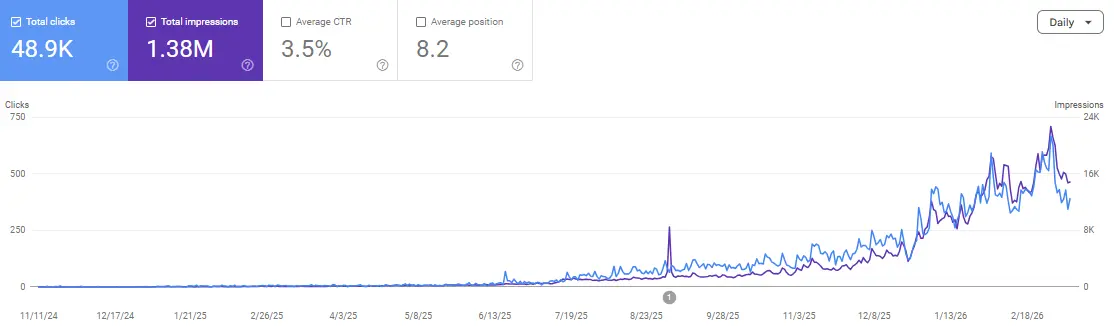
The clearest way to understand programmatic SEO is to study the sites that do it well, because every successful example follows the same underlying logic: a keyword pattern with real demand, a dataset with genuine unique value, and pages that give users something they cannot easily find elsewhere. This guide breaks down nine real-world programmatic SEO examples across different industries, explains exactly what makes each one work, and pulls out the replicable principle you can apply to your own site.
If you are not yet clear on the mechanics of programmatic SEO, start with what programmatic SEO is and how it works before studying these examples. The patterns here make far more sense once the foundation is in place.
Want to discuss which of these patterns might work for your business? Join the Scale-Xpert community on Discord where practitioners share real programmatic projects, exchange backlinks, and review each other’s approaches before launch.
What Every Successful Programmatic SEO Example Has in Common
Before diving into individual cases, understanding the shared pattern saves you from copying the surface appearance of these examples without understanding why they work. Every site in this list succeeds for the same three reasons, and sites that replicate the format without these three factors fail.
Every successful programmatic SEO example has a keyword pattern that maps directly onto a dataset the site already owns or has exclusive access to. Zapier owns its integration data. Nomadlist owns its city research data. Wise owns its exchange rate data. The data is not scraped from a competitor or pulled from a generic public source. It is either proprietary, uniquely aggregated, or regularly updated in a way that competitors have not replicated.
Every successful example also has pages that answer a specific question a real user is asking, not just a variation of a head keyword. The Zapier integration pages do not target “automation software.” They target “[specific app] + [specific app] integration,” which is what a user types when they know what they want and are looking for a specific solution. This specificity is what makes the pages genuinely useful rather than thin.
Finally, every successful example scales to a volume that justifies the programmatic approach. A site with 50 relevant variations does not need programmatic SEO. A site with 5,000 or 50,000 relevant variations does. The examples below all sit at scales where manual content creation is genuinely impractical, which is the only context where programmatic SEO offers a real strategic advantage. These principles are described fully in how to do programmatic SEO step by step.
Example 1: Zapier Integration Pages
Zapier’s integration pages are the most cited programmatic SEO example in the industry, and they work because Zapier had something nobody else had: a comprehensive dataset of every app in its ecosystem and every possible connection between them.
The keyword pattern
The pattern is “[App A] + [App B] integrations.” With thousands of apps in the Zapier ecosystem, the number of possible app-pair pages runs into millions. Each page targets a specific two-app integration search that a user types when they already know which tools they use and want to connect them.
Why the data provides unique value
Zapier is the actual integration platform. Every page describes real integrations that exist within their product, with real setup instructions, real use cases, and real trigger-action configurations. No competitor can replicate this data without building the same product. The data is not just unique. It is uniquely theirs by virtue of what their business does.
The replicable principle
If your business is a marketplace, a platform, or a directory, you own data about the things listed on your platform that no competitor can replicate without replicating your business. Build your programmatic keyword patterns around that proprietary data rather than around generic publicly available information.
Example 2: Nomadlist City Pages
Nomadlist built a programmatic SEO presence by collecting and aggregating data about cities that digital nomads care about, data that no general travel site had compiled in the specific form that this audience needed.
The keyword pattern
The primary pattern is “[city name] for digital nomads” and related variations covering cost of living, internet speed, weather, and safety for each city. Each city page aggregates multiple data points into a single, comprehensive resource for a specific location.
Why the data provides unique value
According to data cited by Ahrefs, Nomadlist has built tens of thousands of programmatic location pages that collectively drive substantial monthly organic traffic. The data that makes these pages work includes cost of living broken down by category, average internet speed from real user measurements, weather by month, safety scores, and community quality metrics. Most of these data points come from Nomadlist’s own user community and its own proprietary research, not from a single publicly available source.
The replicable principle
Aggregating data from multiple sources into a single coherent page for a specific subject is a legitimate programmatic SEO strategy, provided the aggregation itself creates value that a user cannot replicate by visiting the original sources individually. If your aggregation saves the user meaningful time and effort, it has programmatic SEO potential.
Example 3: Wise Currency Conversion Pages
Wise ranks for a vast number of currency conversion queries by generating pages that combine live exchange rate data with genuinely useful surrounding context, turning a simple lookup into a page worth visiting.
The keyword pattern
The pattern is “[currency] to [currency]” and “[amount] [currency] to [currency].” With dozens of major currencies and hundreds of possible pairs, this pattern generates a large number of pages from a simple two-variable structure.
Why the data provides unique value
What makes Wise’s currency pages stronger than a basic converter is that each page provides live exchange rate data pulled from Wise’s actual transfer pricing engine, combined with historical rate context, fee information for transfers, and practical guidance for someone considering an international money transfer. A user arriving on the page gets not just the conversion number but the context needed to make a real financial decision. This depth prevents the page from being replaced by a simple AI Overview calculation.
The replicable principle
Live data that updates automatically and contextual surrounding information that helps users act on the data, rather than just consume it, is a powerful combination for programmatic pages. If your business has access to live data of any kind, building programmatic pages around that data combined with actionable context is a defensible programmatic strategy.
Example 4: TripAdvisor Location Pages
TripAdvisor’s location pages demonstrate programmatic SEO at enormous scale, built on a dataset of user-generated reviews that no single organization could create manually and no competitor could replicate without replicating TripAdvisor’s entire user base.
The keyword pattern
TripAdvisor generates pages for patterns including “things to do in [city],” “best [restaurant type] in [city],” “hotels in [city],” and dozens of variations across locations worldwide. The number of possible combinations across all location types and categories runs into tens of millions.
Why the data provides unique value
The data that powers TripAdvisor’s pages is user-generated reviews, ratings, photos, and recent visitor experiences that represent years of community contribution. Each page aggregates this community data into a structured, useful resource. The freshness and specificity of recent user reviews are things that a generic AI Overview cannot replicate from its training data, which is why TripAdvisor’s pages continue to rank despite the rise of AI search.
The replicable principle
User-generated content, community data, and recent real-world experiences are among the most defensible data sources for programmatic SEO because they are inherently fresh, inherently unique, and inherently impossible for a competitor to replicate without building the same community. If your platform generates user data, reviews, or community contributions, this data is a programmatic SEO asset worth using.
Example 5: G2 Software Comparison Pages
G2’s software comparison pages capture enormous long-tail traffic by generating pages for every possible software comparison query in a category where comparison shopping is how most buyers make decisions.
The keyword pattern
The primary pattern is “[Software A] vs [Software B]” across every tool category in the software industry. With thousands of tools across hundreds of categories, the number of possible comparison pages is substantial. Each page targets the specific comparison search that a buyer types when they have narrowed their selection to two finalists.
Why the data provides unique value
G2’s comparison pages are powered by verified user reviews collected directly from software users. Each comparison page shows side-by-side feature breakdowns, pricing data, user satisfaction scores by category, and recent user testimonials. The combination of structured product data and aggregated user opinion makes each page more useful than a manually written comparison article that reflects only one writer’s perspective.
The replicable principle
Comparison pages built on verified, structured user data consistently outperform opinion-based comparison content because they reflect aggregate real-world experience rather than a single perspective. If your platform collects structured data about multiple products or services, the comparison pattern is one of the highest-converting programmatic formats available.
Example 6: Glassdoor Salary and Company Pages
Glassdoor’s salary pages demonstrate how proprietary community-sourced data can be the foundation of a programmatic SEO strategy that competitors cannot replicate without replicating the data collection mechanism itself.
The keyword pattern
The patterns include “[job title] salary in [city],” “[company name] salaries,” and “[company name] reviews.” These patterns capture high-intent searches from job seekers who are in an active decision-making process about their careers.
Why the data provides unique value
Glassdoor’s salary data comes from millions of self-reported salaries from verified current and former employees. Each page aggregates this proprietary data for a specific job title and location combination, producing a salary estimate that reflects real market conditions rather than an estimate from a single source. This is exactly the kind of original data that Lily Ray, speaking on Edward Sturm’s channel, identifies as the non-negotiable requirement for sustainable programmatic SEO: data that Google did not previously have. This original data principle connects directly to how to add genuine original value to programmatic pages without triggering quality penalties.
The replicable principle
Any business whose users voluntarily share data as part of using the product, whether salaries, prices, reviews, outcomes, or experiences, is sitting on a programmatic SEO asset. Building pages that surface this community-sourced data in a structured, useful format produces pages that are inherently difficult for competitors to replicate.
Example 7: Canva Template Pages
Canva’s template pages are a programmatic SEO example built around a product catalog, demonstrating how an e-commerce or SaaS business with a large catalog can generate keyword-targeted pages for every product or use case without writing each page by hand.
The keyword pattern
The patterns include “[design type] template,” “[occasion] invitation template,” “[business type] presentation template,” and dozens of similar variations. Each page targets a specific design need that a user types when they are looking for a starting point rather than a blank canvas.
Why the data provides unique value
Each Canva template page features a real, usable template that the user can open and edit immediately. The page is not just a description of what a template might look like. It is the template itself, embedded and interactive. This direct utility means the page provides something a user genuinely needs and cannot get from a content article or an AI Overview. The product is the value, and each programmatic page is a landing page for a specific variation of that product.
The replicable principle
When your product itself varies across dimensions that map onto keyword patterns, such as templates by type, tools by use case, or products by specification, each product variation can be a programmatic SEO page. The product page is also the landing page, which eliminates the thin content problem because the page’s purpose is to let users access the product, not to explain what the product is.
Example 8: Airtable Use Case Pages
Airtable’s use case pages show how a SaaS company can programmatically target the “[tool] for [specific use case]” pattern by documenting how different types of users apply the product, turning customer use cases into keyword-targeted landing pages.
The keyword pattern
The patterns include “[Airtable] for [industry or team type],” “[Airtable] [specific use case] template,” and related variations. Each page targets a specific professional context or workflow in which a potential customer might be considering Airtable.
Why the data provides unique value
Airtable’s use case pages work because they combine a real template the user can copy immediately with detailed guidance specific to that use case, team type, or industry. A marketing team considering Airtable for campaign tracking finds a page specifically about campaign tracking with a campaign tracking template embedded. The specificity of the use case match is what makes the page useful rather than generic. According to Ahrefs’ research on SaaS programmatic SEO, use-case and template pages consistently outperform generic feature pages in both ranking stability and conversion rate because they match transactional intent precisely.
The replicable principle
SaaS companies with multi-use products should map their keyword patterns to the specific contexts in which customers use the product rather than to generic feature descriptions. Customers do not search for “flexible database tool.” They search for “content calendar template” or “project tracking for small teams.” Meeting users at the specific use case rather than at the general feature level is what makes these pages convert as well as they rank.
Example 9: Healthline Symptom and Condition Pages
Healthline’s medical content pages demonstrate programmatic SEO in a high-stakes vertical where the approach works because every page combines medically accurate information, expert authorship, and specific content for each condition or symptom, making it impossible to substitute with a generic AI Overview response.
The keyword pattern
The patterns include “[symptom] causes,” “[condition] symptoms,” “is [symptom] serious,” and hundreds of related medical query variations. Each page addresses a specific health question that millions of people search for when experiencing a symptom or managing a condition.
Why the data provides unique value
Healthline’s pages work not because of programmatic data automation in the traditional sense but because each page is produced to a consistent structure and quality standard that applies medical expertise to a specific question. The content template is consistent. The expertise applied to fill it is genuine. Every page is reviewed by medical professionals and attributed to named authors, which directly supports the E-E-A-T signals that Google uses to evaluate health and medical content.
The replicable principle
In high-stakes verticals like health, finance, and legal, programmatic SEO requires not just a consistent template but a consistent application of genuine expertise to each variation. The template handles the structure. The expertise handles the trust. Both are required for the pages to rank and stay ranked in verticals where Google applies heightened quality standards.
What These Examples Tell You About Your Own Site
The pattern across all nine examples is consistent: successful programmatic SEO requires data you own or have exclusive access to, keyword patterns with real search demand, and pages that provide something users cannot get from a generic search result or AI Overview. Studying these examples without applying this filter leads to copying the format without capturing the value.
The question that decides everything
Before launching any programmatic project, ask whether your data is genuinely harder for a competitor to replicate than it would be for them to simply scrape or license a generic alternative. If your data is freely available from other sources and you are only aggregating it, your pages are vulnerable to both competition and AI Overviews. If your data comes from your own users, your own platform, or your own original research, you have a programmatic SEO asset that compounds over time rather than eroding.
The specific patterns worth borrowing
Based on these examples, the highest-performing programmatic patterns are: platform integration data for software and API businesses, location-specific aggregated data for travel and local businesses, user-generated review and rating data for marketplace and review platforms, product or template variations for e-commerce and SaaS businesses, and salary or pricing data for career and comparison platforms. Each of these patterns shares the characteristic that the data is inherently tied to the business generating it, which is what makes the resulting pages defensible.
Building the backlink foundation that programmatic pages need to rank for competitive variations requires the same approach to quality that the pages themselves require. The Scale-Xpert community on Discord is a practical place to exchange backlinks with site owners in your niche, discuss which programmatic patterns fit your data, and learn from real project outcomes.
Frequently Asked Questions
Can a small site with limited resources do programmatic SEO like these examples?
Yes, but at a different scale and with a narrower dataset. The examples in this article operate at enterprise scale because those businesses have enterprise-scale datasets. A small site with a genuine dataset of even a few hundred entries can build a viable programmatic presence around that data. The strategic principle is identical: unique data, real keyword demand, and pages that provide something users cannot easily get elsewhere. Scale is a variable. The quality requirement is not.
Do all of these sites use AI to generate their content?
No. Most of these examples predate modern AI tools and were built on structured data and templates. Zapier’s integration pages, Nomadlist’s city data, and Wise’s currency pages are all primarily data-driven rather than AI-generated. The pages work because the data is valuable, not because the text is sophisticated. AI can be used to enhance descriptions and context within templates, but the underlying data is what determines whether the pages are useful.
How do I identify my own programmatic SEO opportunity like these examples?
Start by auditing what structured data your business already has that competitors lack. Your product catalog, your customer reviews, your proprietary pricing, your user-generated content, your service area data: any of these can become a programmatic dataset if they map onto a keyword pattern with real search demand. The question to ask is: what does my business know or have that a competitor would need to replicate my entire business model to acquire?
Why do Healthline’s pages rank despite being written to a template?
Because the template is a quality floor, not a quality ceiling. Healthline’s template ensures that every page covers the minimum required information for a medical query. The medical expertise applied on top of that template provides the genuine value. Template-driven consistency plus genuine expertise equals pages that rank, not pages that get penalized. The lesson is that a good template does not compromise quality. It ensures consistency while genuine expertise provides the differentiation.
Are these examples still working in 2026 with AI Overviews?
Most of them are, specifically the ones whose data cannot be replicated by an AI Overview. Zapier’s live integration data, Nomadlist’s community-sourced city metrics, Wise’s live exchange rates, and Glassdoor’s salary data are all things that an AI Overview cannot generate from training data. Simpler examples that only provide a lookup or a basic definition are under more pressure from AI Overviews. The principle that has always applied to these examples, that unique data is the differentiator, applies with even more force in the AI search era. This is discussed in detail in how AI is changing programmatic SEO and query fan-out strategy.
How long did these sites take to see results from their programmatic pages?
Most large-scale programmatic projects take three to six months to reach meaningful ranking positions after launch. This timeline assumes pages are technically accessible, the domain has existing authority, and the pages provide genuine value. New domains launching programmatic content from scratch face additional scrutiny and typically take longer. Sites like Zapier and Nomadlist had existing domain authority before scaling their programmatic content, which is one reason their results appeared faster than a new domain would experience.
What is the best industry for programmatic SEO based on these examples?
Any industry with large, structured, differentiated data that maps onto specific search queries is a good fit. The examples in this article span software, travel, finance, consumer reviews, e-commerce, SaaS, and healthcare. The industry matters less than whether the business owns data that competitors cannot easily replicate. A niche business with truly proprietary data in an unglamorous industry often outperforms a high-profile business with generic data in a competitive one.
Conclusion
The nine examples in this guide all succeed for the same underlying reason: they own data that competitors cannot easily replicate, they build that data into keyword patterns with real search demand, and they generate pages that give users something genuinely useful that a generic search result or AI Overview cannot substitute. Understanding this shared logic matters more than studying any individual example in isolation.
In summary, the most replicable patterns are: integration or compatibility pages for platform businesses, location-aggregated data pages for travel and local businesses, user-generated review and rating pages for marketplace businesses, product and template variation pages for e-commerce and SaaS businesses, and proprietary salary or pricing data pages for career and comparison businesses. Each pattern works because the data is tied to the business generating it, which is what makes the resulting pages defensible over time.
Before building your own programmatic project, identify what data your business owns that a competitor would need to replicate your entire operation to acquire. That data is your programmatic SEO foundation. Build your keyword patterns around it, design your templates to surface it usefully, and generate your pages at the scale the data justifies. The examples in this guide were not built by copying competitors. They were built by recognizing the unique value in data they already had.
Join Scale-Xpert on Discord to discuss which programmatic patterns fit your own dataset, exchange backlinks with site owners building similar projects, and stay current with how successful programmatic strategies are evolving in the AI search era.