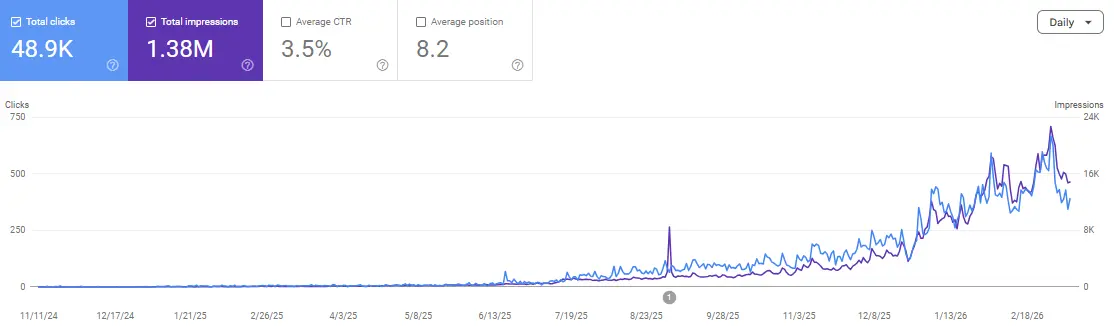
Doing programmatic SEO means building a keyword pattern, creating a page template, preparing a dataset, generating the pages, and validating their quality before scaling. Each step is simple on its own. The difficulty is in doing them all well enough that every generated page provides genuine value, because pages without value are the ones Google penalizes. This guide walks you through the entire process in order, with enough detail to execute your first project from start to finish.
If you are not yet clear on what programmatic SEO is conceptually, read the complete beginner’s guide to programmatic SEO first. This article picks up where that guide leaves off, focusing entirely on execution.
Want to share your progress or get feedback on a project you are building? Join Scale-Xpert on Discord where practitioners discuss programmatic strategies, exchange backlinks, and help each other avoid costly mistakes.
Step 1: Choose Your Keyword Pattern
Your keyword pattern is a repeatable search query structure with one or more variable elements, and the quality of this pattern determines whether your entire programmatic project has viable search demand or not. Choosing a weak pattern means building thousands of pages nobody searches for. Choosing a strong one means each page targets a real query with real intent.
What a keyword pattern looks like
A keyword pattern follows the formula: [static phrase] + [variable]. For example, “[city] cost of living” has a static phrase (cost of living) and a variable (city name). Other proven patterns include “[product] alternatives,” “best [category] in [city],” “[tool A] vs [tool B],” and “[topic] statistics [year].” Each variable slot becomes a different page.
How to validate that the pattern has real search demand
Before building anything, check that people actually search for variations of your pattern. Take five to ten specific variations of your pattern, such as “Tokyo cost of living,” “Lisbon cost of living,” and “Austin cost of living,” and check each in a keyword research tool like Ahrefs, Semrush, or Google Keyword Planner. If most variations show measurable search volume, even if individually small, the pattern is viable. If few or none show volume, the pattern is not worth pursuing regardless of how many pages you could technically generate.
Where beginners go wrong with pattern selection
The most common mistake is choosing a pattern based on how many pages you could create rather than whether users actually search for those variations. A pattern like “[random noun] fun facts” can generate an almost unlimited number of pages, but if nobody searches for most of those variations, the pages will rank for nothing and provide no traffic. Volume potential without demand is a waste of effort and crawl budget. Jeremy Tang, founder of CMAX, emphasizes on the Channel Agency Podcast that the strategic advantage of programmatic SEO is in targeting long-tail white space with genuine demand, not in creating pages for the sake of scale.
Start with patterns your business naturally supports
The strongest programmatic patterns emerge from data your business already has. If you run a SaaS tool, “[your tool] + [integration partner]” is a natural pattern. If you run a local directory, “best [business type] in [city]” maps directly to your data. If you run an e-commerce store, “[product] reviews” or “[product] vs [competitor product]” works naturally. Patterns that match your existing data and expertise produce more credible pages than patterns you have to stretch to fill. Understanding how to research keywords at a foundational level helps you evaluate patterns more rigorously before committing.
Step 2: Build Your Dataset
Your dataset is the structured information that makes each page unique, and the quality and originality of this data is the single biggest factor in whether your project succeeds or gets penalized. A dataset full of genuinely useful, hard-to-replicate information produces pages worth visiting. A dataset of shallow, freely available data produces pages worth ignoring.
What a programmatic dataset needs to contain
At minimum, your dataset needs one column that maps to your keyword variable and one or more columns of unique, substantive information for each row. For a “cost of living in [city]” pattern, the dataset needs a city column plus columns for rent, groceries, transportation, utilities, and other relevant data points. The more unique and specific data columns you include, the more genuinely useful each generated page becomes.
Where to find data worth using
The best programmatic datasets come from sources that are genuinely difficult or time-consuming for others to replicate. According to Ahrefs’ analysis of successful programmatic projects, the most reliable data sources include your own proprietary data from your product or platform, original research or surveys you have conducted, licensed databases that are not freely available to everyone, APIs that provide live or frequently updated data, and unique aggregations that combine multiple public sources into something more useful than any one source alone. The key criterion is whether the data gives each page something users cannot easily find with a simple Google search.
What to avoid in your dataset
Datasets built entirely from information that is freely and easily available elsewhere, such as basic Wikipedia facts, commonly known statistics, or data that Google can surface directly through its own features, produce pages that have no unique value. This is the thin content trap that Lily Ray warns about on Edward Sturm’s channel: if your data does not add something Google did not already have, the pages built from it are at serious risk of demotion. Be honest about whether your dataset passes this test before investing time in template creation and page generation.
Clean and structure the data before building anything
Inconsistent data produces inconsistent pages. Before connecting your dataset to a template, clean it thoroughly. Standardize formatting across all entries, fill in missing values or mark them explicitly, remove duplicates, verify factual accuracy for a representative sample, and ensure that every row has enough substance to generate a page worth visiting. This data hygiene step prevents quality issues that are much harder to fix after thousands of pages have been generated.
Step 3: Design Your Page Template
Your template defines the structure, layout, and content framework that every generated page will follow, and it needs to balance reusable structure with enough unique content per page to provide genuine value. A lazy template that only swaps a keyword produces thin pages. A well-designed template creates pages that feel individually crafted despite sharing a common structure.
What a strong template includes
A strong programmatic page template includes a clear, descriptive title tag incorporating the target keyword variable, a meta description that summarizes what the specific page offers, an introductory paragraph that directly answers the core question for that specific variation, data-driven sections that pull unique information from the dataset for each page, contextual content that varies meaningfully based on the data, internal links to related pages within the programmatic set and to other relevant content on your site, and a clear call to action or next step for the user.
Static content versus dynamic content
Every template has a mix of static content that stays the same across all pages and dynamic content that changes based on the dataset. The key is getting the ratio right. Too much static content makes pages feel identical. Too much dynamic content without a unifying structure makes pages feel disjointed. The strongest templates use a consistent structure with headlines and sections that repeat but fill those sections with data and context that is genuinely different for each page.
How to avoid the “same page, different keyword” problem
The most reliable safeguard is to ensure that at least 40 to 60 percent of each page’s visible content is unique to that specific page rather than shared across all pages. This is a rough guideline, not a hard rule, but it reflects the threshold where pages start to feel individually useful rather than mechanically templated. If the only difference between two pages is a swapped city name in an otherwise identical block of text, the template needs significantly more dynamic content sections.
Test the template with edge cases before generating at scale
Before generating all your pages, test the template with three to five entries that represent different conditions in your dataset: one with complete data, one with minimal data, one with an unusual or extreme value, and one from a low-demand variation. If the template produces a genuinely useful page for all of these, it will likely perform well at scale. If any edge case produces a thin or broken page, fix the template before generating the full set. This principle of validating before scaling is central to avoiding the penalties that programmatic SEO can trigger.
Step 4: Choose Your Tools and Generate the Pages
The right tool depends on your technical skill level and the scale of your project, and in 2026 there are viable options for every skill level from no-code to fully custom. The generation step is the most mechanically straightforward part of the process, provided your keyword pattern, dataset, and template are solid.
No-code options for beginners
For beginners with no development experience, the most accessible options are Airtable or Google Sheets as a data source connected to a CMS like WordPress through plugins like WP All Import or tools like Whalesync. These let you map spreadsheet columns to template fields and generate pages without writing code. The trade-off is less flexibility in template design compared to custom builds.
Low-code options for intermediate users
Tools like Webflow with its CMS collections, or platforms like Softr and Pory that connect to Airtable and generate pages from database rows, offer more design control than pure no-code approaches while still not requiring traditional programming. These are well-suited to projects with 500 to 5,000 pages where template design matters but custom development is not justified.
Custom development for large-scale or complex projects
For projects generating tens of thousands of pages or requiring complex logic, a custom-built solution using frameworks like Next.js, Gatsby, or Django connected to a database gives the most control and performance. This requires developer involvement but produces the most robust and scalable output. Platforms like Zapier, cited in Ahrefs’ programmatic SEO guide, are often used to automate the data-feeding process in custom builds.
Generate a small batch first, not the full set
Regardless of which tool you use, generate a small batch of 50 to 100 pages first rather than the entire set. Publish them, submit them for indexing through Google Search Console, and monitor how Google treats them over two to four weeks before generating the rest. This incremental approach catches quality and technical issues before they scale to a level that damages your site.
Step 5: Optimize for Indexing and Internal Linking
Pages that Google cannot find or crawl efficiently will never rank, so your indexing and internal linking strategy is just as important as the content itself. Programmatic sites with thousands of pages face specific crawl budget challenges that smaller sites do not.
Submit a comprehensive XML sitemap
Generate an XML sitemap that includes every programmatic page and submit it through Google Search Console. For very large page sets, split the sitemap into multiple files of 50,000 URLs or fewer, following Google’s sitemap guidelines. The sitemap is the primary mechanism for telling Google that these pages exist and should be crawled.
Build internal links between programmatic pages
Each programmatic page should link to a set of related pages within the same programmatic collection. A city cost-of-living page should link to nearby cities or cities with similar cost profiles. A product comparison page should link to related product comparisons. These cross-links help Google discover the full set of pages and signal that they form a coherent, interrelated body of content rather than isolated pages.
Link from your main site to the programmatic section
If your programmatic pages live in a separate section or subdirectory of your site, make sure that section is linked from your main navigation, your sitemap, or prominent hub pages. Orphaned programmatic sections that are not linked from the rest of the site receive less crawl priority and take longer to index. Connecting your programmatic content to your broader site structure also supports on-page SEO fundamentals that affect how Google evaluates and prioritizes your pages.
Monitor index coverage in Search Console
After submitting your sitemap, monitor the Index Coverage report in Google Search Console over the following weeks. Look for pages that are crawled but not indexed, which Google calls “Discovered but not indexed” or “Crawled but not indexed.” A high rate of non-indexing is a strong signal that Google does not consider those pages valuable enough to include in its index. If more than 20 to 30 percent of your programmatic pages are not being indexed, reassess your template and data quality before generating additional pages.
Step 6: Monitor, Validate, and Scale
The final step is not a one-time action but an ongoing process of monitoring how your pages perform, validating that they are providing genuine value, and scaling only when the data supports it. Publishing is the beginning of the work, not the end.
Track three key metrics from the first week
From the moment your first batch is published, track these three metrics weekly: the percentage of pages Google has indexed, the average engagement rate on the programmatic pages versus your site-wide average, and the number of organic sessions the programmatic pages are generating. Healthy programmatic pages show steady growth in all three metrics over the first one to three months.
What healthy versus unhealthy signals look like
Healthy signals include steady increases in indexed pages, engagement rates that are at or above your site average, organic sessions growing week over week, and users spending meaningful time on the pages. Unhealthy signals include a high percentage of pages remaining unindexed after four weeks, engagement rates significantly below your site average, zero or near-zero organic sessions after two months, and user behavior patterns that suggest visitors are landing and leaving immediately.
When to scale up
Scale up only when your first batch demonstrates healthy signals across all three metrics for at least four to six weeks. At that point, generate and publish the next batch of pages and repeat the monitoring cycle. Scaling incrementally in validated batches is the single most important risk mitigation practice in programmatic SEO. It catches problems while they are small and reversible rather than after they have scaled to a level that triggers site-wide quality signals.
When to stop or pull back
If your monitoring shows persistent unhealthy signals after eight weeks, stop generating new pages and investigate. The most common causes are a dataset that does not provide enough unique value per page, a template that produces too much duplicated content across pages, or a keyword pattern that does not match real search demand. Address the root cause before resuming. Sometimes the honest conclusion is that the project is not viable in its current form, and pulling back is the right decision. This kind of honest evaluation is part of building a long-term SEO strategy that compounds reliably.
If you are running a programmatic project and want to compare notes with others at the same stage, the Scale-Xpert community on Discord is where practitioners share real metrics from their own projects, exchange backlinks, and give practical feedback on templates and datasets.
Frequently Asked Questions
What is the easiest way to start a programmatic SEO project without coding?
Use Google Sheets as your database and connect it to WordPress through a plugin like WP All Import. This combination lets you define your dataset in a spreadsheet, map columns to template fields, and generate pages without writing any code. It is the fastest path from idea to published pages for someone with no development background, and it scales comfortably to several thousand pages.
How many pages should I start with for my first programmatic project?
Start with 50 to 100 pages. This is large enough to observe meaningful indexing and engagement patterns and small enough that any quality issues are contained before they scale. Monitor the batch for four to six weeks before deciding whether to expand. Attempting thousands of pages as a first project, before you have validated the quality of your template and dataset, is the most common beginner mistake.
How do I know if my pages are providing enough unique value?
Apply the human test and then verify with data. First, read five randomly selected pages from your set and ask honestly whether a real person would find each one genuinely useful. Second, check your Google Analytics engagement data: if engagement rates are at or above your site average and users are spending meaningful time on the pages, the value is confirmed. If engagement is poor, the pages likely need more unique, substantive content.
Do I need a developer to do programmatic SEO?
Not for most beginner and intermediate projects. No-code tools like Airtable, Google Sheets, WP All Import, Webflow CMS, and Softr handle the connection between datasets and templates without programming. A developer becomes valuable for large-scale projects above 10,000 pages, complex conditional logic within templates, or custom integrations with live data APIs. Start without a developer and bring one in when you reach a complexity ceiling.
How long does it take to build and launch a programmatic SEO project?
Most first projects take two to four weeks from initial keyword research to published first batch. The breakdown is roughly: one week for keyword pattern selection and dataset preparation, one week for template design and testing, a few days for generation and technical setup, and then a launch of the first 50 to 100 pages followed by the monitoring period. Subsequent batches are faster because the template and tooling are already in place.
Can I use AI to generate the content within my templates?
Yes, but with important caveats. AI can help generate descriptions, summaries, and contextual text within your template fields, which saves significant time. However, the unique value of each page should come primarily from the underlying data rather than from AI-generated prose. AI text that does not add information beyond what the data already provides is padding, not value. Use AI to enhance the presentation of genuinely unique data, not to substitute for it.
What happens if Google deindexes my programmatic pages?
Deindexing means Google has decided your pages are not valuable enough to include in its search results. If a significant portion of your pages are deindexed, review your template for thin or duplicated content, verify that your dataset provides genuine unique information on each page, and check whether the pages are technically accessible. After making improvements, request reindexing through Google Search Console and monitor the coverage report. If the pages are still not indexed after improvements, the project likely needs a more fundamental redesign of either the dataset or the template.
Conclusion
Doing programmatic SEO successfully requires executing six steps in order: choosing a viable keyword pattern, building a dataset with genuine unique value, designing a template that produces individually useful pages, generating a small batch first, optimizing for indexing and internal linking, and monitoring performance before scaling. The mechanics are straightforward. The discipline to ensure genuine value at every step is what separates projects that compound traffic from projects that get penalized.
In summary, the most important principles to carry into your first project are: validate search demand before building, insist on genuinely unique data, test templates with edge cases, publish in small validated batches rather than all at once, and be willing to stop or redesign if the data shows the pages are not performing. Every successful programmatic project was built incrementally. Every catastrophic failure was built by scaling before validating.
Start small, measure rigorously, and scale only what works. The compound traffic potential of well-executed programmatic SEO is enormous. The path to getting there safely is patience and honesty about what your pages actually provide.
Join the Scale-Xpert community on Discord to share your project progress, exchange backlinks with site owners in your niche, and get practical feedback from practitioners who have built programmatic projects from scratch.