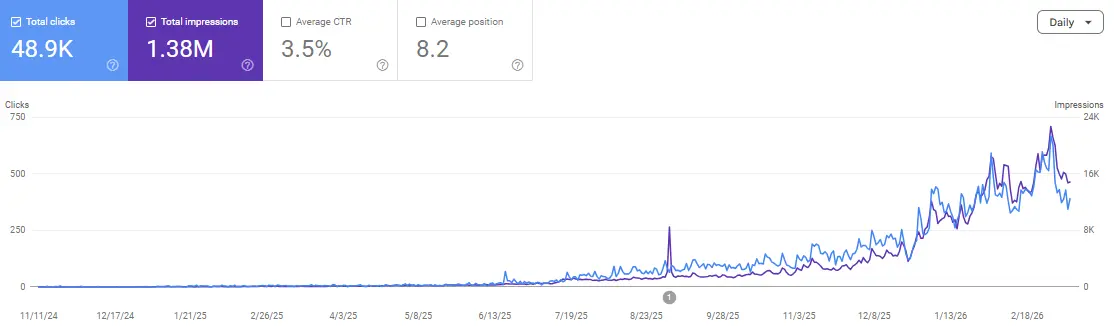
Artificial intelligence in SEO is no longer a future trend you can ignore. Instead, it is already shaping how search engines understand content, how users interact with results, and how you approach optimization as an SEO.
If you are just getting started and want to understand what artificial intelligence in SEO really means in practice, this guide walks you through the essentials in plain language.
If you enjoy breaking down complex SEO ideas like this and want to discuss strategies with others in real time, there is a growing community on Discord where these conversations happen naturally.
What Artificial Intelligence In SEO Actually Means
When people talk about artificial intelligence in SEO, they are generally referring to two key areas. First, how search engines use AI to rank and evaluate pages. Second, how you can use AI tools to improve your own website.
On one side, search engines rely on AI to interpret queries, understand page content, and decide what results to display. On the other side, AI tools help you perform keyword research, plan content, write articles, and run technical audits more efficiently.
In fact, artificial intelligence is transforming SEO by improving keyword research, content creation, and predictive analysis. As a result, SEO strategies become more efficient and better aligned with user intent.
At the same time, tools such as Ahrefs, Semrush, Surfer SEO, Frase, and ChatGPT automate repetitive tasks like keyword analysis, content optimization, and performance tracking. Because of this, businesses can improve rankings while saving time and effort.
You still need SEO fundamentals. AI simply gives you newer, more powerful ways to apply them.
How Search Engines Use AI Today
To understand how AI changes SEO, you first need to understand how modern search engines operate.
Today, search engines rely heavily on artificial intelligence through systems such as Google’s RankBrain and BERT. These technologies use machine learning and natural language processing to understand search intent more accurately. As a result, they focus on meaning and context rather than exact keyword matches.
In addition, AI has enabled new types of search experiences. For example, platforms like Google AI Overviews, SearchGPT, and Perplexity generate personalized answers based on user intent and context instead of simply listing pages.
Behind the scenes, AI also powers advanced evaluation systems. For instance, the U.S. patent US11769017B1 highlights how search engines analyze content relevance using deeper contextual signals.
Because of these developments, SEO success now depends on how well you cover a topic and satisfy user intent, not how often you repeat keywords.
Google’s Search Generative Experience And AI Overviews
Google’s Search Generative Experience, or SGE, is one of the clearest examples of AI in modern search.
Rather than showing only a list of links, SGE combines traditional results with AI generated summaries at the top of the page. These summaries pull information from multiple sources and often include follow-up questions.
As a result, users can get answers faster without visiting multiple pages.
However, this shift creates a new opportunity. Research shows that pages optimized to answer specific questions are more likely to be cited in AI generated results. Therefore, structuring your content clearly is more important than ever.
Why AI Search Changes Your SEO Strategy
As AI powered search continues to grow, your SEO strategy needs to evolve as well.
AI generated answers can significantly shorten the path between a question and an answer. Because of this, many users may find what they need directly in the search results without clicking further.
However, if your content is cited in those answers, you still gain strong visibility and authority. In many cases, this leads to more qualified traffic.
For this reason, SEO now places more emphasis on:
- Clear, intent driven content
- Question based headings and structure
- Strong E E A T signals
In addition, AI enables more personalized results. This means different users may see different answers based on their behavior, location, or device.
How AI Transforms Keyword Research
Artificial intelligence has completely changed how keyword research works.
Instead of focusing only on exact keywords, AI tools analyze large datasets to understand patterns in user behavior and intent. As a result, they can group related terms, identify trends, and suggest topic clusters.
Because of this, keyword research becomes more strategic and less guesswork.
In practice, this approach means you should:
- Start with the user’s core problem
- Expand into related questions and variations
- Group keywords into topics
- Map each topic to specific content
At this stage, many SEO practitioners start experimenting and comparing notes. If you ever feel stuck or want to validate ideas, having a space like a Discord community to exchange insights can quietly speed up your learning curve.
Using AI For Content Creation And Optimization
AI powered tools can significantly speed up content creation. For example, they can generate outlines, drafts, and optimization suggestions within minutes.
Tools like Surfer SEO, Frase, and Semrush help improve structure, readability, and topic coverage.
However, it is important to remember that AI should support your work, not replace it.
You still need to:
- Verify facts carefully
- Add real examples and insights
- Adjust tone and clarity
When used correctly, AI becomes a powerful assistant that improves both speed and quality.
AI Powered Technical SEO And Audits
Technical SEO has always required detailed analysis. Fortunately, AI makes this process faster and more accurate.
AI tools can automatically detect issues related to site speed, crawlability, and mobile usability. In addition, they can prioritize fixes based on their potential impact.
Because of this, you can move from reactive fixes to proactive optimization.
AI Tools That Are Shaping Modern SEO Workflows
Today, most SEO workflows involve AI powered tools in some form.
Platforms such as Semrush, Surfer SEO, and ChatGPT help with research, content creation, and performance tracking. As a result, they reduce manual work and allow you to focus on strategy.
Over time, this shift makes SEO more efficient and scalable.
AI, User Intent, And Personalized Search
One of the biggest advantages of AI is its ability to understand user intent more deeply.
Because of this, search results are becoming more personalized and context aware. Users now search using natural language, often asking detailed and specific questions.
As a result, you need to create content that reflects real scenarios and user needs.
When your content aligns with intent, it typically leads to:
- Higher engagement
- Longer session duration
- Better conversion rates
AI In SEO For Investment Attraction And B2B Growth
AI in SEO is not only about traffic. It also plays a key role in attracting leads and investment opportunities.
By analyzing trends and user behavior, AI helps you create content tailored to specific industries and audiences. Consequently, your SEO efforts become more aligned with real business goals.
Preparing Your SEO Strategy For An AI First Future
As artificial intelligence in SEO continues to evolve, adaptability becomes essential.
To stay competitive, you should:
- Focus on user intent
- Build topic based content
- Strengthen E E A T signals
- Use AI tools strategically
- Monitor search performance regularly
Ultimately, AI raises the standard of SEO rather than replacing it.
Frequently Asked Questions About AI In SEO
1. Is AI bad for SEO or will it replace SEO jobs?
AI does not replace SEO jobs. Instead, it changes how the work is done by reducing repetitive tasks and increasing focus on strategy.
2. Can I use AI to write all my content and still rank?
You can use AI for drafting. However, human review is essential to ensure accuracy, quality, and trust.
3. How do I optimize for AI Overviews and SGE?
You should structure content around clear questions and concise answers, followed by deeper explanations.
4. Which AI SEO tools should I start with as a beginner?
Start with tools like Semrush, Ahrefs, or ChatGPT. Then, expand as your workflow grows.
5. Does AI change how I do local SEO?
Yes. In particular, it increases the importance of conversational and intent based queries.
Conclusion
Artificial intelligence in SEO is already transforming how search engines operate and how users interact with content.
Therefore, your best strategy is to combine strong SEO fundamentals with thoughtful use of AI. By focusing on clarity, usefulness, and intent, you can stay competitive as search continues to evolve.
And if you prefer not to figure all of this out alone, you might find it useful to occasionally step into a Discord space where SEO practitioners share experiments, wins, and failures in real time. Sometimes a simple conversation can unlock your next breakthrough.