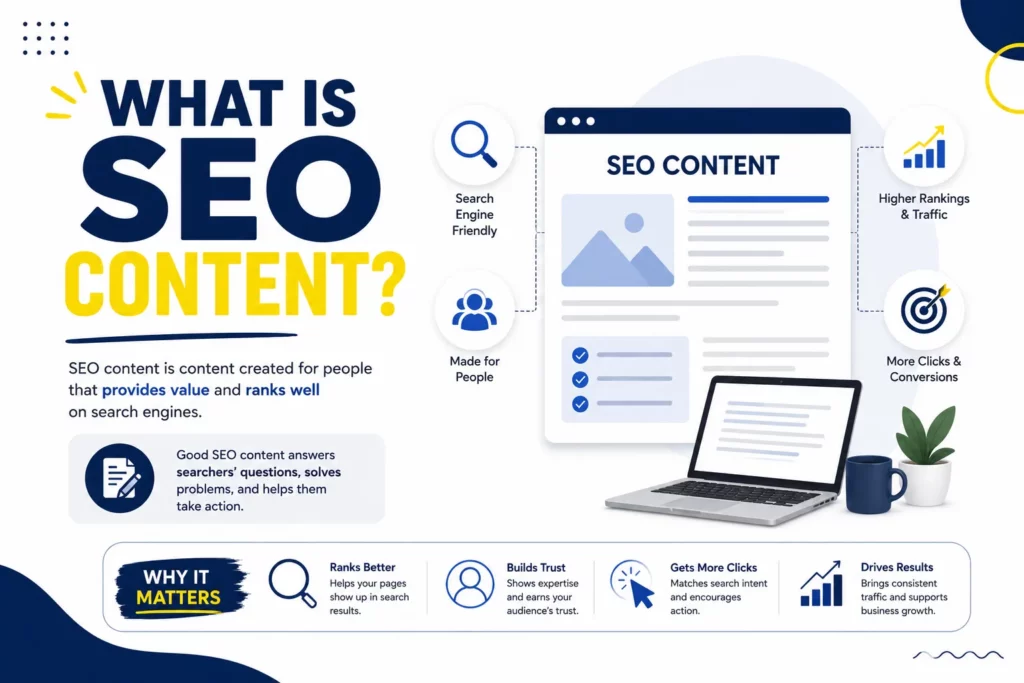
What is SEO content? It is any article, landing page, product page, video, image, tool, or resource created to answer a search need and attract relevant organic visitors.
Effective SEO content combines audience research, useful information, search intent, original value, clear structure, internal links, and technical accessibility. Therefore, it involves much more than placing keywords inside an article.
For practical feedback while planning your pages, you can join an SEO discussion community and exchange ideas with other website owners and content creators.
Quick Answer
SEO content is content created to satisfy a specific search need while remaining accessible and understandable to search engines.
Strong search-focused content gives people a useful answer, uses an appropriate page type, adds original value, and guides the reader toward a logical next step. However, no content format or optimization checklist can guarantee rankings.
What Does SEO Content Mean?
SEO content connects what people search for with information, products, services, or tools available on your website.
For example, someone searching “how to do keyword research” probably expects a practical tutorial. A detailed keyword research guide can satisfy that need when it provides clear instructions and relevant examples.
This type of content can include:
- Blog articles
- Product and category pages
- Service pages
- Local landing pages
- Comparison guides
- Videos and images
- Templates
- Calculators
- Interactive tools
- Original research
The format should depend on what the searcher expects, not on which format is easiest for the publisher to produce.
SEO Content vs SEO Writing vs Content Marketing
These terms are related, but they do not mean exactly the same thing.
| Term | Meaning |
|---|---|
| SEO content | Any page or resource created to satisfy search demand and attract organic visibility |
| SEO writing | The process of researching, writing, and optimizing search-focused text |
| Content marketing | Creating and distributing useful material to attract, educate, and convert an audience |
| Content optimization | Improving an existing page for relevance, usability, visibility, and conversions |
For example, a free calculator can be SEO content even though it contains little traditional writing. Meanwhile, a newsletter can support content marketing without being designed primarily for search traffic.
Why Search-Focused Content Matters
People use search engines to find explanations, products, comparisons, services, and solutions.
When your website provides a suitable answer, it may attract relevant organic traffic without requiring payment for every visit.
A strong content strategy can help you:
- Reach people actively researching a topic
- Build useful coverage around your expertise
- Introduce products or services naturally
- Support internal linking
- Earn backlinks and mentions
- Create pages that continue producing value
- Learn more about audience needs through search data
However, traffic alone should not be the goal. A topic should also fit your audience, expertise, products, services, or wider website strategy.
Google says its ranking systems are designed to prioritize helpful and reliable information created primarily to benefit people rather than content made mainly to manipulate rankings.
Common Types of SEO Content
Different queries require different search experiences.
Definition and Beginner Guides
These pages explain a concept in clear language.
Examples include:
- What is on-page SEO?
- What is technical SEO?
- What is organic traffic?
- What is keyword clustering?
How-To Tutorials
Tutorials show readers how to complete a task.
They often include numbered steps, screenshots, examples, tools, and common mistakes.
Comparisons and Reviews
Commercial searches may require content that helps users compare options.
A useful comparison should explain:
- Evaluation criteria
- Strengths and weaknesses
- Pricing context
- Suitable users
- Important limitations
- How the products were tested
Product and Category Pages
Product pages describe one specific item, while category pages help visitors browse several related options.
These pages should provide clear information, useful filtering, trustworthy details, and an obvious next step.
Service and Local Landing Pages
Service pages explain what a business offers, who the service is for, and how a customer can proceed.
Local pages should also provide genuinely useful location-specific information rather than changing only the city name.
Tools, Templates, and Resources
A downloadable template, calculator, checklist, or free tool may satisfy some queries better than a long article.
Videos and Image Resources
Some problems are easier to understand visually. Therefore, review whether video, diagrams, screenshots, or original images would improve the answer.
How to Create SEO Content Step by Step
The following workflow turns a keyword idea into a useful published page.
Step 1: Define the Audience and Goal
Before opening a keyword tool, decide who the content is for.
Ask:
- What problem does this audience have?
- What do they already understand?
- What should they learn or accomplish?
- Why is your website qualified to help?
- What should they do after reading?
A page created only to attract traffic may bring visitors who have little connection to your website.
Step 2: Find a Relevant Topic
Choose a subject that fits both your audience and your expertise.
Evaluate:
- Audience relevance
- Business relevance
- Recurring demand
- Content freshness requirements
- Competition
- Your ability to add useful information
A low-volume topic can still be valuable when it attracts the right audience or supports an important product, service, or topic cluster.
Step 3: Research the Keyword Cluster
Do not build a page around only one isolated phrase.
Collect:
- One primary keyword
- Closely related variations
- Supporting questions
- Related subtopics
- Search volume
- Keyword difficulty
- Search Console queries
- People Also Ask questions
- Relevant competitor terms
Next, use keyword clustering to decide which phrases belong on one page and which require separate articles.
Step 4: Confirm Search Intent
Search intent describes what someone wants to achieve through a query.
The user may want to:
- Learn something
- Reach a specific website
- Compare available options
- Buy, book, subscribe, or download
Review this complete search intent guide before assigning an important keyword to a page.
For example, “best keyword research tools” usually needs a comparison. Meanwhile, “how to use a keyword research tool” is better suited to a tutorial.
Step 5: Analyze the Current Search Results
Search the target keyword and examine what currently appears.
Review:
- Dominant page type
- Content format
- Common angle
- Level of detail
- Recurring subtopics
- Search features
- Weak or outdated information
- Signs of mixed intent
The leading results might include tutorials, products, tools, videos, forums, or category pages.
Use them to understand audience expectations. However, do not copy their headings and produce another nearly identical article.
Step 6: Identify Your Original Value
Saying that content must be “high quality” is not enough. Define what will make your page meaningfully useful.
Original value may include:
- First-hand experience
- Original screenshots
- A clearer framework
- Real examples
- A case study
- A downloadable template
- Expert commentary
- Original data
- Better comparisons
- A complete checklist
- Updated information
Google recommends evaluating whether a page provides original information, meaningful analysis, clear sourcing, and substantial value beyond rewriting other sources.
Step 7: Build a Content Brief
A content brief keeps the page focused before drafting begins.
Include:
- Target audience
- Page goal
- Primary keyword
- Supporting keyword cluster
- Search intent
- Recommended content type
- SEO title
- H1
- H2 and H3 outline
- Important questions
- Original examples
- Internal links
- Reliable external sources
- Required screenshots
- Call to action
The brief should guide the writer without forcing every competitor heading into the page.
Step 8: Write and Edit the Draft
Write the first draft for clarity before worrying about exact keyword frequency.
Then edit for:
- Accuracy
- Logical structure
- Repetition
- Unsupported claims
- Missing examples
- Awkward keywords
- Unnecessary filler
- Grammar
- Tone consistency
- Short, readable paragraphs
Answer the central question near the beginning. Afterward, add the detail readers need to understand or complete the task.
Step 9: Optimize the Page
Once the main content is useful, improve its page-level elements.
Review:
- SEO title
- Meta description
- URL
- H1
- H2 and H3 headings
- Opening answer
- Internal links
- External references
- Image file sizes
- Image alt text
- Structured data where appropriate
- Mobile readability
Use this on-page SEO checklist for a more detailed review.
In addition, confirm that the page is crawlable and indexable. Helpful content cannot attract search visitors when search engines cannot properly access it. Review the main technical SEO essentials before publishing.
Step 10: Publish, Measure, and Improve
Publishing is not the final step.
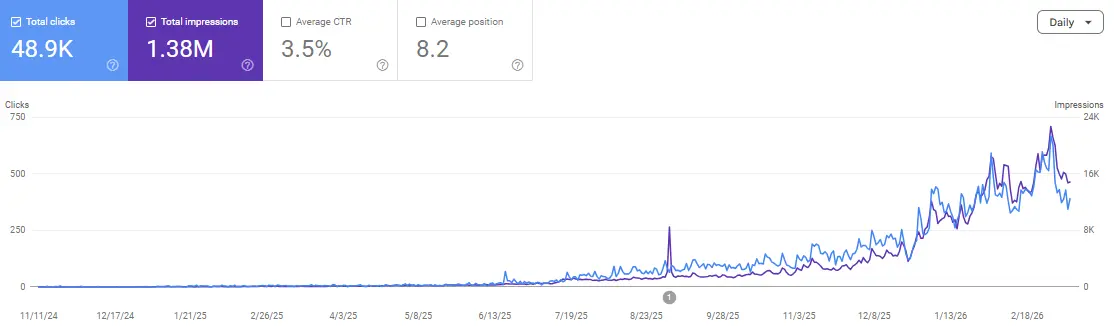
Use Google Search Console to monitor:
- Impressions
- Clicks
- Click-through rate
- Average position
- Ranking queries
- Page performance over time
The Performance report allows website owners to compare these metrics across queries, pages, countries, devices, and date ranges.
Also monitor:
- Organic sessions
- Conversions
- Backlinks
- Internal links
- Engagement
- Performance before and after updates
Avoid making major decisions after only a few days. Some pages need time to be crawled, indexed, evaluated, and discovered for a wider group of queries.
SEO Content Example: From Keyword to Published Page
Suppose you plan an article about keyword intent.
| Stage | Decision |
| Audience | Beginner SEO learners |
| Primary keyword | what is keyword intent |
| Search intent | Informational |
| Expected format | Beginner guide |
| Supporting topics | Four types, mixed intent, examples, SERP analysis |
| Original value | Step-by-step intent workflow and mapping example |
| Internal links | Keyword research, clustering, mapping, on-page SEO |
| CTA | Continue to the keyword-clustering guide |
| Measurement | Impressions, queries, clicks, CTR, and average position |
This process creates a clearer publishing decision than simply repeating the target phrase throughout an article.
People-First Content Checklist
Before publishing, confirm that:
- The topic fits your audience.
- The page solves a real problem.
- Search intent has been manually reviewed.
- The content type matches the search results.
- The introduction answers the main question.
- The article adds original value.
- Claims are accurate and properly sourced.
- Headings follow a logical hierarchy.
- Keywords appear naturally.
- Relevant internal links are included.
- Images support the explanation.
- The author or reviewer is clearly identified.
- The page works on mobile devices.
- Search engines can crawl and index it.
- Performance can be measured after publishing.
Common SEO Content Mistakes
Writing for Search Engines Instead of People
Unnatural repetition can make an article difficult to read. Use the primary phrase where it provides clarity, then rely on related terms and natural language.
Choosing Topics Only by Search Volume
Large search volume does not make a topic relevant to your audience or website.
Ignoring the Current Results
A blog article may struggle when the query clearly requires a product page, tool, video, or local result.
Rewriting Existing Articles
Combining several competitor pages rarely creates meaningful original value.
Publishing Without Internal Links
Internal links help readers find related information and help search engines discover and understand connected pages. Google recommends crawlable links with descriptive anchor text.
Updating Content Without a Reason
Not every article needs constant changes. Refresh a page when its information becomes inaccurate, incomplete, less competitive, or misaligned with the current search intent.
Expecting Guaranteed Rankings
Useful optimization can improve a page’s ability to compete. However, rankings also depend on competition, authority, technical accessibility, links, relevance, and many other signals.
When Should Existing Content Be Updated?
Review a page when you notice:
- Declining impressions or clicks
- Falling average positions
- Outdated screenshots
- Broken links
- Old statistics
- Changed products or tools
- Missing subtopics
- New audience questions
- Search-intent changes
- Weak internal links
- Competitors offering more useful resources
Long-lasting guides should still be maintained. This evergreen content guide explains how to identify and refresh resources built around recurring search demand.
FAQs
What is SEO content in simple terms?
SEO content is a page or resource created to satisfy a search need and attract relevant visitors from unpaid search results.
What is an example of SEO content?
A step-by-step keyword research tutorial is one example. Product pages, comparison guides, calculators, templates, videos, and service pages can also be search-focused content.
What is the difference between SEO content and regular content?
Search-focused content is planned around a discoverable audience need, keyword cluster, search intent, and suitable page format.
Regular content may be created for newsletters, social media, existing customers, or other channels without targeting organic search.
What is the difference between SEO content and SEO writing?
SEO content includes every search-focused format, including tools, images, product pages, and videos. SEO writing specifically refers to researching, writing, and optimizing text.
Can product pages be SEO content?
Yes. A product page can target transactional demand when it provides useful product details, clear pricing, trust signals, and an easy next step.
Does SEO content need to be long?
No fixed length works for every query. The page should be detailed enough to satisfy the expected need without adding unnecessary filler.
How do I know whether a page matches search intent?
Review the dominant page types, formats, angles, and features in the current search results. Then compare them with the experience provided by your page.
How often should SEO content be updated?
Update it when information changes, performance declines, search intent shifts, or the page no longer provides a complete and accurate answer.
Can AI-generated content appear in search results?
The tool used to create a draft is not the only consideration. Accuracy, originality, usefulness, transparency, and compliance with spam policies still matter.
Human review is particularly important for verifying facts, adding experience, correcting generic language, and ensuring the page genuinely helps its audience.
Does SEO content guarantee organic traffic?
No. A page may still face strong competition, weak authority, technical problems, limited demand, or poor internal discovery.
Conclusion
Understanding what is SEO content helps you move beyond adding keywords to articles.
Start with a relevant audience problem. Then research the keyword cluster, confirm search intent, analyze the current results, add original value, and build a focused brief. After writing, improve the page with clear headings, useful internal links, accurate metadata, images, and technical checks.
Finally, measure the page in Search Console and update it when the information or search landscape changes.
To discuss a content brief, compare search results, or get feedback on a new topic, continue the conversation with other SEO learners.