
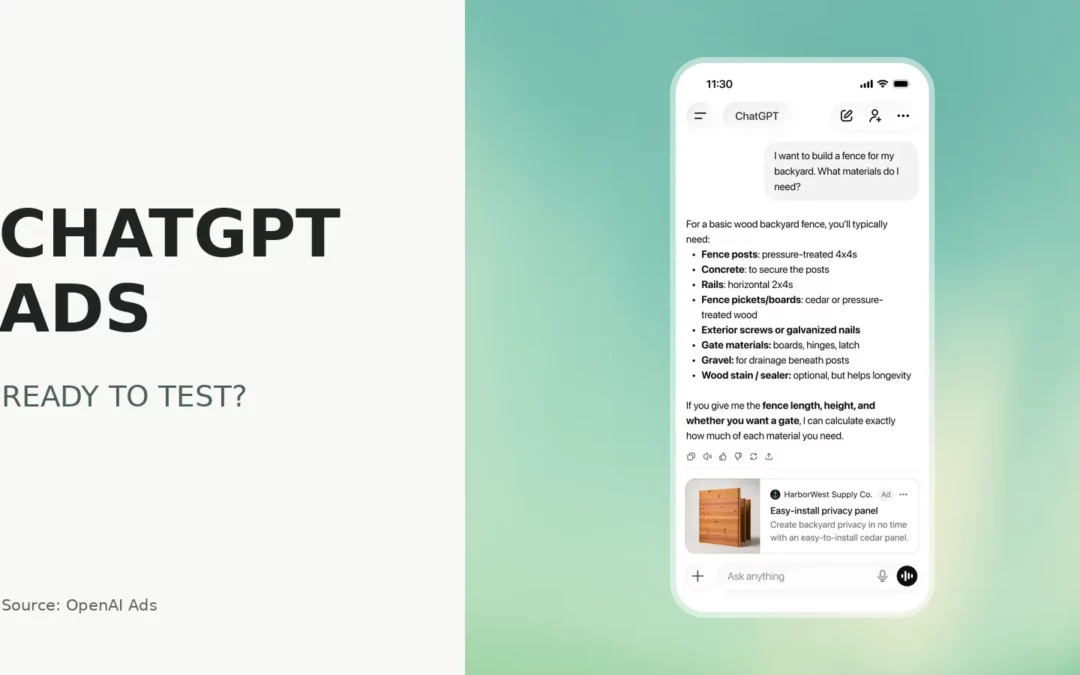
ChatGPT Ads let businesses pay for advertising placements within ChatGPT. Before funding a campaign, check whether your business can access the platform, whether your offer fits a real customer need, and whether you can connect advertising spend to outcomes worth paying for.
A new source of clicks can look promising while leaving the important question unanswered: did those visits produce customers at a cost your business can sustain?
This guide explains how to assess that question before launch, with a readiness checklist and a practical framework for your first test.
What Are ChatGPT Ads—and Can They Buy a Recommendation?
ChatGPT Ads are sponsored placements, separate from the assistant’s answers. OpenAI says advertisers cannot shape, rank, or alter those answers by purchasing advertising. A sponsored placement also does not mean OpenAI endorses the business.
That distinction matters when your goal is AI visibility. An ad impression, an organic brand mention, and a citation linking to your website describe different outcomes. Paying for one does not establish that you will receive the others.
OpenAI’s advertising FAQ explains that ads may appear for eligible Free and Go users, while Plus, Pro, Business, Enterprise, and Edu accounts are ad-free.
For planning purposes, keep separate records for paid campaign performance and earned visibility. Our guide to how ChatGPT picks sources addresses the organic side.
Can Your Business Actually Run ChatGPT Ads?
Check advertiser access before preparing an extensive campaign.
OpenAI’s Ads Manager availability page distinguishes account creation from self-service access. The legal entity advertising and receiving the bill must be based in a supported country. Indonesia is currently listed, alongside other markets; the live list should remain your reference when planning a launch.
Three questions need separate answers:
- Can your business use Ads Manager?
- Can your account target the markets you want?
- Can your ads pass review and meet delivery requirements?
A signup confirmation answers only part of that process.
Record the billing entity, intended markets, and any account restrictions in your campaign brief. This prevents a common planning mistake: building an international test around access that has not been established.
How Does ChatGPT Decide Which Ads Are Relevant?
ChatGPT advertising considers conversational intent alongside signals such as the advertisement and its destination. OpenAI’s advertiser introduction describes a relevance-weighted, second-price auction.
That is more specific than saying the highest bidder always wins. It also does not support an invented formula such as “maximum bid plus relevance equals placement.”
Start with the customer’s situation. What are they trying to decide? What constraint makes your offer useful? What evidence would help them evaluate it?
Understanding search intent in SEM provides a useful foundation, even though the controls and delivery mechanics differ.
The same advertiser introduction says qualifying advertisers can use Negative Phrases for certain brand-specific placement requirements. Availability should be checked for the account; it is not a reason to assume every advertiser has Google-style negative keyword controls.
Context Hints Describe Relevance, Not Guaranteed Delivery
According to OpenAI’s context hints guidance, hints add information about your product, customers, and useful situations at the ad-group level. They are not exact-match keywords or instructions that enforce exclusions, geography, or schedules.
Consider this hypothetical example for scheduling software:
Vague hint: “Scheduling, appointments, booking, business software.”
More informative hint: “Appointment scheduling for independent tutors who need students to book lessons around recurring availability.”
The second version connects a product capability with a customer need. It should only be used if the product supports that situation.
Now check the rest of the journey. If the ad describes tutor scheduling but the destination barely mentions lessons or recurring appointments, the message loses coherence.
Choose the Outcome Before Choosing the Campaign
Write down what success means before selecting settings.
For an online store, that could be completed purchases at an acceptable acquisition cost. For a service business, it could be qualified enquiries rather than every form submission. For software, it may involve signups followed by activation or paid subscriptions.
Those are business definitions. They should guide your campaign evaluation.
OpenAI’s campaign documentation currently describes Views, Clicks, and Conversions objectives. A conversion-oriented campaign can use click or impression billing; selecting Conversions does not mean you pay only when a customer converts.
| Campaign purpose | What to evaluate |
|---|---|
| Exposure | Whether the audience and message suit the awareness goal |
| Website traffic | Whether visits engage with the relevant offer |
| Conversion acquisition | Whether attributed outcomes meet business quality and cost requirements |
Do not use a traffic result to declare a sales strategy successful. A campaign can deliver visits efficiently while failing your customer acquisition requirements.
If the charging terminology is unfamiliar, our explanation of pay-per-click advertising provides background.
Conversion Optimization Is Already Documented
Some early walkthroughs describe a platform focused on clicks. Current conversion optimization documentation supports optimization toward a selected standard conversion event.
It also distinguishes supported optimization events from custom events: custom conversion events are not currently supported as the optimization goal.
Before publishing an older tutorial’s instructions into your campaign, check its date and the current documentation. Then confirm the settings available in your account.
Choose an event that represents meaningful progress. An easy-to-trigger event can produce a busy dashboard without establishing customer value.
Validate Tracking Before Buying Traffic
A pixel loading successfully does not prove your purchase or lead event is correct.
OpenAI’s conversion measurement guide describes measurement through its Pixel, Conversions API, or both. It explains preserving the oppref click reference and using the same event ID to deduplicate the same conversion sent through both methods.
Build your verification around a real action, such as a test order or submitted enquiry.
| Check | Evidence to collect |
|---|---|
| The intended action happens | Confirmation in your store, application, or CRM |
| The correct event fires | Event details associated with that action |
| The event happens once logically | No duplicate purchase or lead count |
| Redirects preserve required information | Final destination and identifier checks |
| Campaign reporting can be reconciled | A documented path from action to reported outcome |
Apply appropriate notices and consent requirements to the implementation.
Add consistent UTM parameters for your analytics workflow. Keep paid ChatGPT traffic distinguishable from organic AI referrals; our GA4 traffic sources guide explains why source classification matters.
Match the Landing Page to the Customer’s Decision
Your destination should continue the promise made by the ad.
OpenAI’s creative guidance recommends specific, useful messaging and the most relevant destination rather than automatically sending everyone to a generic homepage.
For a hypothetical scheduling product, a tutor-focused page might explain recurring availability, lesson booking, reminders, and applicable pricing. A visitor should not have to search a broad software catalogue to establish whether the advertised solution exists.
Audit the page with four questions:
- Does the opening explain the use case the ad introduced?
- Can the visitor verify the important claims?
- Are pricing, eligibility, and limitations understandable?
- Is the next step clear and functional on mobile?
For SEO teams, this is an opportunity to improve a useful page rather than manufacture another near-duplicate destination for every hint variation.
Calculate What a Click Can Be Worth
There is no universal CPC that makes a campaign attractive.
A business with strong margins and repeat purchases can tolerate different acquisition costs from one selling a low-margin product once. A lead-generation business must account for qualification and close rates.
For a simple direct-sale model:
Allowable CPC = target advertising cost per customer × assumed click-to-customer conversion rate
Suppose your target advertising cost per customer is $60 and your assumed conversion rate is 2%. The implied allowable CPC is $1.20.
At 0.5%, it falls to $0.30. At 4%, it rises to $2.40.
These are illustrative calculations, not ChatGPT Ads benchmarks. The conversion-rate assumption needs evidence, and the acquisition target must fit your margins and operating costs. Agency fees, tools, and creative production also affect the full cost of acquiring customers.
Use several plausible scenarios before committing. If the test only looks affordable under an optimistic conversion assumption, reduce the commitment or improve the offer first.
Use This Readiness Checklist Before Launch
Instead of assigning an arbitrary readiness score, identify what would prevent a useful test.
| Area | Ready to test | Resolve first |
|---|---|---|
| Access | Business and intended markets are eligible | Access or targeting restrictions are unclear |
| Offer | A specific customer problem and credible solution | Generic claims with no distinct reason to buy |
| Destination | Relevant, functional page with a clear action | Broken flow or mismatched promise |
| Measurement | Business action and event have been validated | Only page views or untested events |
| Economics | Acquisition target and affordable loss are defined | Budget chosen without margin calculations |
| Evaluation | Outcome, timeframe, and decision rules are written | Success will be decided after seeing the numbers |
A tracking failure makes the experiment hard to interpret. A broken checkout makes buying traffic premature. Resolve these before spending, rather than allowing encouraging click numbers to obscure them.
Design a First Test That Answers One Question
A useful pilot starts with a narrow hypothesis:
Can this offer acquire qualified customers from ChatGPT advertising within our acceptable cost range?
Define the offer, audience need, destination, conversion event, evaluation period, and maximum affordable spend. Include the expected delay between a visit and a business outcome.
Create a manageable set of distinct messages. Change one major hypothesis at a time where practical, and keep a record of changes.
Set decision rules before launch:
- Pause for repair when the destination or tracking fails.
- Rework the proposition when valid visits consistently reveal a mismatch.
- Continue learning when the available evidence remains too limited.
- Consider more budget when business-quality outcomes justify another test.
An inconclusive pilot is possible. Spending the entire allowance does not guarantee enough information to estimate future performance reliably.
Read the Results Without Confusing Attribution With Growth
Maintain three views: delivery in Ads Manager, website activity in analytics, and business outcomes in your transaction system or CRM.
When those views disagree, inspect the event definitions, dates, identifiers, and attribution settings before deciding that the channel failed or succeeded.
OpenAI’s measurement update discusses attribution, eligible view-through measurement, and early work on incrementality. The distinction is important: a reported conversion associates an outcome with advertising under a measurement method. Incrementality asks whether advertising caused additional outcomes.
For B2B, follow enquiries into qualification and pipeline. For ecommerce, examine completed orders and returns where relevant. Neither a platform conversion total nor a low CPC can replace those checks.
How ChatGPT Ads Fit Alongside SEO and Google Ads
Evaluate ChatGPT advertising as a paid experiment within a wider acquisition strategy.
Compare channels using the same business outcome and comparable cost definitions. Do not compare one platform’s inexpensive visits with another platform’s qualified customers.
Keep organic visibility work accountable to its own goals. Helpful content, technical accessibility, and reliable evidence serve a different role from buying distribution; the difference between SEM and SEO is a useful starting point.
For now, the practical decision is whether you can run a controlled, measurable experiment without weakening the channels already supporting the business.
Frequently Asked Questions
Are ChatGPT Ads the same as organic AI recommendations?
No. Sponsored placements and organic answers are separate. Assess paid delivery and organic mentions with separate objectives and reporting.
Can businesses in Indonesia use ChatGPT Ads?
Indonesia appears on OpenAI’s current self-service availability list. Check the live documentation and account requirements before committing to a launch.
Does choosing Conversions mean I pay per sale?
No. Conversion optimization and billing are different. Review whether the campaign charges for valid clicks or impressions.
Do context hints guarantee placement for certain prompts?
No. They provide relevance information. They do not guarantee placement in a particular conversation.
What should I check if clicks produce no reported conversions?
First check whether business outcomes occurred, then whether events recorded them correctly. After that, investigate attribution, offer fit, landing-page friction, and evaluation time.
Should I replace Google Ads with ChatGPT Ads?
That decision needs business-specific evidence. Start with an affordable test and compare customer quality and acquisition economics before reallocating substantial budget.
Make the First Test Earn the Next One
Before launch, you should be able to name the customer problem, show the relevant destination, demonstrate a valid conversion, and explain your spending limit. After launch, the evidence should determine whether the next step is repair, another test, or additional budget.
If you are weighing paid experiments alongside longer-term search visibility, you can connect with Paul Gautheron on LinkedIn. Scale Xpert focuses on SEO and Reddit visibility, offering a useful starting point for discussing how those foundations fit your wider growth plan.