Your rankings move the day Google announces a spam update. The timing tempts you to rewrite pages or remove links, but it cannot identify the cause of your site’s change.
The Google September 2026 spam update began September 24. It applies globally and to all languages; completion may take up to two weeks. Google has not published a list of targeted techniques, so a useful response starts with evidence.
Use this guide to record the rollout, test other explanations, and review policies where evidence warrants it.
What has Google confirmed about the September update?
The Google Search Status Dashboard records the start as September 24, 2026, at 9:15 a.m. Pacific Daylight Time. Its entry says the update applies globally, covers all languages, and may take up to two weeks to complete. At this article’s research cutoff on September 25, the status page had not posted a completion entry.
“Up to two weeks” is an estimate, not a confirmed finish date. Check the dashboard again before updating a finished-rollout timeline or comparing stable periods. Scale Xpert’s timeline of previous Google spam updates supplies earlier context, while this article focuses on the September event and diagnosis.
Google’s spam update documentation describes periodic improvements to automated detection systems, including SpamBrain. It does not disclose which policy category received special attention in September. Claims about specific targets need evidence Google has not provided.
Where do answers about this update actually come from?
The status dashboard answers when, where, and for how long Google expects rollout. Google’s spam policy documentation explains existing prohibited practices. Search Console data can show what happened on your verified property, while an audit can investigate whether an observed pattern is consistent with one of several causes.
None of those sources provides a list of every website affected by the update. A colleague’s screenshot or a rank-tracking alert can suggest a question, but it cannot establish the cause of your own decline. Keep confirmed statements, site observations, and hypotheses in different columns.
| Claim | Evidence required | Status on September 25 |
|---|---|---|
| A global spam update began September 24 | Official status entry | Confirmed |
| A particular site lost Web visibility | Its Search Console data and comparable dates | Property-specific; requires access |
| The release targets one named tactic | An explicit Google statement or direct evidence that supports the narrow claim | Not confirmed by Google’s status entry |
| An individual page lost AI citations because of this release | Repeated feature observations plus careful alternative checks | Not established by the status entry or an organic traffic chart |
The last distinction matters for SEO content. A document can discuss Google’s existing spam policies without claiming that every listed violation is the September update’s primary target. Treat the policy list as a set of audit questions, not a secret release note.
Start with a rollout evidence ledger
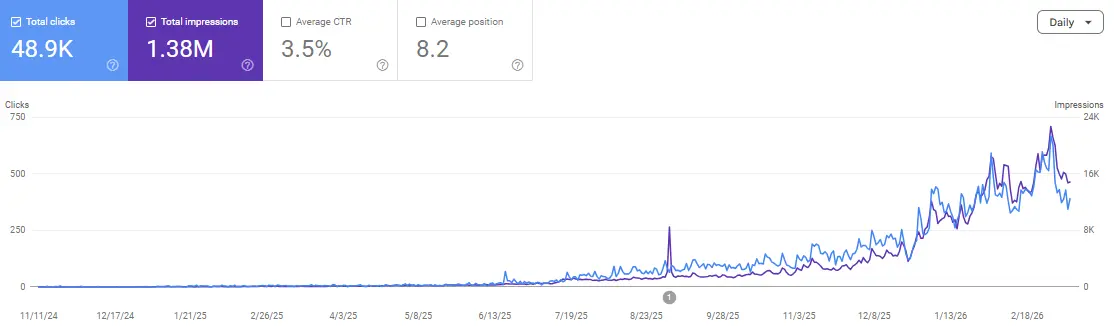
In Search Console > Performance > Search results, save clicks, impressions, CTR, and average position for complete daily periods. Segment by pages, queries, countries, devices, and search type when useful. Google’s traffic drop guide recommends comparing similar periods and checking wider demand, technical problems, and data anomalies.
Record the official launch time in Pacific Time alongside the date used by your GSC report. Standard daily Search Console reporting uses Pacific Time, while the 24-hour view can use the browser’s local timezone. Avoid treating a partial launch day or preliminary data as a clean before-and-after experiment.
Use a small, repeatable ledger instead of a screenshot with one declining line:
| Field | Record from your site |
|---|---|
| Property, timezone, exact date range, export time | ___ |
| Landing page, template, intent, and target country | ___ |
| Clicks, impressions, CTR, position, and changes from comparable periods | ___ |
| Group of similar pages that remained stable | ___ |
| Recent releases: canonical, noindex, robots, redirects, templates, server | ___ |
| Manual Actions / Security Issues status | ___ |
| Policy issue observed, with example URL and visible evidence | ___ |
| Alternative explanation and next verification step | ___ |
Compare falling pages with similar pages that remained stable. The comparison cannot prove causation, but differences in templates, query groups, or recent migrations give you something concrete to investigate.
Test the decline before you label it a spam hit
If clicks fell but impressions stayed steady
Investigate CTR, titles, search appearance, and changes in where or how users see results. A click decline with stable impressions does not by itself demonstrate spam demotion. Look at the affected queries and pages, then review the live results and demand in your important countries.
If clicks and impressions fell on one directory
Compare that directory with similar sections and look for template changes, indexability mistakes, redirects, or a fall in search demand. Check whether its highest-value queries lost visibility or simply became less popular. A content audit spreadsheet helps track URL-level findings before anyone edits or consolidates pages.
If many pages lost substantial visibility
Review the affected set at both page and site level. Google’s traffic drop guide distinguishes small changes in average position from large changes across many searches; it also notes that technical faults and seasonality can resemble ranking changes. Check crawling, canonical selection, server logs where available, recent deployment history, and Google Trends for the relevant topics.
If Search Console shows a Manual Action
Open its details and follow the Manual Actions report. Google can detect spam through automated systems and separately apply manual actions after human review. A clean Manual Actions screen means no manual action is shown; it does not prove an automated ranking system made no change.
Google’s reconsideration request documentation concerns a manual action or security issue after its documented problem has been fixed. It is not a remedy for a graph that moved during an algorithmic rollout. Do not describe every spam-update traffic drop as a “manual penalty.”
Audit real policy risks without guessing September’s targets
Google’s spam policies include scaled content abuse, deceptive practices, and link spam. These categories existed independently of the September announcement. Use them to inspect genuine weaknesses on your site, while leaving the release’s specific targets unassigned until there is evidence.
For scaled content abuse, review groups of near-identical pages created primarily to capture many keyword variations without helping readers. The policy definition applies regardless of whether software, AI, or humans produced the pages. AI assistance on its own is not an announced September violation; Scale Xpert’s discussion of AI-assisted content and Google’s quality rules explains that distinction.
For link practices, Google’s policy specifically names excessive reciprocal exchanges and links created mainly to manipulate rankings. A relevant partnership is not a reason to assume this release targets link spam, and an arbitrary disavow campaign is not a justified first response. If a site operates a link partnership community, review whether its actual placements are editorially useful and how any compensation is disclosed or qualified. Document the practice you found before changing it.
Record an example URL and the matching policy before fixing a verified violation. Preserve useful pages that merely share a format with the affected group.
What about AI Overviews and being cited as a source?
Google’s spam policies cover attempts to manipulate generative AI responses. Google has not said September specifically targets AI Overviews. Our August spam update analysis discussed similarly unconfirmed citation theories; do not turn them into September facts.
According to Google’s AI features guidance, a page must be indexed and eligible for a Search snippet to qualify as a supporting link in AI Overviews or AI Mode. Google does not require a special schema to appear. Eligibility is the starting point, not a promise that a particular answer will cite the page.
Make a page worth referencing by providing firsthand evidence. Give a study its sample and method, a comparison its source data and exceptions, and a tutorial screenshots of the steps actually tested. Scale Xpert’s guide to creating original, non-commodity source material offers ways to gather those inputs. Then label observations honestly and keep important evidence visible in indexable page text.
After rollout, a consented case study can add affected and unaffected page groups, dates, changes, and outcomes that contradicted the original theory. That would make this article more useful to cite without guaranteeing citation.
What should you do while the rollout continues?
Preserve a baseline. Investigate technical failures and verified violations as they appear, while avoiding large speculative changes that obscure the cause. After rollout ends, compare matching full periods and document the explanations that survived your checks.
Google says that after a spam update, changes may help if its systems learn over months that a site now complies with spam policies. There is no fixed recovery date to promise a client. Conversely, a short-lived fall that resolves without site changes is not proof a specific remedy worked.
When Scale Xpert members share findings, a table with dates, affected URLs, comparison pages, and rejected alternatives is more useful than a dramatic percentage without a denominator. You can compare methods in the Scale Xpert Discord community, while keeping client data private or sharing it only with permission.
Frequently asked questions
Is the September 2026 spam update already complete?
At the September 25 research cutoff, Google’s status entry showed the rollout starting on September 24 and estimated it could take up to two weeks. Recheck the dashboard for a posted completion before claiming it has ended.
Does a traffic drop on September 24 prove the update affected my site?
No. The dates overlap, but technical changes, demand, other SERP changes, and reporting anomalies can also affect performance. Compare URL groups, queries, devices, countries, and site changes.
Did Google say it targeted AI-written articles?
No September-specific target list was published in the reviewed status entry. Google’s standing policy does prohibit scaled production of unoriginal pages with little value, regardless of how they were made.
Is this a link spam update?
Google called it a spam update and did not identify a link-specific target on the status page. Link spam remains a standing policy category, so examine actual manipulative practices without assigning them to this release.
Should I delete every page that lost clicks?
No. Check impressions, search demand, technical status, and the page’s value first. Removing a useful URL from a small, inconclusive sample can destroy the evidence needed to diagnose the decline.
Can I submit a reconsideration request for an algorithmic drop?
A reconsideration request is for problems identified in a manual action or security issues notification after they have been fixed. Check those reports first; an algorithmic fluctuation alone does not create that process.
How long can recovery take after a spam update?
Google says its automated systems may need months to learn that a site now complies with its spam policies. A genuine fix has no guaranteed recovery deadline, and the rollout’s two-week estimate is not a recovery estimate.
Will following this checklist guarantee AI citations?
No. It can produce a more accurate diagnosis and more useful, verifiable content. Google sets baseline requirements for supporting AI links, but it does not offer a citation guarantee.
Conclusion
The Google September 2026 spam update is confirmed; its detailed targets and your site’s individual outcome are separate questions. Preserve the rollout dates, examine comparable Search Console data, test technical and demand-related explanations, and review a spam policy only against concrete evidence from your own pages.
The most credible SEO response is an evidence trail that can be checked later. It protects useful content, makes genuine problems easier to fix, and gives other publishers a source worth citing instead of another speculative update recap.