The Google August 2026 spam update is best treated as an enforcement update to Google’s existing spam systems, not proof of a new anti-AI rulebook. Industry coverage from Search Engine Journal, Search Engine Roundtable, and Search Engine Land reports that the rollout began on August 18, 2026 and may take several days, so early ranking movement needs careful interpretation.
The bigger question is whether the Google August 2026 spam update connects to a broader fight against authority signals manufactured to influence AI-generated answers. Google has not confirmed that theory. However, current spam policies explicitly cover attempts to manipulate generative AI responses in Search.
For practical discussion while the rollout develops, the Scale-Xpert Discord community is open for backlink exchange conversations and SEO learning without turning every ranking fluctuation into a new theory.
What Is the Google August 2026 Spam Update?
The Google August 2026 spam update is a reported global spam-system rollout intended to improve Google’s ability to detect practices that violate existing Search spam policies. Google explains that spam updates happen when it makes notable improvements to automated spam-detection systems, including its AI-based SpamBrain system.
This distinction matters because a spam update does not automatically mean a new policy. Instead, Google may become better at detecting behavior that was already prohibited. Our earlier Google June 2026 spam update analysis provides useful historical context.
Key takeaways
- Avoid panic-driven sitewide changes from first-day volatility.
- Google has not confirmed that this update specifically targets AI-generated content or AI Overviews.
- A creator analysis shared for this review suggests AI citation manipulation may be part of the context, but that remains speculation.
- Reported changes in ChatGPT’s Reddit citations do not prove a connection to Google’s update.
- Synthetic authority tactics such as manufactured Reddit or Quora activity are fragile because source trust can change.
What Has Google Actually Confirmed About Spam Updates?
Google has confirmed that automated spam systems operate continuously and that spam updates represent significant improvements to how those systems work. Google also identifies SpamBrain as an AI-based spam-prevention system that is periodically improved to recognize spam and new spam patterns.
Therefore, the safest reading of the Google August 2026 spam update is that detection changed, while the rulebook may not have changed. To understand that enforcement layer, start with how SpamBrain detects search spam.
Google’s current spam policy includes attempts to manipulate generative AI responses. In addition, scaled content abuse covers many unoriginal pages with little user value, regardless of how they are produced.
A useful evidence standard is:
| Claim type | How Scale-Xpert treats it |
|---|---|
| Official | Explicitly stated by Google |
| Reported | A credible journalist reports private confirmation |
| Observed | A dataset shows a measurable change |
| Inference | A reasonable interpretation of several signals |
| Speculation | A theory without direct confirmation |
This prevents observations from becoming invented ranking factors. In practice, the Google August 2026 spam update should be analyzed with the same evidence discipline.
Is the Google August 2026 Spam Update Targeting AI Overviews?
Google has not confirmed that the Google August 2026 spam update specifically targets spam created to manipulate AI Overviews. The theory is plausible because Google’s spam policies explicitly include manipulation of generative AI responses, but plausibility is not confirmation.
The creator analysis argues that low-quality pages and synthetic authority signals built mainly to force AI citations could be vulnerable. Meanwhile, Google’s 2026 guidance favors unique, valuable, non-commodity content instead of pages mass-produced for query variations. This makes the Google August 2026 spam update relevant to AI citation strategy, even without proof that AI Overviews are the main target.
Google also says there are no secret GEO requirements for appearing in AI Overviews or AI Mode. Pages still need to be indexable, useful, snippet-eligible, and compliant with Search policies.
Therefore, the better goal is not to “optimize for the update.” Learn how Google AI Overviews select sources and create information worth retrieving.
What Does the ChatGPT and Reddit Citation Shift Tell Us?
The reported ChatGPT and Reddit citation shift shows that AI source selection can change quickly, but it does not prove that ChatGPT and the Google August 2026 spam update changed for the same reason. No causal connection has been established.
The creator points to changes around August 8 and August 14. Separately, a Promptwatch-related report circulating on August 18 described Reddit’s ChatGPT citation share falling from roughly 3.8% to about 0.5% by August 14. Promptwatch says its datasets track billions of citation and prompt observations.
However, citation percentages depend on methodology, prompts, models, and time windows. Promptwatch’s broader data also shows that source mixes differ significantly across AI platforms.
The practical lesson is diversification. Understand how ChatGPT picks sources, but do not build an authority strategy around one platform remaining heavily cited forever.
Are Manufactured Reddit and Quora Authority Tactics at Risk?
Manufactured Reddit and Quora authority tactics are strategically risky because they create synthetic evidence instead of genuine expertise. The Google August 2026 spam update has not been confirmed as a direct crackdown on these tactics, so that distinction matters.
Examples include self-promotional Reddit recommendation threads, burner accounts, or asking and answering your own Quora question. Even if these pages gain visibility, moderation or AI source reweighting can erase it quickly.
Instead, build genuine third-party evidence through useful answers, independent mentions, transparent expertise, original research, and real community participation.
To compare ethical AI SEO and link-building approaches with other practitioners, the Scale-Xpert SEO community provides a place to exchange relevant backlinks and discuss evidence rather than manufacture consensus.
What Should You Do While the Update Is Rolling Out?
Site owners should monitor the Google August 2026 spam update and avoid broad reactions based on a few hours of volatility. This is a Scale-Xpert recommendation, not August-specific guidance from Google.
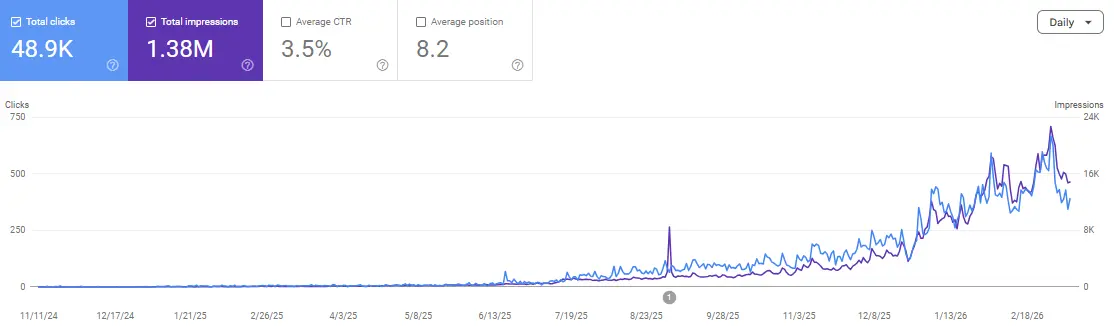
First, record a baseline in Search Console. Compare pages, queries, countries, clicks, impressions, and average position to determine whether a decline is isolated or sitewide. Google confirms that Search Console performance reporting supports these dimensions and metrics.
Then look for patterns:
- Position and impressions falling together can indicate visibility loss worth investigating.
- Clicks falling while rankings remain stable may point to CTR or SERP changes.
- One directory declining can justify a cluster-level audit.
- Many near-duplicate pages declining together can justify reviewing intent overlap and scaled-content risk.
- A Manual Actions alert requires a separate response from an algorithmic ranking change.
Finally, keep an edit log. Monitoring the Google August 2026 spam update is easier when major site changes are documented.
How Can You Make Content More Likely to Earn AI Citations?
Content is more likely to become a useful AI source when it provides unique, verifiable, well-structured information beyond what already exists. Google’s 2026 generative AI guidance explicitly recommends valuable, unique, non-commodity content and contrasts it with summaries that simply restate existing information.
For the Google August 2026 spam update, publish more than a rewritten news recap. Add an evidence ledger, first-party observations, a risk matrix, original screenshots, or a dataset comparing affected and unaffected page groups.
In addition, make important sections self-contained and answer the heading immediately. Google describes its generative Search features as using Search ranking systems and retrieval techniques to surface relevant web sources.
For citation strategy, the Google August 2026 spam update reinforces a useful editorial question: “What does this URL contribute that a model could not generate from competing articles?” If the answer is nothing, improve the page. The Scale-Xpert framework for creating non-commodity content AI cannot easily replicate applies directly.
A Practical Risk Matrix for AI Citation SEO
The strongest AI citation strategy favors durable evidence over manufactured authority. The matrix below is a Scale-Xpert editorial framework, not an official Google scoring system.
| Tactic | Risk | Better approach |
|---|---|---|
| Mass-rewriting competitor articles | High | Add original data, tests, or expert interpretation |
| Many pages for tiny query variations | High | Consolidate overlapping intent |
| Fake Reddit recommendation threads | High | Participate genuinely and disclose affiliation |
| Self-answering promotional Quora posts | High | Answer real questions with useful expertise |
| AI-assisted writing with original value | Low | Verify facts and add unique contribution |
| First-party datasets and experiments | Low | Publish methodology and limitations |
Therefore, the Google August 2026 spam update should not trigger an “AI content is dead” response. Google allows generative AI as a tool while warning against scaled output that adds little or no value.
FAQ
Is the Google August 2026 spam update an AI content update?
No. Google has not confirmed that the Google August 2026 spam update is specific to AI content. Google’s policies focus on manipulative intent and lack of value, not simply whether AI assisted the writing.
Is Google targeting AI Overview manipulation?
Google’s policies cover attempts to manipulate generative AI responses, but Google has not confirmed that AI Overview manipulation is the primary target of this rollout. Therefore, treat that claim as a hypothesis.
Did ChatGPT reduce Reddit citations because of this Google update?
There is no evidence establishing that connection. The reported Reddit decline is a parallel signal, but ChatGPT and Google Search can change independently.
Are Reddit and Quora useless for AI visibility now?
No. Genuine community discussions can still be useful, but citation exposure is volatile. Third-party monitoring shows meaningful differences between platforms.
Should I rewrite my site during the rollout?
Avoid broad reactive rewrites unless a page has a clear policy or quality problem. Instead, monitor page groups and change pages based on evidence.
Can AI-generated content still rank after the Google August 2026 spam update?
Yes. AI assistance is not automatically spam. Google says generative AI can support research and structure, while scaled AI output without added value may violate spam policies.
How long can spam-update recovery take?
Recovery can take time because Google’s automated systems need to learn that a site consistently complies with spam policies. Google says that process may take months.
Conclusion
The Google August 2026 spam update should be treated as a warning against manipulative, low-value systems, not evidence that Google has declared war on AI content. The confirmed direction is consistent: Google wants helpful original content, its spam rules cover attempts to manipulate generative AI responses, and scaled unoriginal production remains risky.
The Reddit and ChatGPT observations show how quickly AI source ecosystems can change. However, durable strategy comes from evidence, unique experience, first-party data, transparent sourcing, and information that deserves citation.
For ongoing observations after the rollout, join the Scale-Xpert backlink exchange and SEO learning hub to compare real evidence with other practitioners instead of chasing unconfirmed tactics.