How to use Google Search Console for keyword research is simple: open the Performance report, review real search queries, and use that data to improve your content. This matters for SEO because Google Search Console shows how people already find your website through Google Search.
In this guide, you will learn how to read GSC queries, impressions, clicks, CTR, and average position, then turn them into keyword ideas.
What Is Google Search Console Keyword Research?
Google Search Console keyword research means using your own search performance data to find SEO keywords and content opportunities.
Unlike keyword tools, Google Search Console does not only estimate demand. Instead, it shows query data from searches where your site already appeared.
For example, you may target “what is search volume,” but Google Search Console queries may show phrases like “search volume SEO,” “search volume meaning,” or “how search volume works.” Because of this, GSC keyword research helps you improve existing content with real search query data.
Why Use Google Search Console for Keyword Research?
Google Search Console keyword research is useful because it shows how Google already connects your pages to organic queries.
This helps beginners make better decisions after publishing content. For example, a page may receive many impressions but very few clicks, which means users saw the page in search results but did not click it often.
You can use this data to:
- Find keyword ideas from real queries
- Improve old articles
- Add missing sections
- Add FAQs based on user searches
- Improve title tags and meta descriptions
- Find pages with low CTR
- Spot keyword opportunities
- Support content optimization
In addition, GSC queries can help you avoid guessing. Instead of only asking what to write next, you can check what Google is already testing your site for.
How to Use Google Search Console for Keyword Research Step by Step
This workflow is best for beginners who already have Google Search Console connected to their website.
Step 1: Open the Search Console Performance Report
Open Google Search Console and choose your website property.
Then go to:
Performance → Search results
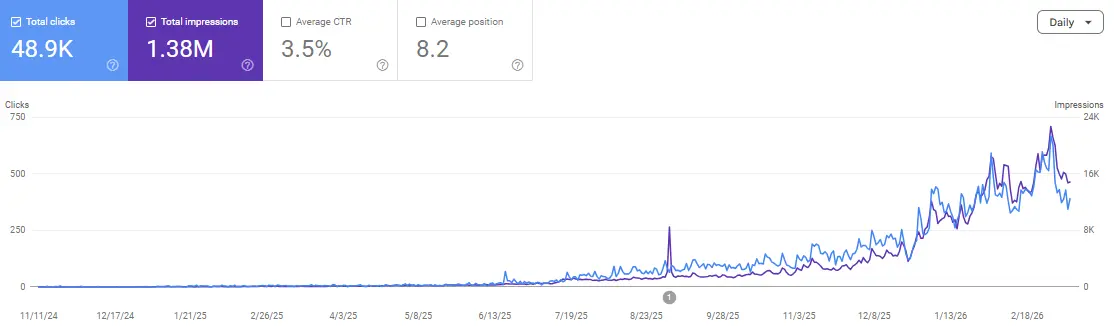
The Search Console Performance report shows important search performance metrics. These include clicks, impressions, CTR, and average position.
Start with this report because it shows the queries that caused your site to appear in Google Search.
Step 2: Set the Right Date Range
Next, choose a useful date range.
For most beginner websites, use the last 3 months or last 6 months. However, if your site has very low traffic, a longer range may give you more data.
Use date comparison when you want to measure a content update. For example, compare the last 3 months with the previous 3 months after refreshing an article.
Because SEO data changes slowly, avoid making decisions from only a few days of data.
Step 3: Review GSC Queries
Click the Queries tab under the chart.
This table shows Google Search Console queries, which are the search terms users typed when your site appeared in search results. Therefore, this is where most keyword research work begins.
Look for queries that are:
- Relevant to your page
- Getting impressions
- Getting few clicks
- Ranking near page one or page two
- Clear in search intent
- Useful for your audience
For example, if your page gets impressions for “keyword research checklist,” you may add a checklist section or create a supporting article.
How to Read Impressions, Clicks, CTR, and Average Position
Google Search Console keyword research becomes more useful when you understand the main metrics.
Impressions
Impressions show how often your page appeared in Google Search results.
High impressions mean Google sees some relevance between your content and the query. However, impressions do not mean users clicked your page.
Clicks
Clicks show how many users clicked your result.
If a query has impressions but no clicks, review the page title, meta description, and search intent match.
CTR
CTR means click-through rate.
It compares clicks against impressions. For example, if a query has many impressions but low CTR, your result may need a clearer title or stronger angle.
Average Position
Average position shows the average ranking position of your result for a query.
Use it as a guide, not a perfect ranking number. Rankings can change by device, country, personalization, and search layout.
[Screenshot placement: Add screenshot here]
What the screenshot should show: Metric cards for clicks, impressions, CTR, and average position with simple example values.
Caption: “Use the four main metrics together, not one by one.”
Alt text: “Google Search Console metrics showing clicks impressions CTR and average position”
How to Find Keyword Opportunities in GSC
The easiest keyword opportunities are often queries with impressions but low clicks.
These queries show that your page is already visible, but the result is not getting enough traffic yet. Therefore, they are good places to improve content.
Look for these patterns:
| GSC pattern | What it may mean | Best action |
|---|---|---|
| High impressions, low clicks | Title or meta may be weak | Improve title and meta description |
| Position 8 to 20 | Page is close to stronger visibility | Add better sections and internal links |
| Many related queries | Topic has more depth | Add FAQs or supporting sections |
| Query with different intent | May need a new page | Create a supporting article |
| Branded query | People know your brand | Improve brand landing pages |
For example, if your “what is search volume” article gets impressions for “search volume vs keyword difficulty,” you can add a comparison section and link to your full guide on [keyword difficulty vs search volume].
How to Use GSC Queries for Content Optimization
Use GSC queries to improve pages that already have visibility.
First, open the Pages tab and choose one article. Then switch back to the Queries tab so you only see queries for that page.
Ask these questions:
- Does the page answer the query clearly?
- Should the query become an H2 section?
- Is the query better as an FAQ?
- Does the title match the strongest search intent?
- Are internal links missing?
- Does the article overlap with another page?
For example, if your content pruning article gets queries about “update vs delete old content,” add a short comparison section. However, if the topic is large enough, create a separate article and link both pages naturally.
This process supports content optimization without creating duplicate content.
How to Turn Query Data Into Keyword Ideas
GSC queries can become new keyword ideas when the intent is clear and the topic needs more depth.
Use this process:
- Export or copy queries from one page.
- Group similar queries by search intent.
- Mark queries that are already answered.
- Mark queries that need a new section.
- Mark queries that deserve a separate article.
- Add internal links after publishing or updating.
For example, “how to use GSC queries for SEO” may fit inside this article. Meanwhile, “Google Search Console Performance report explained” may deserve a separate supporting guide.
Common Google Search Console Keyword Research Mistakes
Beginners often misuse Search Console data because they treat every query like a new article idea.
Avoid these mistakes:
- Creating a separate page for every query
- Ignoring search intent
- Trusting impressions without checking clicks
- Judging CTR without reviewing the SERP
- Treating average position as exact ranking
- Updating content after only a few days of data
- Ignoring branded queries
- Forgetting to filter by page
- Stuffing exact query phrases into content
- Ignoring internal links after updates
In addition, remember that Search Console may not show every query. Some query data can be limited, so use GSC as strong real-site data, not a complete keyword universe.
What Should You Do Next?
Start with one article that already gets impressions.
Use this beginner workflow:
- Open the Search Console Performance report.
- Set the date range to 3 or 6 months.
- Click the Pages tab.
- Choose one important article.
- Click the Queries tab.
- Find queries with impressions but low clicks.
- Group queries by search intent.
- Add missing sections, FAQs, and internal links.
- Improve the title and meta description if needed.
- Check results again after a few weeks.
Useful internal links for this article include:
FAQs
How do I use Google Search Console for keyword research?
Use the Performance report to review queries, impressions, clicks, CTR, and average position. Then use those queries to improve pages, add FAQs, update headings, and find new keyword ideas.
What are GSC queries?
GSC queries are the search terms that caused your website to appear in Google Search results. They help you understand how users actually find your pages.
Is Google Search Console keyword research better than keyword tools?
Google Search Console is better for analyzing your existing website data. However, keyword tools are better for finding broader keyword ideas before your site ranks.
How do I find keyword opportunities in Google Search Console?
Look for queries with impressions, low clicks, clear relevance, and average positions near the first or second page. These are often useful content optimization opportunities.
Can I use Google Search Console queries for new article ideas?
Yes. GSC queries can reveal questions, comparisons, and long-tail keyword ideas that your site is already connected to.
Why are some queries missing from Google Search Console?
Some queries may be hidden or limited for privacy and reporting reasons. Because of this, treat Google Search Console queries as useful data, not a complete list of every search.
Conclusion
How to use Google Search Console for keyword research comes down to reading real query data and turning it into better SEO decisions.
Use the Performance report to find GSC queries, impressions, clicks, CTR, and average position. Then improve your content with stronger headings, FAQs, internal links, titles, and meta descriptions.
Google Search Console keyword research is powerful because it shows how your site already appears in search. However, it works best when you combine it with search intent checks, keyword tools, and manual SERP review.
Want to improve your Google Search Console keyword research workflow with other beginner and semi-intermediate SEO practitioners? Join the Scale Xpert community here.