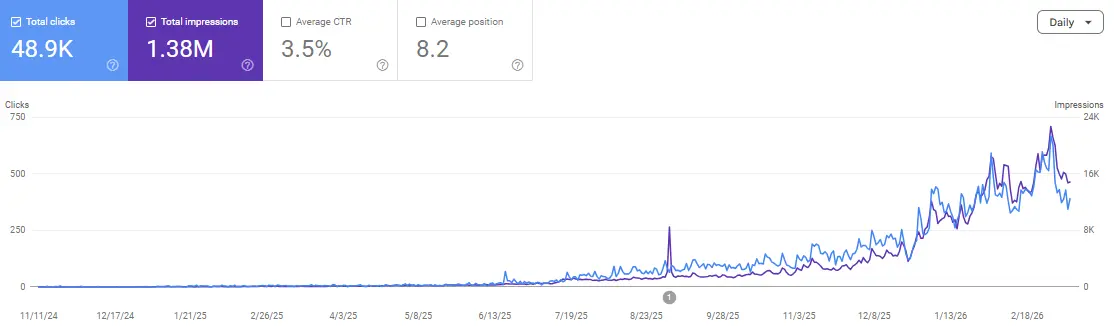
Google Search Console tracks organic traffic through clicks, CTR, and average position. Impressions are the lone exception to this organic focus. They can include data from paid search surfaces under specific, narrow conditions.
Furthermore, the modern search landscape is increasingly complex. You now face three distinct types of visibility data in Search Console: traditional organic search, AI search features like AI Overviews, and hybrid paid impressions. Treating these as a single, combined metric leads to flawed SEO decisions. This guide explains exactly what each Google Search Console metric tracks. You will discover what it excludes, why impressions behave oddly, and how to isolate the specific data you actually need.
If you are learning to interpret Search Console data alongside other SEOs and want a community to ask questions in, Scale Xpert’s Discord is built for exactly that. It is a community for learning SEO and exchanging backlinks where practitioners help each other understand data like this every day.
The Short Answer First
Google Search Console serves primarily as an organic search tool. Clicks, average CTR, and average position in the Performance Report reflect organic results exclusively. The dashboard completely excludes paid Google Ads clicks and positions.
Impressions function differently. Google defines an impression as the number of times any site URL appeared in a user’s viewed search results, excluding paid Google Ads search impressions. However, this phrasing hides a few technical edge cases. It does not state that Google excludes all paid-related elements. Blended surfaces like Shopping results can quickly blur these lines.
In 2026, a third data category complicates your reporting. The Generative AI Performance Report tracks impressions inside AI Overviews and AI Mode separately. These metrics are neither standard organic nor paid. Instead, they occupy a unique search surface with a distinct tracking logic.
What Google Search Console Definitively Tracks and Excludes
Clicks in Search Console
Clicks measure the exact number of times a user selected an organic link to your site. The platform excludes paid Google Ads clicks entirely. If a user clicks your paid ad instead of your organic listing, Search Console ignores that interaction. This rigorous filtering makes clicks your most reliable metric for pure organic traffic analysis.
Impressions in Search Console
Impressions track how often a user saw your URL in their search results page. While the official guidelines claim to exclude paid Google Ads, actual impression behavior is highly nuanced. Google blends organic results with Shopping grids, Featured Snippets, and image carousels.
The system logs an impression whenever your URL loads on screen, regardless of the format. Because organic and paid listings mix inside Shopping panels, product queries can easily inflate your total impressions.
Average CTR in Search Console
Google calculates Average CTR by dividing total clicks by total impressions. Because secondary surfaces can inflate your impressions without generating clicks, your overall CTR might look slightly deflated. This pattern mostly impacts e-commerce websites rather than simple informational blogs.
Average Position in Search Console
This metric tracks the typical numerical rank of your organic listings. It completely ignores paid Google Ads positions. The system averages this score across every query that triggers an impression. Consequently, un-targeted queries with zero traffic value can skew your overall position score.
The Three Data Types in GSC in 2026
To make accurate optimization choices, you must categorize your performance data into three distinct buckets.
Type 1: Traditional Organic Search Data
This data represents the standard blue-link results across Web, Image, Video, News, and Discover surfaces. You access this information by adjusting the Search Type filter. Separating these surfaces prevents image or video logs from masking your primary desktop text visibility.
Type 2: AI Search Feature Data
Launched in June 2026, the Generative AI Performance Report isolates impressions from AI Overviews and AI Mode. Google keeps this data entirely separate from the standard Performance Report.
This structural split is vital for accurate analysis. A page might dominate traditional organic results but fail to appear in AI summaries. Conversely, a semantically rich page might win heavy AI impressions while ranking poorly on old-school search grids. Note that this report does not track clicks yet. To understand this deeper, read our guide on what the Google Search Console AI Performance Report tracks.
Type 3: The Paid Impression Nuance
While standard Google Ads stay out of GSC, Google Shopping creates a hybrid exception. The Shopping ecosystem mixes paid ads with free organic listings. If your product appears in a free Shopping slot, Search Console records a standard organic impression. This narrow exception primarily changes how e-commerce brands evaluate their performance data.
GSC Data: Google Analytics vs. Native Search Console
Connecting Search Console to Google Analytics 4 often creates confusion because the numbers rarely match perfectly. This happens because the two platforms apply different processing rules to the same underlying data stream.
| Platform | Impression Definition | Paid Ad Treatment |
| Native Search Console | Total organic surface appearances. | Implies exclusion of ads but includes hybrid Shopping. |
| Google Analytics 4 (GA4) | Explicitly filtered search logs. | Strictly filters out paid attributes via API processing. |
Inside GA4, the Search Console acquisition reports explicitly filter out paid Google Ads impressions. In contrast, native Search Console uses a broader internal definition. These data discrepancies do not indicate a software bug. They merely reflect distinct attribution algorithms.
The Search Type Filter: Your Ultimate Diagnostic Tool
The Search Type filter acts as your best asset in the Performance Report. It allows you to isolate your performance metrics by specific Google surfaces.
You can filter by Web, Image, Video, News, Discover, Google Maps, or Shopping. By default, the dashboard groups all search surfaces together. This combined view frequently skews your data interpretations. Always set the filter to Web to view clean, uninflated organic search metrics. If your numbers drop significantly after applying this filter, other visual surfaces were inflating your counts.
Why This Distinction Matters for SEO Decisions
Misinterpreting these numbers causes costly optimization mistakes. Watch out for these four common analytical traps:
-
Confusing AI Growth with Organic Success: A huge spike in the Generative AI Performance Report does not mean your traditional rankings improved. It simply means you won an AI Overview slot.
-
Misdiagnosing CTR Drops: If hybrid Shopping impressions increase, your average CTR will naturally drop. Changing your title tags to fix this drop is a mistake. The issue is a shift in your impression mix, not bad copy.
-
Misattributing Update Success: Content adjustments might coincide with a global expansion of AI Overviews. If you look only at raw impressions, you might credit your edits instead of Google’s systemic shift.
-
Chasing GA4 Discrepancies: Wasting hours trying to align native GSC data with GA4 reports is pointless. Their internal definitions differ by design.
A Practical Workflow for Reading GSC Traffic Data Correctly
Follow this technical sequence to analyze your data accurately:
-
Select Your Master Tool: Choose either native GSC or GA4 for your specific analysis session. Never mix their numbers.
-
Isolate the Surface: Apply the Web filter inside the Performance Report to view baseline organic data.
-
Audit AI Metrics Separately: Check the Generative AI Performance Report in its own silo to monitor AI Overview trends.
-
Run Period Comparisons: Compare the last 28 days against the previous period across both reports to trace clean visibility trends.
-
Verify Clicks Against Impressions: If your impressions spike while clicks flatline, you are gaining visibility on low-CTR surfaces like Discover or Image search.
To master these operational workflows, review our complete guide to what Google Search Console is and how to use it.
How to Verify What Type of Traffic You Are Looking At
Use these rapid diagnostic steps to verify any mysterious traffic shifts:
-
Toggle the Web Filter: Apply the Web search type. If the traffic spike vanishes, a secondary surface caused it.
-
Inspect the AI Dashboard: Check if the shift aligns with your AI Overviews data. Google expanded AI Overviews significantly across late 2025 and early 2026.
-
Analyze Query Intent: Review the Queries tab. Transactional phrases often trigger hybrid Shopping impressions, while informational terms trigger AI features.
-
Cross-Reference Google Ads: Check your live ad accounts. A simultaneous jump in paid impressions indicates a broader market trend, not an organic SEO shift.
FAQs
Does Google Search Console show paid traffic from Google Ads?
No. The platform excludes paid Google Ads clicks and positions entirely. It focuses strictly on organic channels.
Why do my impressions increase without a corresponding increase in clicks?
This layout happens when you win visibility on low-CTR surfaces like Discover, Image Search, or AI Overviews. Use the Search Type filter to isolate the exact source.
Is the Search Console data in Google Analytics the same as in Search Console itself?
No. The platforms apply different data-filtering rules and attribution systems. Expect minor variations between them.
What does the Search Type filter do in the Performance Report?
It separates your search performance metrics by individual surfaces like Web, Image, Video, and Shopping.
How do AI Overviews impressions appear in Search Console?
They appear exclusively inside the Generative AI Performance Report. Standard performance dashboards do not include them.
Why is my average CTR lower than I expect based on my rankings?
The metric averages every single impression your site receives. Low-ranking terms down on page two or three drag down your score.
Can I see both organic and AI impressions together in one view?
No. Google separates these datasets due to their wildly different user click behaviors.
Conclusion
Google Search Console serves as a pure organic diagnostic engine. While clicks and rankings remain completely free of paid data, impressions include modern hybrid surfaces. The introduction of the June 2026 AI reporting tools forces us to segment our data across three distinct pillars. To build a reliable optimization strategy, you must use the Search Type filters and audit AI metrics independently.
Want to talk through your Search Console data with SEOs who are working through the same questions? Scale Xpert’s Discord is a community for learning SEO properly and building backlinks together.