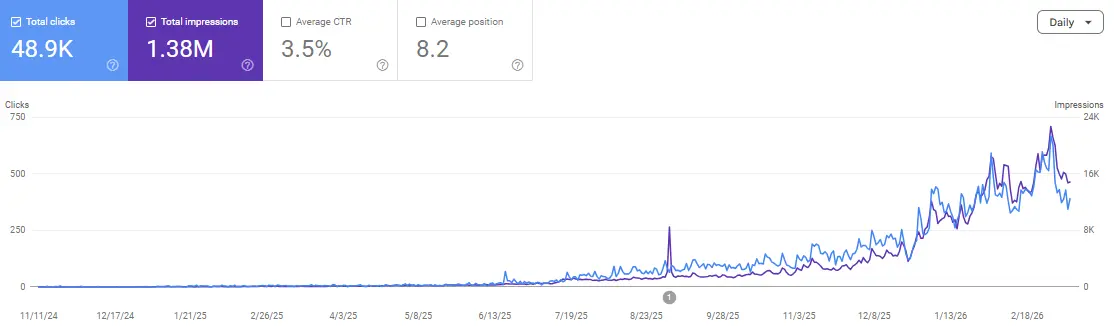
Your Google Search Console AI Performance Report is not a passive dashboard to glance at monthly. It is a diagnostic engine. It tells you exactly which pages Google’s AI retrieval system considers worth citing and which ones it completely ignores.
To learn the absolute basics of this dashboard first, read our Google Search Console AI Performance Report: Complete Guide for SEOs and Publishers.
Once you know the fundamentals, you must learn to read this data actively. Connecting these metrics to specific content and link-building decisions turns an interesting novelty into a powerful optimization lever. This guide covers the practical workflow for translating your AI impressions data into actions that boost your AI search visibility. Test your optimization wins with peers: Scale Xpert is a community where SEOs master organic strategy. If you want to test how your link adjustments affect your AI impressions alongside practitioners running the same experiments, join us on Discord.
Start with the Pages View: Your Master Dataset
The Pages dimension is your most strategically valuable view. It shows you the specific URLs Google’s AI systems retrieve. Open your report and switch to the Pages tab immediately.
[Open GSC AI Report] ──► [Select Pages Tab] ──► [Sort by Impressions Descending] ──► [Isolate Top 10 Blueprint URLs]
Sort your data by impressions in descending order. Your top five to ten pages represent Google’s current benchmark for authority. These URLs succeed at a structural, contextual, or authority level. Understanding their shared traits is the fastest way to replicate success across your site.
Analyze these top URLs and audit the following elements:
-
The literal length and structure of the copy.
-
The presence of explicit formatting elements like tables or bullet points.
-
The comparative strength of their backlink profiles.
-
The specific nature of their information density.
-
The date of their last major content refresh.
The common denominators you discover form your optimization blueprint.
Identifying Gaps Between Organic Rankings and AI Impressions
Once you map your top AI pages, isolate the assets that perform poorly inside generative search despite ranking well organically.
Pull your top-performing URLs from the traditional Search Console Performance Report. Cross-reference them directly against your AI impression data.
Pages that sit comfortably in your organic top 20 but fail to log AI impressions reveal a critical disconnect. Google’s traditional core ranking algorithm and its AI retrieval systems disagree about your authority. This disagreement is highly diagnostic.
The Content Depth Deficit
This disconnect typically happens for two reasons. First, some pages rank organically through historic backlink signals but lack content depth. A page with 50 old referring domains pointing to a thin, 400-word article can still hold a traditional ranking slot.
However, AI retrieval systems evaluate content at the chunk level. The system will bypass your page if your sections are too shallow to answer a complex sub-query natively. To understand why this happens, look into Why RAG is the Foundation of AI SEO Visibility.
The Semantic Breadth Deficit
Second, traditional pages often rely too heavily on exact-match keyword targeting. This approach lacks the semantic breadth that modern AI frameworks require.
For example, an old-school page optimized strictly for “best SEO tools” might only cover three platforms in brief detail. This asset will lose AI citations to a comprehensive page that evaluates 15 tools across distinct corporate use cases. This remains true even if the deeper page holds a lower traditional ranking.
These explicit data gaps provide clear, highly testable optimization targets.
A 4-Step Diagnostic Sequence for Low-Impression Pages
For every high-organic, low-AI-impression page you uncover, run this exact four-step quality audit.
1. Audit Heading Structure
Open the target page and analyze your H2 and H3 tags. Do they function as clear questions or explicit sub-topic answers?
AI engines look for distinct textual chunks. A well-defined H2 section that directly addresses an intent point is highly retrievable. Decorative or ambiguous headings fail completely.
[Bad Heading]:  "Why This Matters" ──────► (AI crawler ignores / cannot contextualize)
[Good Heading]: "What Is the Difference Between Dofollow and Nofollow Links?" ──► (AI crawler extracts cleanly)
2. Check for Conversational FAQ Elements
Pages featuring clearly labeled FAQ blocks consistently outperform assets that lack them. This is not just a stylistic preference.
FAQs naturally generate concise text blocks that match the semantic layers created during AI processing. Learn more about how Google fragments complex searches by reading Query Fan-Out: How Google AI Search Finds Answers From Many Pages at Once.
3. Evaluate Information Specificity
Vague, high-level commentary is entirely useless to an AI retrieval model. A sentence stating that “email marketing provides a strong return on investment” can be easily paraphrased from thousands of sites. It will not earn a specific citation.
Instead, use data-rich language: “A 2026 industry study analyzing 2,000 corporate campaigns recorded an average ROI of $36 for every dollar spent.” Specific, verifiable data points win citations.
4. Benchmark the Backlink Profile
Compare the link volume of your high-AI pages against your low-AI pages using an external index. If your top AI assets show a clear pattern of relevant, editorial citations, it confirms that your link profile directly powers your AI visibility.
When executing an outreach campaign to fix this, understanding what makes a backlink look natural to search engines is critical. The exact quality signals that protect you from traditional penalties also validate your content inside generative engines.
Content Updates That Directly Move AI Impressions
You can run targeted optimizations to improve a page’s retrieval score. Use the date dimension in your Search Console report to monitor the success of these four specific content upgrades.
Restructure Content Around Questions
Rewrite standard topic labels into direct, clear question formats. This creates clean semantic boundaries that align with generative extraction patterns.
Build Rich FAQ Blocks and Deploy Schema
Add a dedicated FAQ section to the bottom of your core page. Ensure every individual answer provides a comprehensive response within two to four sentences.
Pair this addition with correct technical markup. To see how these background code signals alter your visibility metrics, read our evaluation on Does Structured Data Help AI Search? Google’s Official Answer for 2026.
Inject Non-Commodity Value
Purge generic industry fluff. Replace predictable phrasing with original data, case studies, and comparison frameworks.
To separate your brand from programmatic text junk, study Commodity Content vs Non-Commodity Content: What Kind of Content Does AI Actually Want?. Once you master those concepts, use our guide on How to Create Non-Commodity Content That Is Genuinely Hard for AI to Replicate.
Secure Contextual Editorial Backlinks
Acquiring editorial links remains your most durable competitive advantage. A single backlink from an authoritative, niche-relevant publication moves your AI impression metrics more reliably than superficial copy updates.
How to Run Before-and-After Testing via the Dates Tab
The Dates dimension is your scientific baseline. Do not guess whether an on-page optimization worked. Use a rigid, time-bound testing workflow to measure results.
-
Isolate Baseline Metrics: Record the exact AI impression volume of your target URL for the previous 28 days.
-
Log the Optimization Date: Document the precise day you pushed your content changes live.
-
Submit for Reindexing: Use the GSC URL Inspection tool to request a fresh crawl.
-
Monitor in Intervals: Track data changes at two-week intervals over a two-month period.
[Day 0: Log Baseline & Push Edit] ──► [Day 14: Check Crawl Status] ──► [Day 28: Evaluate Impression Shift]
AI impression adjustments typically populate within two to four weeks of a successful recrawl. Track your adjustments in an internal log. Note the exact optimizations made alongside pre- and post-test impression metrics.
Over time, this spreadsheet becomes your team’s custom playbook. Your site’s data will reveal exactly how responsive your specific niche is to structural updates.
Decoding Data Gaps: A Strategic Matrix
Comparing your AI Performance report against standard organic metrics reveals four distinct performance combinations. Use this matrix to guide your response.
| Performance Mix | Root Cause Diagnosis | Required Strategic Action |
| High Organic CTR / Low AI Impressions | URL satisfies a purely transactional or navigational intent that requires no AI synthesis. | Do nothing. Transactional landing pages do not need informational AI visibility to convert. |
| High AI Impressions / High Organic CTR | The ultimate win. Your URL satisfies both standard rankings and generative retrieval frameworks. | Protect the asset. Maintain its link velocity. Avoid making major structural edits. |
| High AI Impressions / Low Organic CTR | The page is heavily cited, but the AI summary completely satisfies the user’s intent, causing zero-click behavior. | Evolve the page. Introduce deep interactive tools, downloadable assets, or original reports to draw users to your site. |
| Low AI Impressions / Low Organic CTR | The URL is underperforming across both search environments due to low authority or weak formatting. | Consolidate or rewrite. Perform a major content upgrade or merge it into a stronger asset. |
The zero-click pattern highlights a wider shift toward Agentic Search: When AI No Longer Just Reads Web Pages. As search tools begin synthesizing multi-page data natively, you must adapt. Building a unified SEO content strategy helps you navigate these systemic traffic shifts.
Prioritizing Link Building Using AI Impression Thresholds
You can use your AI Performance Report to maximize the ROI of your link-building campaigns. The link between backlink authority and AI impressions operates as a virtuous cycle.
[High-Quality Backlinks] ──► [Higher AI Impressions] ──► [More Brand Citations] ──► [Organic Link Growth]
Focus your outreach efforts on pages that already show modest AI visibility rather than scattering links blindly across your domain. If a URL sits just outside your top five AI pages, it is already recognized as highly relevant by Google’s systems.
Securing two or three editorial backlinks for these specific pages can push them past the retrieval threshold. This velocity triggers consistent AI citations within a few weeks.
For pages with zero AI impressions, evaluate whether you face an authority barrier or a formatting issue. If neighboring URLs within the same topic cluster enjoy strong AI impressions, your content layout is likely fine, meaning link authority is your primary bottleneck.
Use a clean topical authority building framework to group your link-building assets. Funneling high-tier editorial links into a specific cluster validates your expertise across that entire topical domain simultaneously.
FAQs
What does a sudden spike in AI impressions mean?
A spike means Google’s generative models have mapped your content to a high-volume query cluster. This indicates your information density and semantic structure closely match current user intent trends.
How does content depth impact AI visibility?
AI retrieval engines select comprehensive, authoritative pages. Building comprehensive guides protects your site as search behaviors shift. For a full breakdown of this topic, read Why Deep Content Is More Important Than Ever in the AI Search Era.
Can I optimizhttps://www.google.com/search?q=https://scale-xpert.com/why-deep-content-matters-ai-search-era/e for AI search without changing my traditional SEO strategy?
No. The core ranking signals are deeply intertwined. The structural optimizations and premium link profiles required to win AI impressions are the exact same factors that drive standard organic visibility.
How do I prepare for broader global rollouts of this report?
Focus heavily on structural clarity, natural link acquisition, and information depth. To see how these pillars fit into Google’s long-term timeline, read our analysis on How Google AI Search at I/O 2026 Changes SEO Strategy Forever.
Conclusion
The Google Search Console AI Performance Report provides a direct feedback loop for tracking your generative search footprint. Actively reviewing this data lets you stop guessing and start measuring.
Your highest-impression URLs show you exactly what Google’s retrieval engines prefer. Meanwhile, your performance gaps pinpoint where your content lacks structure or authority. Use these metrics to continuously upgrade your on-page schema, track updates, and secure a resilient search presence.
Want to break down your live AI impression trends with other webmasters? Join us over at the Scale Xpert Discord to share data insights, optimize link campaigns, and track the global report rollout with technical marketers.