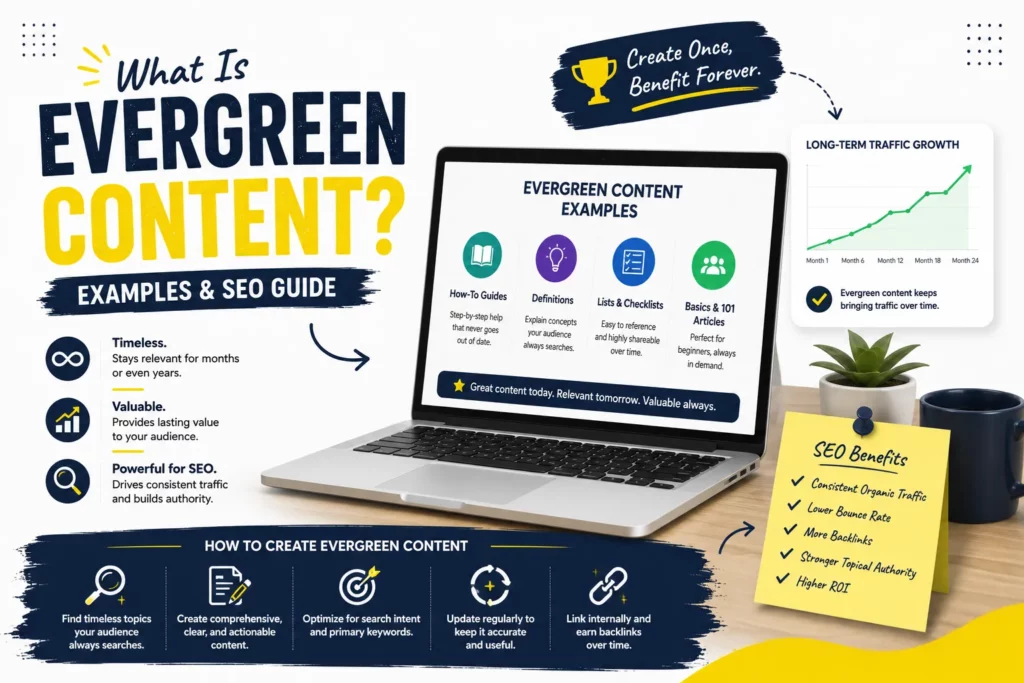
What is evergreen content? It is content that remains useful and relevant long after publication because it answers a recurring question or solves an ongoing problem.
Definitions, tutorials, checklists, and beginner guides often fit this description. However, a timeless topic does not mean an article can be published once and ignored forever. Links, screenshots, tools, statistics, and recommendations may still become outdated.
For feedback while planning long-term articles, you can join an SEO discussion community and exchange ideas with other website owners and content creators.
Quick Answer
Evergreen content is a long-lasting resource built around a topic with recurring audience interest. Common examples include how-to guides, definitions, reference pages, templates, and educational checklists.
Although these resources can attract traffic for months or years, they still require occasional updates to remain accurate, useful, and competitive.
What Evergreen Means in Content Marketing
In content marketing, “evergreen” describes information that does not depend heavily on a specific event, date, trend, or announcement.
For example, a guide explaining how keyword research works can remain useful because new website owners continue searching for the topic. In contrast, an article about a recent search algorithm announcement may lose relevance once the news cycle ends.
Therefore, the goal is not to remove every date or current example. Instead, it is to build the article around a problem that people will continue experiencing.
Evergreen Topics vs Evergreen Content
An evergreen topic and an evergreen article are related, but they are not identical.
| Term | Meaning |
|---|---|
| Evergreen topic | A subject with stable, recurring interest |
| Evergreen content | A useful resource created around that subject |
| Fresh evergreen resource | A long-lasting page that remains accurate and competitive |
| Outdated evergreen resource | A page targeting a timeless subject but containing old information |
For example, “how to perform keyword research” is a recurring topic. A detailed keyword research guide can serve that demand for years.
However, the article may become outdated when its screenshots, recommended tools, or instructions no longer match current platforms.
Timeless vs Trending vs Seasonal Content
Not every article is either completely timeless or completely temporary.
| Content type | Demand pattern | Example | Update requirement |
| Evergreen | Relatively stable | What is anchor text? | Occasional accuracy updates |
| Trending | Sudden, short-lived interest | New search algorithm announcement | Immediate and frequent updates |
| Seasonal | Returns at specific times | Black Friday SEO checklist | Refresh before each season |
| Hybrid | Stable subject with changing details | Best SEO tools | Regular feature and price updates |
Each type can support a successful content strategy. However, they serve different purposes.
Trending posts may generate rapid exposure, while durable resources can create a more consistent foundation for organic visibility.
Examples of Content That Stays Relevant
Several formats are well suited to recurring search demand.
Definitions and Beginner Guides
Definitions help new readers understand important concepts. Since new people enter an industry regularly, clear educational resources may continue receiving searches.
Examples include:
- What is on-page SEO?
- What is off-page SEO?
- What is technical SEO?
- What is organic traffic?
- What is anchor text?
How-To Tutorials
Step-by-step tutorials solve recurring problems.
For example, people will continue searching for information about improving website traffic, researching keywords, starting a blog, or fixing common SEO problems.
Checklists and Templates
Checklists turn complicated processes into repeatable actions. In addition, templates give readers something practical they can use immediately.
Examples include:
- SEO audit checklist
- Content brief template
- Blog publishing checklist
- Outreach email template
- Keyword-mapping worksheet
Reference Resources
Glossaries, statistics pages, calculators, and original studies can also become long-term content assets.
However, reference pages often need more frequent maintenance because data, definitions, and external sources can change.
What Is Not Fully Evergreen?
Some formats become outdated quickly because their value depends on current information.
Examples include:
- Weekly industry news
- Event announcements
- Monthly traffic reports
- Current social media trends
- Annual product rankings
- Time-sensitive promotions
- Articles about a specific software release
A “best SEO tools” article is only partially evergreen. The general topic remains relevant, but pricing, features, screenshots, and recommendations may change regularly.
Therefore, avoid describing an article as evergreen only because the central subject has long-term interest.
Why Long-Lasting Content Matters for SEO
Evergreen content can support long-term SEO when it continues satisfying recurring search intent.
Google does not publish a special “evergreen content” ranking factor. Instead, its guidance focuses on helpful, reliable, people-first information that provides substantial value and leaves readers feeling they have learned enough to achieve their goal.
A strong long-term resource can provide several benefits.
Recurring Organic Traffic
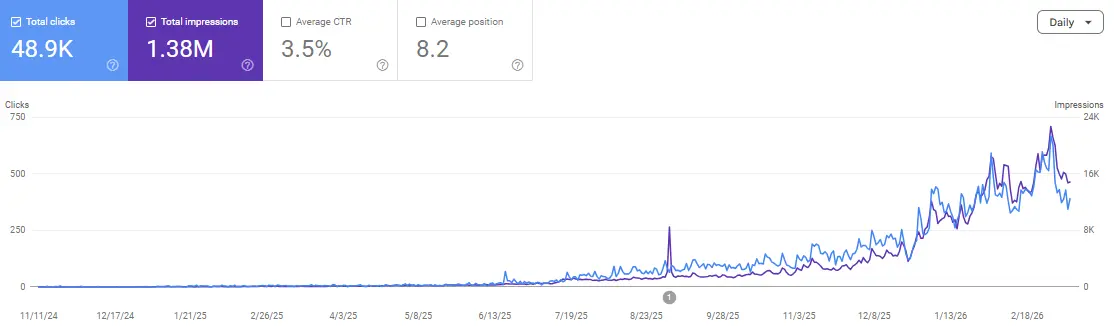
Topics with steady demand may continue attracting impressions and clicks after the initial publication period.
As a result, one useful article can contribute to organic website traffic for an extended time.
More Efficient Content Investment
News content may require constant publishing to maintain traffic. In comparison, a durable guide can continue producing value between updates.
However, long-term performance still depends on relevance, competition, authority, internal links, and maintenance.
Natural Backlink Opportunities
Detailed tutorials, original research, templates, and reference resources are easier for publishers to cite than short generic posts.
Therefore, creating useful long-term assets can support your efforts to earn more relevant backlinks.
Stronger Topical Coverage
A collection of connected definitions, tutorials, and supporting resources can help readers explore a subject in greater depth.
In addition, contextual internal links make it easier for visitors and search engines to discover related pages.
How to Find Evergreen Topic Ideas
Start by looking for questions that your audience asks repeatedly.
Useful sources include:
- Keyword research tools
- Google Search Console
- Google Trends
- Customer-support conversations
- Community discussions
- People Also Ask results
- Competitor content
- Sales and onboarding questions
Next, evaluate each idea with these questions:
- Will people still have this problem next year?
- Does the answer depend on a specific event or version?
- Is search demand stable or temporary?
- Can the article be updated realistically?
- What content format matches the search intent?
- Can you add something more useful than existing results?
For example, “what are keywords in SEO?” addresses a recurring beginner question. Meanwhile, “the most popular keywords this week” is time-sensitive.
How to Create Evergreen Content
A long-lasting article requires more than selecting a broad topic.
Step 1: Confirm Recurring Demand
Use keyword data, trend history, community questions, and Search Console information to determine whether interest is likely to continue.
However, avoid choosing a topic only because it has high search volume. It must also fit your audience and website.
Step 2: Match Search Intent
Review the current search results to understand whether users expect a definition, tutorial, comparison, checklist, template, or tool.
For example, a brief definition will struggle when readers clearly want a complete implementation guide.
Step 3: Cover the Topic Completely
Answer the central question early. Then add the examples, process, mistakes, tools, and frequently asked questions required to help readers complete their goal.
Google recommends creating substantial and complete content rather than simply rewriting obvious information from other pages.
Step 4: Add Original Value
Strengthen the article with elements competitors cannot copy easily, such as:
- First-hand experience
- Original screenshots
- Templates
- Checklists
- Case studies
- Expert commentary
- Original research
- Examples from your website
Step 5: Optimize the Page Naturally
Use a descriptive title, one H1, organized H2 and H3 headings, concise paragraphs, and relevant image alt text.
In addition, apply the principles from this on-page SEO guide without repeating the exact keyword unnaturally.
Step 6: Build Contextual Internal Links
Connect the page to definitions, supporting tutorials, and deeper guides.
Descriptive links create a clearer learning path than vague anchors such as “read more” or “click here.”
Step 7: Plan Future Updates
Before publishing, record the elements that may expire:
- Screenshots
- Tool interfaces
- Prices
- Product features
- Statistics
- External links
- Recommendations
- Search-engine documentation
This makes future content refreshes faster and more consistent.
How to Keep Evergreen Content Fresh
Publishing is only the beginning.
Review long-term resources when you notice:
- Declining impressions or clicks
- Falling keyword positions
- Outdated screenshots
- Broken links
- Old data or statistics
- Changed products or tools
- New competing subtopics
- Search-intent changes
- Missing internal links
- Questions the article does not answer
A practical review schedule might be:
- Every 3 to 6 months for tool guides
- Every 6 to 12 months for SEO tutorials
- Annually for stable definitions
- Immediately after an important change
Do not change the publication date without making meaningful improvements. Instead, update the content, document the changes, and show an accurate modification date.
How to Measure Performance
Use Google Search Console and analytics data to monitor:
- Organic impressions
- Organic clicks
- Click-through rate
- Average position
- Ranking queries
- Organic sessions
- Backlinks and referring domains
- Engagement
- Conversions
- Performance before and after updates
Search Console defines impressions, clicks, and position as separate performance metrics, so review them together rather than relying on only one number.
Additionally, compare longer periods such as six or twelve months. Weekly changes may be influenced by seasonality, competition, search features, and algorithm updates.
Common Mistakes to Avoid
Even useful topics can perform poorly when the execution is weak.
Avoid:
- Treating “evergreen” as “never update”
- Adding the current year without a real reason
- Choosing topics with no recurring demand
- Ignoring search intent
- Rewriting competitors without original value
- Using outdated screenshots and statistics
- Publishing thin definitions
- Forgetting contextual internal links
- Measuring results after only a few days
- Overusing the exact focus keyword
Evergreen Content Checklist
Before publishing, confirm that:
- The topic has recurring audience interest.
- The article matches the correct search intent.
- The introduction answers the main question.
- The content includes useful examples.
- The guide adds original value.
- Titles and headings are descriptive.
- The exact keyword appears naturally.
- Relevant internal links are included.
- External claims have reliable sources.
- Images have descriptive alt text.
- Potentially outdated sections are documented.
- A future review date is scheduled.
- Performance can be measured in Search Console.
- The page works properly on mobile.
- The article has one clear H1.
FAQs
What is evergreen content in simple terms?
Evergreen content is information that remains useful for a long period because it answers a question or solves a problem people repeatedly experience.
What are common evergreen content examples?
Common examples include definitions, beginner guides, tutorials, checklists, templates, glossaries, and reference resources.
Is evergreen content good for SEO?
It can support long-term SEO when the topic has recurring demand and the page remains helpful, accurate, competitive, and accessible.
However, being timeless does not automatically guarantee high rankings.
Does evergreen content need to be updated?
Yes. Even when the central topic remains relevant, screenshots, links, tools, statistics, and recommendations may change.
How often should evergreen articles be refreshed?
The right frequency depends on the topic. Stable definitions may need annual reviews, while tool and platform guides may require updates every few months.
How can I find evergreen topics?
Review keyword trends, Search Console queries, community questions, customer-support requests, and recurring problems in your industry.
Are “best products” articles evergreen?
They are usually hybrid content. The core demand may remain stable, but product availability, prices, features, and recommendations require regular updates.
What is the difference between evergreen and trending content?
Evergreen topics have relatively stable, recurring interest. Trending content receives attention because of a recent event, announcement, or short-lived discussion.
Yes. Tutorials, explainers, and reusable tips may remain valuable over time. However, social distribution is often more feed-driven and time-sensitive than search traffic.
Does evergreen content guarantee long-term traffic?
No. Traffic also depends on competition, content quality, authority, technical accessibility, search demand, and regular maintenance.
Conclusion
Understanding what is evergreen content helps you build a content library that continues serving readers after the initial publication period.
Start with a recurring audience problem, match the correct search intent, provide a complete answer, and add something original. After publishing, monitor performance and refresh outdated sections before content decay becomes severe.
To compare topic ideas, discuss content-refresh decisions, or get feedback on a long-term content plan, join the SEO community conversation and learn alongside other website owners.