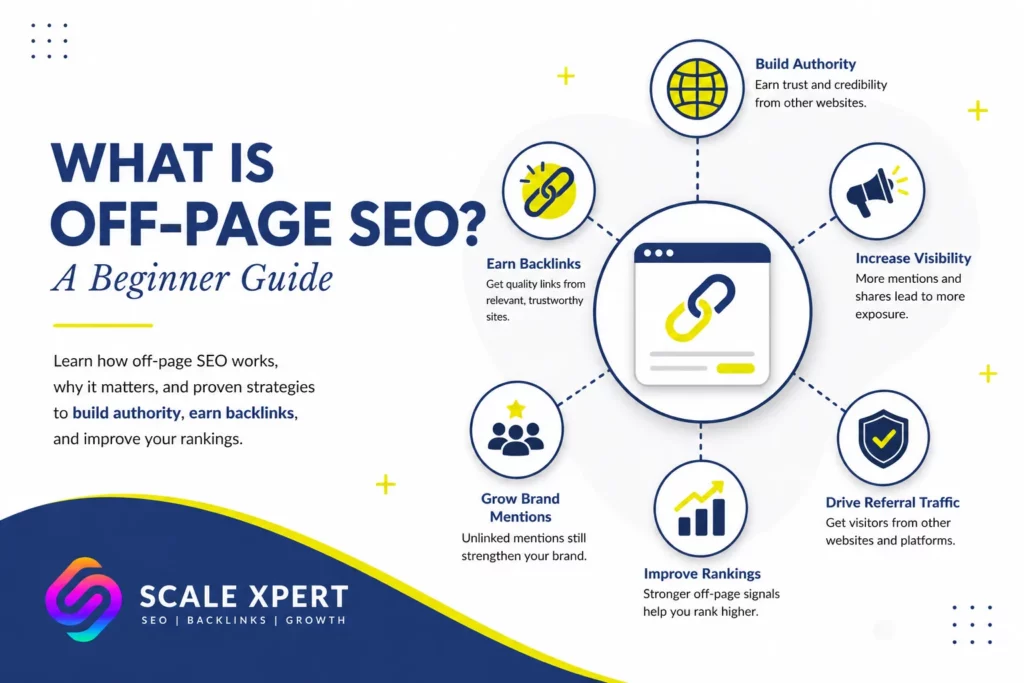
What is off-page SEO? It refers to activities performed outside your website to improve its authority, reputation, and organic search visibility. These activities include earning relevant backlinks, gaining brand mentions, using digital PR, collecting genuine reviews, and maintaining accurate business citations.
Unlike on-site improvements, you cannot control every external signal directly. However, you can create valuable content, build relationships, and promote your expertise in ways that encourage other people to discuss or reference your website.
For practical ideas and feedback, you can join the SEO discussion community and connect with website owners working on similar authority-building campaigns.
What Is Off-Page SEO in Simple Terms?
Off-page SEO is the process of building trust and recognition for a website across the wider internet. In simple words, it covers what other websites, publications, platforms, and customers communicate about your business.
Common external signals include:
- Backlinks from relevant websites
- Unlinked brand mentions
- News coverage and digital PR
- Customer reviews
- Local business citations
- Community discussions
- Referral traffic
- Branded searches
Therefore, off-site SEO is not simply a link collection exercise. It is a broader process of earning authority, visibility, and a positive reputation.
Why External Authority Matters
Your website can describe itself as useful and trustworthy. However, recommendations from independent sources may provide additional evidence that people value your content, expertise, or services.
A strong off-page SEO strategy can help you:
- Build website authority
- Improve brand awareness
- Earn targeted referral traffic
- Attract links from relevant publishers
- Strengthen trust with potential customers
- Support long-term search visibility
In addition, external exposure can introduce your brand to audiences who would not find it through search results alone.
On-Site vs Off-Site Optimization
On-page and off-page SEO support different parts of organic growth.
On-page optimization includes changes made directly to a page, such as titles, headings, content, images, internal links, and URLs. You can learn more in this guide to on-page SEO elements and implementation.
Off-page optimization focuses on signals created beyond your own domain. These include links, mentions, reviews, public relations, local listings, and professional relationships.
In simple terms:
- On-page SEO helps search engines understand your content.
- Off-page SEO helps build trust and authority around that content.
- Technical SEO helps search engines access, crawl, and index the website.
Although each area has a different purpose, they work best together.
The Most Important Off-Page SEO Factors
Several external signals can contribute to online authority. However, their value depends on quality, relevance, context, and authenticity.
1. Relevant Backlinks
Backlinks are links from other websites that point to your pages. They can act as recommendations when they appear naturally within useful and relevant content.
A valuable backlink usually:
- Comes from a trustworthy website
- Appears on a relevant page
- Fits naturally within the surrounding content
- Uses appropriate anchor text
- Offers value to real readers
- Has the potential to send referral traffic
Quality matters more than quantity. Therefore, ten relevant editorial links can be more useful than hundreds of links from unrelated or low-quality websites.
Beginners can first review what backlinks are and how they work before starting outreach.
2. Brand Mentions
A brand mention occurs when another website, publication, forum, or social account discusses your company or content.
Not every mention includes a link. Nevertheless, unlinked mentions can increase awareness, encourage branded searches, and create future link opportunities.
You can also contact publishers who already mention your brand and politely ask whether adding a useful link would improve their content.
3. Digital PR
Digital PR involves promoting original research, expert commentary, data, tools, or stories to journalists and online publications.
For example, an SEO company might publish a study comparing click-through rates across different industries. It could then share the findings with marketing publications, newsletter writers, and industry journalists.
As a result, one strong campaign may generate:
- Editorial backlinks
- News coverage
- Brand mentions
- Referral traffic
- Expert citations
- Social discussion
4. Reviews and Online Reputation
Reviews influence how potential customers evaluate a business. Moreover, genuine feedback can improve trust across local platforms, marketplaces, and industry directories.
Ask customers for honest reviews at appropriate moments. However, avoid buying reviews, offering misleading incentives, or creating fake accounts.
Responding professionally also matters. A helpful response shows that the business values customer feedback, even when the original review is negative.
5. Local Citations
A local citation is an online reference to a business name, address, and phone number. These references commonly appear in map services, business directories, local associations, and industry listings.
Consistency is important. Therefore, businesses should correct outdated phone numbers, addresses, opening hours, and duplicate profiles.
6. Community Participation
Professional communities, forums, events, and niche groups can introduce your expertise to relevant audiences.
The goal should not be to place links in every discussion. Instead, answer useful questions, share real experience, and contribute when your knowledge fits the conversation.
Over time, genuine participation can lead to relationships, brand mentions, collaborations, and natural backlinks.
Practical Off-Page SEO Examples
Imagine a small marketing website publishes an original study about how title length affects organic click-through rates.
The team then:
- Shares the research with relevant bloggers.
- Pitches the findings to marketing journalists.
- Discusses the methodology in professional communities.
- Creates simple charts that other writers can reference.
- Contacts websites that have covered similar studies.
Over time, the page receives editorial backlinks, unlinked brand mentions, community discussions, referral visitors, and increased branded searches.
This is a complete off-page SEO example because it combines valuable content, promotion, public discussion, and earned recognition. The team is not simply purchasing links. Instead, it is giving other people a genuine reason to cite the research.
Practical Methods for Beginners
You do not need to use every technique at once. Start with methods that match your resources, audience, and expertise.
Create Link-Worthy Resources
Publish content that offers something worth referencing, such as:
- Original research
- Statistics
- Free tools
- Templates
- Detailed tutorials
- Industry surveys
- Comparison studies
- Expert interviews
A basic article that repeats common advice may struggle to earn attention. However, a resource containing original value has a stronger chance of attracting links.
Study Competitor Backlinks
Competitor research can reveal publications, directories, resource pages, and writers that already cover your subject.
Use this guide to find backlinks to a website for free and identify realistic opportunities rather than contacting random domains.
Use Guest Posting Selectively
Guest posting can provide exposure when the website is relevant, active, and useful to its audience.
Before pitching, review the site’s recent posts, audience, outbound links, and editorial quality. In addition, propose a topic that fills a real content gap.
This guide explains how to find relevant guest-posting opportunities without relying only on generic lists.
Build Relationships Before Asking
Cold outreach often fails because the recipient has no reason to trust the sender.
Instead, become familiar with relevant publishers, writers, and website owners. Share their work, offer useful input, or contribute to industry discussions before requesting anything.
Tactics You Should Avoid
Unsafe techniques may produce links quickly, but they rarely create lasting authority.
Avoid:
- Buying cheap backlinks in bulk
- Using automated comment spam
- Joining link farms
- Publishing thin guest posts at scale
- Creating fake reviews
- Submitting to unrelated directories
- Using identical anchor text repeatedly
- Joining manipulative private blog networks
- Sending generic outreach to thousands of websites
Off-page optimization should resemble reputation building, not artificial signal creation.
Beginner Off-Page SEO Checklist
Use this checklist when building your first campaign:
- Audit your existing backlink profile.
- Identify authoritative websites in your niche.
- Study where competitors earn links.
- Create at least one resource worth citing.
- Promote your strongest content to relevant publishers.
- Recover useful unlinked brand mentions.
- Build relationships with journalists and bloggers.
- Participate in relevant communities.
- Maintain accurate local business citations.
- Encourage genuine customer reviews.
- Monitor new and lost backlinks.
- Track referral traffic and branded searches.
- Avoid bulk link purchases and automated spam.
- Review the quality of every opportunity.
- Improve weak pages before building links to them.
For more detailed methods, follow these proven strategies for earning additional backlinks.
How Long Do Results Usually Take?
Authority-building activities rarely produce immediate results. Outreach, relationship building, content promotion, and digital PR often require several weeks or months.
The timeline depends on:
- The value of your content
- Competition in your industry
- Your current website authority
- Outreach quality
- Publisher response times
- Campaign consistency
Therefore, measure progress over meaningful periods rather than expecting major ranking changes after a few days.
FAQs
What is off-page SEO in simple words?
It means improving a website’s reputation and authority through activities outside the website. These activities may include backlinks, mentions, reviews, public relations, and local citations.
Is off-page SEO only about backlinks?
No. Backlinks are important, but external authority also involves brand mentions, reviews, digital PR, local listings, communities, and online reputation.
What are the most important off-page SEO techniques?
Common techniques include creating link-worthy content, digital PR, selective guest posting, competitor backlink research, relationship building, and recovering unlinked mentions.
What makes a backlink valuable?
A strong backlink normally comes from a relevant and trustworthy page, appears naturally in useful content, and offers value to readers.
Social links do not necessarily work like editorial backlinks. However, social promotion can increase content discovery, referral traffic, brand mentions, and opportunities to earn links.
How can a beginner start off-page SEO?
Start by improving your best content, studying competitor links, joining relevant communities, and contacting websites that may genuinely benefit from referencing your resources.
Is it safe to buy backlinks?
Buying links intended to manipulate rankings can create significant risk. Therefore, focus on earning relevant links through valuable content, relationships, promotion, and legitimate partnerships.
How do I measure off-site SEO results?
Track referring domains, backlink quality, referral traffic, branded searches, new mentions, keyword movement, and conversions from external sources.
Conclusion
Understanding what is off-page SEO helps you recognize that organic visibility depends on more than the content published on your domain. Backlinks, brand mentions, reviews, digital PR, citations, and professional relationships all contribute to online authority.
However, sustainable results come from earning recognition rather than manufacturing it. Create useful resources, promote them to relevant audiences, participate honestly, and measure progress over time.
To exchange practical ideas, discuss outreach challenges, or get feedback on your strategy, you can join the SEO community conversation and learn alongside other website owners.