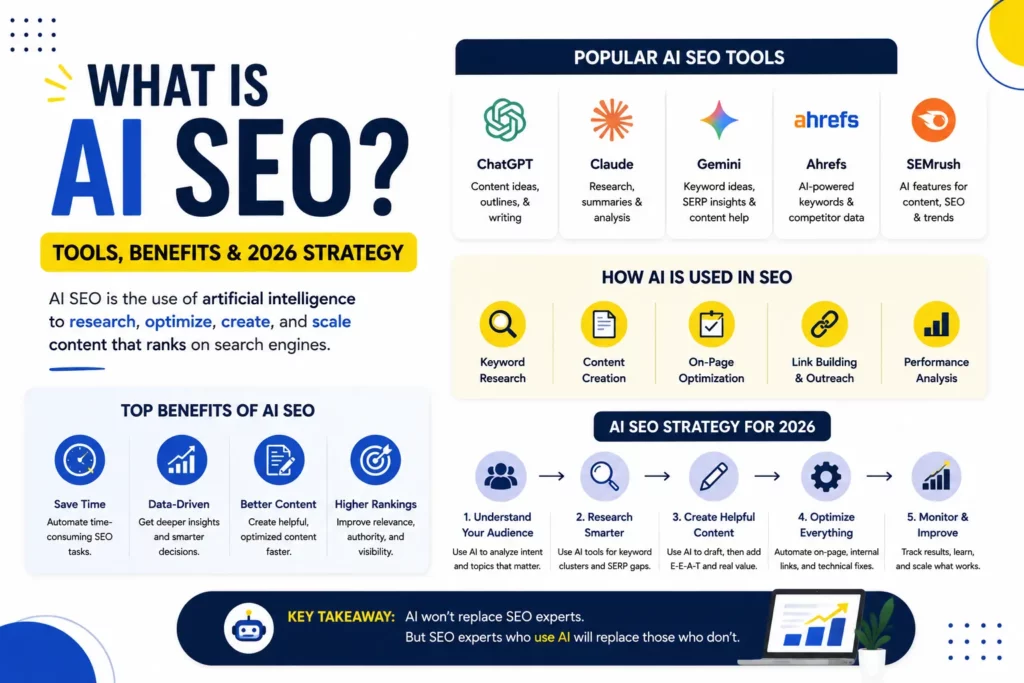
What is AI SEO? It is the use of artificial intelligence to improve SEO work while also preparing websites for visibility in AI-generated search results.
AI can support keyword research, content planning, technical analysis, reporting, and repetitive tasks. At the same time, platforms such as Google AI Overviews, AI Mode, ChatGPT Search, and Microsoft Copilot are changing how people discover websites and evaluate brands.
For practical feedback while testing these strategies, you can join an SEO and AI discussion community and compare workflows with other website owners.
Quick Answer
AI SEO has two main meanings:
- Using artificial intelligence to research, analyze, create, and automate SEO work.
- Improving a website’s visibility in AI-generated answers, citations, and conversational search experiences.
Therefore, a complete AI SEO strategy must combine efficient tools with useful content, technical accessibility, reliable information, and human judgment.
The Two Sides of AI SEO
The phrase is often used too narrowly. It does not refer only to producing articles with an AI writing assistant.
| Area | Meaning | Examples |
|---|---|---|
| AI-assisted SEO | Using AI to complete or improve SEO tasks | Keyword grouping, content briefs, data analysis, audit summaries |
| AI search optimization | Improving visibility in AI-generated search experiences | AI Overviews, AI Mode, ChatGPT Search, Copilot citations |
The first side helps SEO teams work faster. Meanwhile, the second focuses on how websites are discovered, understood, cited, and visited through AI-powered platforms.
AI SEO vs Traditional SEO
Traditional SEO focuses on making pages accessible, relevant, useful, and competitive in search results.
AI SEO does not replace those principles. Instead, it adds new workflows and discovery surfaces.
| Traditional SEO | AI SEO |
| Keyword and audience research | AI-assisted data classification |
| Search-result rankings | Rankings plus AI citations |
| Content optimization | AI-supported briefs and analysis |
| Technical crawling and indexing | Accessibility for search and AI retrieval |
| Organic clicks | Clicks, mentions, citations, and influenced conversions |
Google states that its generative search features remain connected to its core Search ranking and quality systems. Therefore, foundational SEO remains relevant for AI Overviews and AI Mode.
AI SEO, AEO, and GEO Explained
Several terms now describe optimization for AI-driven discovery.
- AI SEO: Using AI for SEO and adapting SEO for AI search.
- AEO: Answer engine optimization, usually focused on appearing in direct answers.
- GEO: Generative engine optimization, often focused on citations and visibility in generated responses.
These labels can help describe different goals. However, Google’s current guidance treats optimization for its generative features as part of SEO rather than as a completely separate discipline.
How AI Is Changing Search in 2026
The largest changes are not limited to faster content production.
AI-Generated Answers Appear Inside Search
Google AI Overviews and AI Mode can combine information from several sources into a generated answer.
Google explains that these experiences use retrieval-augmented generation to retrieve relevant pages from its search index. In addition, query fan-out can generate related searches to find supporting information for a more complex question.
As a result, one user question may lead an AI system to retrieve pages addressing several related subtopics.
Search Is Becoming More Conversational
Users can ask detailed questions, refine the answer, request comparisons, and continue with follow-up prompts.
This changes keyword research because people are not always entering one short phrase and selecting one blue link. However, the underlying need still matters, which makes keyword intent analysis essential.
Citations Are Becoming a New Visibility Surface
AI-generated answers may cite or link to supporting websites.
ChatGPT Search, for example, combines conversational answers with information from the web and links to sources.
Therefore, visibility may occur before a person visits your website. A brand can be introduced through a citation, mention, product reference, or summarized recommendation.
Click Journeys Are Becoming Less Direct
A searcher may first read an AI answer, compare several cited sources, ask a follow-up question, and visit a website later.
Consequently, rankings and clicks remain important, but they no longer describe the entire discovery process.
AI Visibility Can Now Be Measured More Directly
Google’s current guidance points website owners to a Generative AI performance report in Search Console for understanding discovery through its generative features.
Bing Webmaster Tools also introduced an AI Performance report in public preview. It provides citation totals, cited pages, grounding queries, and visibility trends across supported Microsoft AI experiences.
How SEO Professionals Use AI
AI can assist with many tasks when it receives reliable inputs and clear instructions.
Keyword Research and Clustering
AI can categorize keyword lists, identify patterns, and suggest groups based on wording or likely intent.
However, important clusters should still be validated through current search results. This keyword-clustering guide explains why similar phrases may require separate pages when their expected formats differ.
Content Planning
AI can help create:
- Initial outlines
- Content briefs
- FAQ groups
- Topic comparisons
- Internal-link suggestions
- Editing checklists
Nevertheless, the final plan should reflect real audience needs and your website’s experience.
Content Analysis
AI can compare documents, find repetitive sections, summarize competing pages, and identify missing questions.
It can also support SEO content creation by organizing research. However, it should not replace original examples, evidence, or expert judgment.
Technical Analysis
AI can help summarize crawl reports, classify errors, generate spreadsheet formulas, and explain technical findings.
Still, automated recommendations require validation. A tool may identify a redirect, blocked URL, or duplicate title without understanding whether the situation is intentional.
Review the main technical SEO essentials before implementing automated fixes.
Reporting and Data Analysis
AI can turn large exports into more manageable categories.
For example, it may help:
- Classify Search Console queries
- Compare performance periods
- Summarize page-level changes
- Find declining topic clusters
- Draft reporting notes
- Identify unusual patterns
The quality of the analysis depends on the quality and completeness of the data provided.
How to Use AI for SEO Step by Step
A safe workflow combines automation with human review.
Step 1: Start With Real Data
Collect information from sources such as:
- Google Search Console
- Analytics
- Keyword research platforms
- Website crawlers
- Customer questions
- Sales conversations
- Current search results
Do not ask an AI assistant to invent an SEO strategy without website data or business context.
Step 2: Use AI to Organize the Information
Suitable tasks include:
- Grouping keywords
- Categorizing queries by intent
- Summarizing crawl issues
- Finding repeated audience questions
- Comparing outlines
- Drafting an initial content brief
Step 3: Validate Important Decisions
Manually check:
- Search intent
- Page type
- Current search results
- Keyword relevance
- Technical feasibility
- Source accuracy
- Brand context
An AI-generated label should be treated as a hypothesis rather than a final answer.
Step 4: Add Human Experience
Improve the output with material that cannot be produced from generic prompts alone.
Examples include:
- First-hand workflows
- Original screenshots
- Internal data
- Expert opinions
- Failed tests
- Client or website examples
- Business-specific decisions
Step 5: Optimize and Publish
Review titles, headings, internal links, factual claims, accessibility, image alt text, structured data, and indexability.
AI may assist with each task. However, a knowledgeable person should approve the final page.
Step 6: Measure the Result
Track traditional performance alongside AI discovery.
Then use what you learn to improve the page, update weak sections, and strengthen related topic coverage.
AI SEO Tools and What They Can Help With
Instead of choosing tools only because they advertise AI features, select them according to the problem you need to solve.
| Tool category | Useful applications | Human review needed |
| General AI assistants | Brainstorming, summaries, formulas, first drafts | Facts, sources, originality |
| SEO data platforms | Keywords, backlinks, competitors, rankings | Opportunity selection |
| Website crawlers | Technical issue detection | Diagnosis and prioritization |
| Content tools | Topic and structure suggestions | Usefulness and differentiation |
| AI visibility tools | Citation and brand monitoring | Business interpretation |
No third-party tool has access to Google’s internal ranking or AI systems. Therefore, be cautious when a product claims to reveal guaranteed AI-ranking factors or private Google metrics.
How to Optimize for AI Search Visibility
There is no guaranteed formula for earning citations. However, several practices can improve a page’s usefulness and accessibility.
Create Non-Commodity Content
Avoid publishing another generic summary of information already available across the web.
Instead, add:
- Original experience
- Unique viewpoints
- First-hand reviews
- Clear examples
- Reliable evidence
- Original visuals
- Useful tools or templates
Google’s generative AI guidance specifically recommends content that provides value beyond information easily reproduced by an AI model.
Keep the Technical Foundation Clear
Pages generally need to be crawlable, indexed, and eligible to appear with a snippet before they can appear in Google’s generative search features.
Therefore, review:
- Crawl access
- Indexability
- Canonical tags
- Internal links
- JavaScript rendering
- Duplicate URLs
- Mobile usability
- Page experience
Make Important Information Easy to Verify
Use descriptive headings, clear definitions, accurate claims, and reliable sources.
Tables, lists, examples, and concise summaries can help readers understand complicated information. However, structure the page for people rather than forcing every paragraph into an artificial “AI-friendly” format.
Maintain Consistent Entity Information
Use consistent names, descriptions, author details, business information, products, and services across your website.
For local businesses and ecommerce websites, accurate feeds and business profiles may also support visibility in Google’s search and generative experiences.
Support Text With Useful Visuals
Original images, charts, demonstrations, and videos can provide additional discovery opportunities.
However, every visual should support the explanation rather than serve as decoration.
Google’s Guidance on AI-Generated Content
Google does not prohibit content only because AI helped create it.
However, using automation to publish many pages without adding value may violate its scaled-content-abuse policies. Google also recommends reviewing automatically created titles, descriptions, structured data, facts, and image alt text for accuracy and relevance.
Before publishing AI-assisted content, check:
- Are the claims accurate?
- Are the cited sources real and relevant?
- Does the page add original information?
- Has an experienced person reviewed it?
- Is the writing useful rather than repetitive?
- Does it represent the brand accurately?
- Would the page still deserve to exist without search traffic?
Common AI SEO Myths
Traditional SEO Is Dead
It is not. Technical accessibility, useful content, internal links, authority, and clear information remain important.
You Need Special AI Schema
Google currently says there is no special structured-data type required for its generative search features. Continue using supported schema where it accurately describes visible content.
Every Paragraph Must Be Extremely Short
Google says content does not need to be broken into tiny chunks specifically for generative AI. Page length and section size should depend on the audience and subject.
An llms.txt File Improves Google Visibility
Google currently states that it does not use llms.txt for Search visibility. Creating one will neither improve nor damage Google rankings or AI visibility.
AI Can Run SEO Without Human Review
AI can misunderstand context, fabricate information, overlook business constraints, or recommend unnecessary changes.
Therefore, human approval remains essential for strategy, technical decisions, factual content, and brand communication.
How to Measure AI SEO Performance
Use a combined measurement framework.
Traditional SEO Metrics
Monitor:
- Organic impressions
- Organic clicks
- Click-through rate
- Average position
- Ranking queries
- Indexed pages
- Backlinks
- Organic conversions
AI Visibility Metrics
Where data is available, review:
- AI-generated citations
- Cited pages
- Brand mentions
- Grounding queries
- AI referral traffic
- Topics associated with the brand
- Citation trends
- Conversions from AI-referred visitors
Citation totals should not be treated as a direct equivalent of rankings. Instead, use them to understand where your information is being referenced and which topics are associated with your website.
Risks and Limitations
AI can make SEO work faster, but it can also create new problems.
Common risks include:
- Fabricated facts or sources
- Generic writing
- Incorrect keyword grouping
- Misinterpreted search intent
- Poor technical recommendations
- Privacy concerns
- Brand inconsistency
- Mass production without value
- Excessive dependence on one platform
The strongest approach combines automation, reliable data, subject knowledge, and careful review.
FAQs
What is AI SEO in simple terms?
AI SEO means using artificial intelligence to improve SEO workflows and adapting websites for visibility in AI-generated search results.
How can AI help with keyword research?
AI can group keywords, classify intent, summarize themes, and identify repeated questions. However, important decisions should be checked against live search results and reliable keyword data.
Can AI-generated content rank on Google?
AI-assisted content can appear in search when it is useful, accurate, original, and compliant with Google’s policies. Mass-producing low-value pages may violate spam policies.
What is the difference between AI SEO and traditional SEO?
Traditional SEO focuses on organic discovery through search results. AI SEO adds automation, generative-search visibility, citations, conversational discovery, and AI-focused measurement.
What is the difference between AI SEO, AEO, and GEO?
AI SEO is the broadest term. AEO focuses on answer engines, while GEO usually refers to visibility in generative AI responses.
Can AI replace an SEO specialist?
AI can automate parts of research, analysis, drafting, and reporting. However, strategy, prioritization, technical diagnosis, original experience, and business judgment still require human involvement.
How do I optimize for AI Overviews?
Start with foundational SEO. Make the page crawlable and indexable, answer the audience’s question accurately, provide unique value, use clear structure, and support important claims with evidence.
Do I need special schema for AI search?
No special AI schema is required for Google’s generative features. Use existing structured data only when it accurately represents visible page content.
How can I measure AI search visibility?
Use available reporting from platforms such as Google Search Console and Bing Webmaster Tools. In addition, monitor AI referral traffic, citations, brand mentions, and conversions.
Is AI SEO only about content writing?
No. It also includes data analysis, keyword research, technical audits, internal linking, reporting, competitor analysis, and AI-search visibility.
Conclusion
Understanding what is AI SEO requires looking at both sides of the topic.
AI can accelerate keyword analysis, content planning, technical reviews, and reporting. Meanwhile, AI Overviews, AI Mode, ChatGPT Search, Copilot, and other answer experiences are changing how websites earn visibility and influence decisions.
The strongest strategy is not to search for an AI ranking shortcut. Instead, combine technical SEO, original expertise, accurate information, clear structure, useful media, and careful human review.
To discuss an AI workflow, compare visibility reports, or get feedback on an AI-search strategy, continue the conversation with other SEO learners.