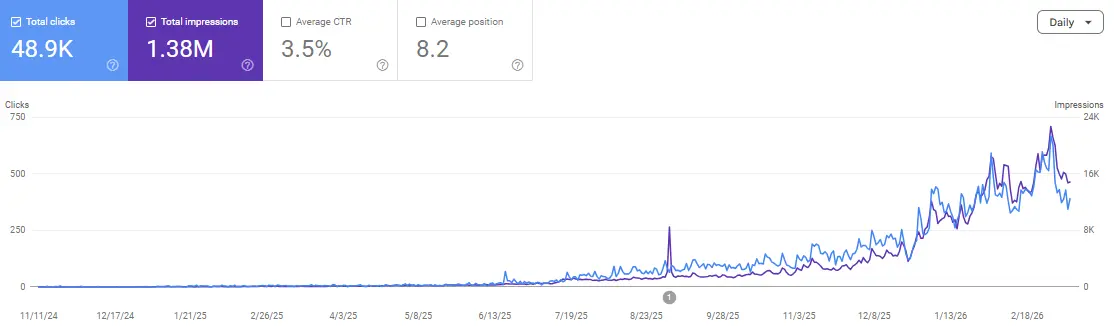
Programmatic SEO and AI search are now deeply interconnected, and understanding how AI retrieval systems evaluate structured content is the single most important factor for building programmatic pages that survive and grow in 2026. The sites that treat these as separate concerns are making a strategic mistake. The sites that build programmatic content with AI retrieval in mind are building a compounding advantage that competitors cannot see coming.
This article explains the connection, what query fan-out is and why it matters, and exactly how to build programmatic content that benefits from AI search rather than being replaced by it.
Before reading further, make sure you understand what programmatic SEO is fundamentally and the risks that poorly executed programmatic content carries. Both form essential context for the strategy laid out here.
If you want to discuss how AI search is affecting your programmatic strategy right now, join the Scale-Xpert community on Discord where practitioners share real data and exchange backlinks.
Why AI Search and Programmatic SEO Are Now Inseparable
AI-powered search tools and programmatic SEO both operate at scale, which is exactly why they interact in ways that purely manual content never does. When an AI retrieval system processes a query, it is doing something structurally similar to what a programmatic site does: it is synthesizing information across many structured sources to produce a precise, specific answer. Sites built on structured, specific, data-rich programmatic pages are more compatible with AI retrieval than sites built on broad, general editorial content.
The shift in how search works
Traditional search matched keywords and ranked pages. AI search, as deployed in tools like ChatGPT Search, Perplexity, and Google AI Overviews, reads multiple pages, extracts relevant information, and synthesizes a response. The pages that get cited are not necessarily the ones with the highest domain authority or the most exact keyword matches. They are the ones with the most directly applicable, specific, and trustworthy information for the question being asked.
What this means for programmatic sites
A well-built programmatic site has thousands of pages, each answering a specific question with specific data. This is structurally ideal for AI retrieval. An AI processing a query about Lisbon’s cost of living for digital nomads does not want a 3,000-word editorial about travel in Portugal. It wants the specific data points that directly answer that question. A programmatic page built around that exact data is more useful to the AI retrieval system than a generalist article, even if the generalist article ranks higher in traditional search.
The expert who identified this connection first
Jeremy Tang, founder of the programmatic SEO platform CMAX, articulated this connection in detail on the Channel Agency Podcast. His argument is that search engines like Google and AI engines like GPT-based systems are now interconnected through a mechanism called query fan-out, where a single user query is decomposed into multiple sub-queries that are answered from many sources simultaneously. A structured programmatic approach, Tang argues, makes your content easier for these AI systems to discover and use as a credible information source because each page is already pre-optimized for a specific query variation.
What Query Fan-Out Actually Is
Query fan-out is the process by which an AI search system takes a single user query and automatically generates multiple related sub-queries, retrieves answers from different sources for each sub-query, and synthesizes the results into a single coherent response. Understanding this mechanism explains why structured, specific programmatic content is inherently more AI-search compatible than broad editorial content.
How the fan-out process works step by step
When a user asks an AI search tool a complex question, such as “what is the best city in Southeast Asia for remote workers with a budget of $2,000 per month,” the AI does not look for one article that answers this directly. It fans out into a set of sub-queries: what cities in Southeast Asia have cost of living under $2,000, what is the internet quality in those cities, what are the visa options for remote workers in each city, and which cities have active digital nomad communities. Each sub-query retrieves from different sources, and the AI synthesizes the answers.
Where programmatic content fits into the fan-out
A programmatic site with individual pages for each city covering cost of living, internet speed, and digital nomad infrastructure is ideally positioned to be retrieved as a source for multiple sub-queries within a single fan-out. Each page answers one specific sub-query precisely. The AI retrieval system does not need to extract a relevant passage from a long general article. It finds an entire page dedicated to the exact specific answer it is looking for. This is the structural compatibility that Jeremy Tang is describing.
The difference between fan-out friendly and fan-out unfriendly content
Fan-out friendly content is specific, data-rich, structured with clear headings, and answers one question well per page. Fan-out unfriendly content is broad, vague, covers many topics shallowly on a single page, and requires the AI to extract specific passages from a sea of general text. Programmatic pages built with genuine unique data are inherently fan-out friendly by design. General editorial content optimized for head keywords is often fan-out unfriendly because its breadth works against specificity. This structural advantage is described in why RAG is the foundation of AI SEO visibility, which explains the retrieval mechanism AI search uses in more technical detail.
The Double-Edged Relationship Between AI and Programmatic SEO
AI search both rewards and threatens programmatic SEO simultaneously, and the determining factor is always the same: whether the programmatic pages provide unique data that the AI cannot generate from its own training. Treating this as a simple opportunity or a simple threat misses the nuance that determines which programmatic projects thrive.
How AI search rewards well-built programmatic content
AI retrieval systems actively seek specific, trustworthy, structured information from authoritative sources. A programmatic site built on proprietary or uniquely aggregated data is exactly the kind of source these systems prefer. When an AI tool is answering a question about software integration options, it wants pages that actually document real integrations, not general articles about automation software. Zapier’s programmatic integration pages are cited by AI tools precisely because no other source documents those specific integrations as precisely.
How AI search threatens poorly built programmatic content
Lily Ray, speaking on Edward Sturm’s channel, identifies the direct threat clearly: AI Overviews eliminate the need for thousands of simple lookup pages when the AI can generate those answers directly. Area code information, basic currency conversion without live data, simple definitions, and factual lookups that do not require aggregation are all categories where AI-generated answers now substitute for programmatic pages directly. These categories represent a significant portion of early programmatic SEO projects, and those projects are now under serious traffic pressure.
The resolution: original data that AI cannot generate itself
The resolution to this tension is the same principle that appears throughout every discussion of sustainable programmatic SEO. Pages built on data that AI cannot generate from its training, because the data is proprietary, live, community-sourced, or uniquely aggregated, are more compatible with AI search than ever. Pages built on information that AI already knows are less relevant than ever. The strategic implication is to audit your programmatic content against this criterion and invest exclusively in the first category going forward.
How to Build Programmatic Content That AI Search Rewards
Building programmatic content for AI search compatibility requires four specific design decisions: data that AI cannot generate, structure that AI can parse, specificity that matches sub-query patterns, and entity clarity that signals authoritativeness to AI retrieval systems. Each of these is a concrete, implementable design choice.
Design decision 1: Ground every page in AI-irreplaceable data
The starting point is ensuring your dataset contains information that an AI language model cannot produce from its own training data. Live exchange rates, real-time inventory, current user reviews, proprietary survey results, platform-specific integration data, and location-specific community metrics are all examples of data that AI models cannot generate independently. Static factual information, general definitions, and information freely available from multiple sources are all replaceable by AI generation.
Design decision 2: Use structure that AI retrieval can parse accurately
AI retrieval systems parse content more accurately when it uses clear heading structure, short focused paragraphs, labeled data points, and explicit answers near the top of each page. A programmatic page that buries its core data in the middle of long paragraphs is harder for AI to retrieve accurately than a page that presents the core data clearly in the first section. This means your template design should prioritize data presentation at the top of each page before supporting context and explanation.
Design decision 3: Match your page specificity to sub-query patterns
Each programmatic page should be specific enough to directly answer a single sub-query rather than broadly covering a topic. The question to ask when designing each page is: what is the single most specific question this page answers? A page that answers “what is the average rent for a one-bedroom apartment in Lisbon in 2026” is a better AI retrieval source than a page that answers “living in Lisbon.” The former matches a specific sub-query in a fan-out. The latter requires the AI to extract a relevant passage from a broader discussion.
Design decision 4: Build entity clarity across your programmatic set
AI retrieval systems use entity understanding to assess the authority and reliability of sources. A site that consistently and accurately covers a defined set of entities, whether cities, software tools, currency pairs, or product categories, is treated as more authoritative for queries related to those entities than a site that covers them intermittently. This means your programmatic content strategy should define the specific entities it covers comprehensively and consistently, rather than covering many entities shallowly. Understanding how AI search connects to topical authority building provides the framework for applying entity clarity across your entire site, not just within your programmatic section.
The Programmatic Content Audit for AI Compatibility
The most immediately actionable step for any existing programmatic site is to audit current pages against a simple framework: does each page contain data that AI cannot generate, and is that data structured to be parseable by AI retrieval systems? Pages that fail both tests are at high risk. Pages that pass both are positioned to grow.
The four-category audit framework
Category one is pages with AI-irreplaceable data and clear structure. These pages are low risk and well positioned for AI search. No action needed beyond maintenance.
Category two is pages with AI-irreplaceable data but poor structure. These pages have the right foundation but are not extractable by AI retrieval systems efficiently. Improving their template structure, adding explicit data labels, and presenting core data earlier on each page will improve their AI search compatibility without requiring new data collection.
Category three is pages with AI-replaceable data but clear structure. These pages are at moderate risk. The structure is right but the data does not differentiate them from what an AI Overview can generate. Adding a layer of unique data, such as recent user input, live data, or proprietary context, can move these pages into category one.
Category four is pages with AI-replaceable data and poor structure. These pages are at the highest risk of traffic loss from AI Overviews. They provide information AI can generate and present it in a way that is hard for AI to cite. These pages need either a fundamental redesign around unique data or consolidation into fewer, higher-quality pages.
Prioritizing your improvement efforts
Improvements in category two produce the fastest results because the data quality is already there. Category three improvements require new data collection which takes longer but produces more durable results. Category four pages often produce the best outcome when removed or redirected rather than improved, because their fundamental data problem cannot be solved by template changes alone. This audit connects to the broader approach of how to refresh old content for better rankings, which provides the operational framework for executing content improvements systematically.
Building programmatic content that performs well in AI search is one of the more challenging strategic shifts in SEO right now. The practitioners figuring this out in real time are sharing what they are finding in communities like Scale-Xpert on Discord, where the conversation includes real data, real backlink exchanges, and honest assessments of what is and is not working.
Frequently Asked Questions
Does AI search help or hurt programmatic SEO overall?
It does both simultaneously, and which effect dominates depends entirely on the quality of the underlying data. Programmatic pages built on genuinely unique, AI-irreplaceable data benefit from AI search because structured, specific content is exactly what AI retrieval systems prefer as source material. Programmatic pages built on generic lookup data are hurt by AI search because AI Overviews substitute for those pages directly. The determining factor is data quality, not the programmatic technique itself.
What is query fan-out and why does it matter for my site?
Query fan-out is the process by which AI search systems decompose a user query into multiple specific sub-queries and retrieve answers from different sources for each one. It matters for your site because a programmatic site with hundreds or thousands of pages, each answering a specific sub-query precisely, is structurally ideal for being retrieved across multiple sub-queries within a single fan-out. This means a well-built programmatic site can appear as a source in an AI-generated answer multiple times within a single user interaction, compounding its visibility in ways that a single editorial article cannot match.
How do I know if my programmatic pages are being cited by AI tools?
The most direct method is to test manually by running relevant queries in ChatGPT Search, Perplexity, and Google AI Overviews and checking whether your site is cited as a source. For systematic tracking, monitor your Google Analytics AI Assistant channel for traffic from recognized AI tools, and track AI Overview impressions in Google Search Console. A consistent pattern of your programmatic pages appearing as sources in AI tool responses is the clearest confirmation that your content is AI-search compatible.
Should I redesign my programmatic templates to be more AI-friendly?
Yes, if your current templates bury data in paragraphs rather than presenting it clearly at the top of each page. The most impactful template change for AI compatibility is ensuring that the core specific data point each page is built around appears in the first section, clearly labeled, before supporting context and explanation follow. This improves AI retrievability without requiring new data collection and typically also improves user engagement because readers find the specific information they came for faster.
Is Jeremy Tang’s CMAX platform the only way to implement this strategy?
No. The principles Jeremy Tang describes are applicable to any programmatic SEO approach, not specific to CMAX. CMAX is one implementation platform for large-scale programmatic content, but the strategic logic of targeting long-tail white space, building content momentum, and structuring pages for AI retrieval compatibility applies regardless of which tools you use to build and manage your programmatic pages.
Will AI Overviews eventually replace all programmatic lookup pages?
They will replace programmatic pages that only provide static factual lookups, but not pages built on live, proprietary, or community-sourced data. Google AI Overviews can answer questions about basic facts from training data. They cannot provide a live exchange rate, a current user review, a proprietary salary data point, or a real-time integration status. The category of programmatic content that AI Overviews cannot replace is the same category that has always represented the strongest programmatic SEO strategy: pages built on data that requires ongoing access to a live system or a real community.
How quickly does AI search compatibility affect programmatic traffic?
Changes to template structure that improve AI parsability typically show results within four to eight weeks as AI tools re-index and begin retrieving from the improved pages. Adding new unique data to existing pages takes longer because the data needs to be recognized as trustworthy before it is consistently cited. Building a new programmatic section from scratch with full AI compatibility in mind follows the same three-to-six-month timeline as traditional programmatic SEO indexing and ranking, with AI citation typically appearing before traditional search rankings stabilize.
Conclusion
Programmatic SEO and AI search are not competing forces. They are complementary systems that reward the same underlying quality: specific, structured, trustworthy content built on data that cannot be easily replicated or generated by AI itself. The sites that understand this connection and build accordingly are positioned for compounding growth. The sites that treat them as separate concerns are building on a foundation that AI search is systematically eroding.
In summary, query fan-out rewards programmatic content because AI retrieval systems prefer specific, structured, data-rich pages that directly answer discrete sub-queries. The threat from AI search is real but targeted specifically at pages built on generic, AI-replaceable data. The opportunity is equally real for pages built on proprietary, live, or community-sourced data that AI cannot generate independently. The practical response is a four-category audit of your existing programmatic content and a forward-looking commitment to building only in the AI-irreplaceable data category.
Jeremy Tang’s insight that programmatic structure makes content more discoverable by AI retrieval systems and Lily Ray’s warning that thin programmatic content is eliminated by AI Overviews are not contradictory. They are two sides of the same principle: the quality and uniqueness of the data determines everything, in AI search exactly as in traditional search.
Join the Scale-Xpert community on Discord to exchange backlinks, share your AI search data, and connect with practitioners who are navigating this strategic shift in real time.