Low hanging fruit SEO means choosing worthwhile search improvements that require relatively little work. However, an easy edit is only a useful opportunity when there is a credible reason it will help the right audience.
Changing a title takes minutes. Discovering that the page answers the wrong question can turn the same task into a substantial rewrite.
Therefore, start with selection rather than a long list of tactics. This guide shows how to identify existing opportunities, reject misleading signals, and choose a manageable first improvement.
If you enjoy comparing practical SEO decisions, join Scale-Xpert on Discord, our backlink exchange community and SEO learning hub.
What Makes an Opportunity Low Hanging Fruit SEO?
A low hanging fruit SEO opportunity combines observable evidence, a limited implementation task, and a useful business outcome. Treat that definition as a planning method, not a promise of immediate ranking gains.
For example, a tutorial with an outdated screenshot may need one verified replacement. By contrast, a page that needs original research, a new tool, and several approvals is a larger investment.
The difference matters because “quick to implement” and “quick to produce results” are separate claims. You control the work more directly than the timing of search performance changes.
For Scale-Xpert, a relevant visitor who engages with an SEO discussion can be more valuable than unrelated traffic. Therefore, low hanging fruit SEO should consider the route to Discord participation alongside clicks.
Where Should You Look Before Creating More Content?
Look first at existing pages with a specific, fixable gap between what readers need and what the page provides. Search data can help identify candidates, but it does not explain every problem by itself.
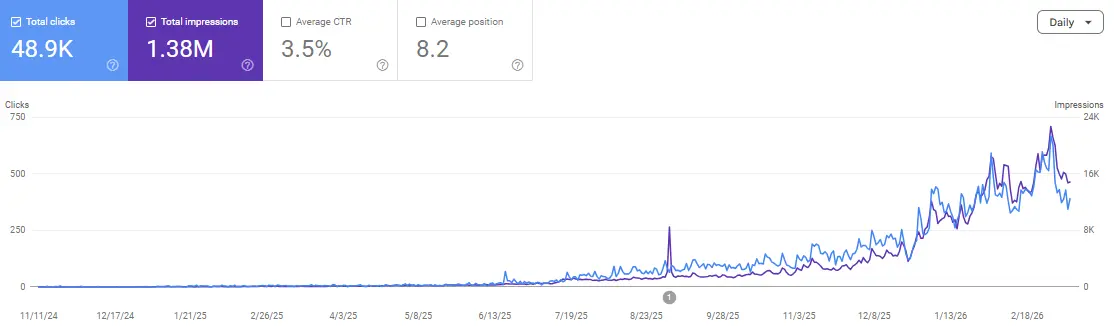
Start with Google’s Search Console Performance report, which provides clicks, impressions, CTR, and average position. Then inspect the page and its queries together rather than treating a sitewide average as a diagnosis.
Use the last six months to understand the broader pattern, with shorter comparable periods for recent changes. However, extend the review when seasonality or a new page makes that window misleading.
For a site serving multiple countries, review important markets separately. Likewise, keep device comparisons consistent so a shift in audience mix does not become a supposed content problem.
Your initial low hanging fruit SEO shortlist can include:
- Relevant queries already producing impressions.
- Useful pages with outdated instructions or missing examples.
- Important destinations that are hard to reach from related content.
- Pages whose title promises something different from their actual answer.
Are Keywords Near the Top Results Automatically Quick Wins?
No, a promising average position identifies a candidate for investigation, not an easy ranking upgrade. Google describes average position as an average of the topmost result for the selected grouping, rather than a permanent position seen by every searcher.
For instance, you might initially inspect queries averaging positions 8–20. However, that range is an editorial filter, not an official threshold for low hanging fruit SEO.
Next, examine the current results for the target market. If searchers predominantly receive interactive tools while your page offers a definition, changing the title may not solve the format mismatch.
Also ask whether the query matters to your audience. A seemingly easy keyword with no connection to your product, expertise, or community may be a poor use of time.
That is where prioritizing keywords by business relevance supports the shortlist. Position is one clue; it is not the entire decision.
How Do You Choose the Best Opportunity to Work on First?
Choose the candidate with the clearest evidence, smallest useful change, and strongest connection to your goal. Use four questions to keep low hanging fruit SEO from becoming a collection of attractive but unrelated tasks.
1. What is the evidence?
Describe what you can actually observe. For example, “the screenshot shows a menu that no longer exists” is stronger evidence than “this article feels old.”
Similarly, a missing contextual link can be verified on the source page. A claim that Google dislikes the article cannot be inferred simply from declining clicks.
2. What is the smallest useful change?
Define a deliverable that another person could review. Instead of “improve content,” write “replace the obsolete export steps and add one annotated sample file.”
However, do not shrink the task so far that it no longer addresses the problem. Adding a sentence about a calculator does not turn an explanation into the working calculator searchers need.
3. Who benefits if it works?
Identify the audience and its next meaningful action. For an SEO community, that might be a practitioner finding an answer and choosing to discuss a related problem.
By contrast, an unrelated viral topic may produce visits without helping the community grow. Consider that mismatch before treating traffic potential as business value.
4. What could make the task larger or riskier?
Check dependencies, approvals, testing, and the chance of changing something that already works. Then decide whether the candidate still belongs on your immediate list.
This low hanging fruit SEO filter is deliberately qualitative. It avoids turning uncertain traffic forecasts into a precise-looking score that the available evidence cannot support.
Which Changes Often Pass the Test?
Changes often pass when they repair an identifiable problem on an otherwise useful page. The examples below are candidates to evaluate, not universal low hanging fruit SEO instructions.
Clarify a misleading or vague title
If the page delivers a specific workflow but the title says only “Helpful SEO Tips,” make the promise clearer. However, do not add a benefit that the content cannot deliver.
Google’s title-link guidance recommends descriptive, concise titles and explains that displayed titles can draw on several sources. Therefore, verify what appears after processing rather than assuming your preferred wording will always be shown.
For low-CTR opportunities in Search Console, inspect the query and surrounding results before editing. An answer-heavy results page may limit clicks even when your title is accurate.
Repair a narrow content gap
A useful tutorial may be missing a prerequisite, limitation, or step that prevents readers from finishing. In that case, refreshing outdated content can be a bounded task.
For example, add the account permissions needed before an export and show where the resulting file appears. Meanwhile, leave accurate sections intact instead of rewriting the entire article merely to change its date.
Add a relevant path to an important page
An existing article may discuss a problem without linking to the page that solves it. Add the link where readers naturally need the next step, using a descriptive anchor.
Google’s link best practices explain how crawlable links and understandable anchor text help discovery and interpretation. However, adding links indiscriminately is not the same as creating a useful route through the site.
If you want feedback on which candidate deserves attention, discuss your SEO shortlist with the Scale-Xpert community. Our backlink exchange community and SEO learning hub welcomes practical questions.
What Does a Useful Shortlist Look Like?
A useful shortlist records a specific decision, not just a list of pages with disappointing metrics. The hypothetical example below illustrates low hanging fruit SEO selection without inventing site performance data.
| Candidate | Observable issue | Smallest useful action | Decision |
|---|---|---|---|
| Existing export tutorial | Instructions use an obsolete menu | Verify and replace the affected steps | Start here if audience relevance is strong |
| Comparison article | Accurate content but vague title | Test a clearer description of its scope | Investigate query and SERP context first |
| Broad glossary page | Searchers need an interactive tool | Build and maintain a functioning tool | Move to a larger project backlog |
| Old article with few clicks | Cause and business role unknown | Inspect demand, usefulness, and indexing | Investigate before deleting |
Notice that the most ambitious opportunity is not automatically first. Instead, the initial task has a clear problem and a deliverable that can be checked.
For each selected task, record the owner, estimated effort, dependency, and intended outcome. Also save the original version so the team can understand or reverse the change if necessary.
Can Low Hanging Fruit SEO Improve AI Citations?
Low hanging fruit SEO can include improving a page’s usefulness as a source, but no small edit guarantees an AI citation. Google’s generative search guidance emphasizes valuable content and says no special writing format or schema is required.
A practical opportunity might be adding the missing method behind a comparison you already performed. Include what you tested, when you tested it, and which limitations affect the result.
Similarly, replace an unsupported conclusion with a clearly attributed source or a labeled illustration. These changes improve verifiability without pretending that a formatting trick controls source selection.
When you already possess first-hand evidence, creating content that is difficult to replicate may require better presentation rather than another generic article. However, collecting new research from scratch may belong outside the quick-win shortlist.
How Should You Measure Results Without Fooling Yourself?
Measure the intended outcome at page and query-group level, while recording other changes that could explain the result. Low hanging fruit SEO is still experimentation under uncertainty.
First, capture the baseline and deployment date. Then confirm the live change, including titles, links, instructions, or tracking affected by the edit.
Use comparable observation periods and allow enough time for meaningful data to accumulate. However, a fixed review date is not a promise that Google will reprocess the page or that its ranking will improve by then.
Track the business action separately from search visibility. For Scale-Xpert, a Discord invite click is an intermediate event; report a completed join only when membership and attribution are verified.
Finally, label the conclusion honestly: promising, inconclusive, or unsuccessful. A rise after an edit is an association, not proof that the edit alone caused it.
Frequently Asked Questions About Low Hanging Fruit SEO
Low hanging fruit SEO works best as a prioritization approach with clear limits on what the evidence can show.
What is the difference between low hanging fruit SEO and general SEO?
General SEO covers the broader program. By contrast, this approach selects manageable opportunities that can be acted on with existing resources and evidence.
Are low-competition keywords always quick wins?
No. A keyword can require expensive content or attract the wrong audience, so inspect the actual task before prioritizing it.
Should I start with pages ranking between positions 8 and 20?
They can be an initial candidate group. However, average position, intent, competition, and business relevance still need review.
Does low CTR mean I should rewrite the title?
Not automatically. First examine the query, ranking context, audience mix, and result format to understand why fewer people click.
How quickly will low hanging fruit SEO produce results?
Implementation can be quick, but results are uncertain. Therefore, set a review process rather than promising a particular ranking or deadline.
Can I do this without paid SEO tools?
Yes, you can begin with Search Console, your own pages, and a simple worksheet. However, deeper technical or competitive questions may require additional data.
Conclusion: Choose the Smallest Change That Solves a Real Problem
Low hanging fruit SEO is most useful when it turns evidence into a manageable action. Start with a relevant existing page, identify a specific gap, estimate the full work, and measure the outcome without assuming an easy ranking gain.
For more conversations about choosing the right next step, connect with SEO learners in Scale-Xpert’s Discord. Our backlink exchange community and SEO learning hub offers a place to share questions and compare approaches.