A clickable phrase in an AI answer can look like an invitation to visit a source. But some reported Google AI Overview links to AI Mode lead to another Google experience instead. For publishers, that makes the destination of a link just as important as its appearance.
The useful SEO question is specific: does this interaction give someone a route to your website, or continue their research inside Google? Answering it requires more than counting blue links or checking whether your brand appears. You need to inspect the journey, document the evidence, and separate visibility from visits.
This guide explains the reported change and a practical response. The recommendations are an audit method, not a claim that publishers can control Google’s interface or guarantee citations.
What was reported about Google AI Overview links to AI Mode?
Search Engine Roundtable’s September 22 report describes links in an AI Overview that open AI Mode rather than publisher pages. It attributes the observation to Gagan Ghotra and includes a recording. This is evidence of an observed interface, not proof of a universal rollout.
The broader transition was already public. In January 2026, Google announced follow-up conversations from AI Overviews into AI Mode, including a global mobile experience. The September observation concerns how that transition can be presented through clickable text.
Avoid turning this into a claim that all citations have disappeared. A navigation link and an external source link can serve different purposes in the same answer. Their coexistence is exactly why publishers need a more precise audit.
Use the destination to classify an interaction. Anchor wording alone is not enough to tell you where someone will land. Apply the same categories every time you inspect a result.
| Interaction | What to record | Publisher interpretation |
|---|---|---|
| Link opens a publisher page | Destination domain and URL | Direct route to a website |
| Link opens a source panel | Panel contents and subsequent click | Potential route that requires another action |
| Link opens AI Mode | New answer, context, visible sources | Continued research inside Google |
| Link opens ordinary Google results | New query and result page | Another search, not yet a publisher visit |
| Overview expands | Visible area before and after | Layout change; no destination implied |
Auto-expansion belongs in the last category. It concerns how much screen space an answer occupies, while an AI Mode link concerns where an interaction goes. Record them separately even when both appear during one session.
Where do the answers and supporting sources come from?
Google explains that AI Overviews and AI Mode may run related searches across subtopics and data sources through query fan-out. They can use different models and techniques, so their answers and supporting links may differ. Google does not publish a complete selection formula. Google’s documentation.
That gives publishers a useful research direction, but no shortcut to inclusion. Map the questions a reader needs to resolve and identify which ones your page can answer with evidence. Do not assume that repeating the initial query covers the whole task.
For example, someone researching an SEO audit might next ask about scope, required access, deliverables, and how to judge recommendations. Those are different needs within one journey. Use search intent to decide which belong together and which require a distinct resource.
Audit the click journey before changing your content
Build a small, repeatable query sample
Choose 20 relevant queries as a manageable starting sample, not a statistically representative benchmark. Include explanations, comparisons, troubleshooting, and branded searches. Select terms that connect to real business outcomes by prioritizing keywords by business relevance.
For each observation, record the query, date, time, country, device, language, and login state. Capture the initial result and the screen after the interaction. If you cannot reproduce a reported feature, record that absence instead of substituting a different example.
Follow the link and inspect the next screen
Check whether the interaction opens a website, source panel, AI Mode answer, or another results page. Then note whether your domain appears and whether its page supports the associated statement. A brand mention without a clickable source should have its own label.
For AI Mode transitions, retain the original query and the resulting prompt when visible. This helps you see whether the follow-up asks a different question. It also prevents you from treating two different information needs as identical citation opportunities.
Report observations with denominators
Suppose a hypothetical test contains 20 initial searches, eight AI Overviews, and three Overviews with a recorded AI Mode transition link. Report all three counts. Writing only that “37.5% of results pushed users to AI Mode” would conceal the denominator and exaggerate the scope.
Repeat observations under comparable conditions before describing a pattern. An interface that appears once is worth documenting, but it should not become a market-wide statistic. Keep a separate column for uncertainty, failed checks, and incomplete captures.
Improve citation readiness with evidence readers can verify
Check eligibility before rewriting paragraphs
Google says supporting pages must be indexed and eligible for a search snippet. It does not require special AI markup, schema, or machine-readable files for inclusion. Eligibility still does not guarantee selection. Official inclusion requirements.
Start your own review with the intended landing page. Check its index status, access restrictions, and whether its important evidence is readable. Fix a specific problem you find rather than making site-wide technical changes because a competitor received a citation.
Give each important claim an evidence trail
Replace vague assertions with a clear description of what was observed, how it was checked, and where its limitations begin. A screenshot becomes more useful when readers know the query, date, device, and action that produced it. A numerical result needs a denominator and a definition.
For instance, replace “Google is taking all publisher clicks” with a bounded observation: “In this recorded session, the highlighted phrase opened AI Mode; the adjacent source card opened a publisher page.” This is an example of reporting style, not a result from testing performed for this article.
Offer something worth visiting the source for
Build an accessible observation log, comparison worksheet, downloadable dataset, or reproducible procedure. Keep the essential explanation visible on the page so readers can assess its relevance before downloading anything. These are useful linkable assets built around original evidence, not guaranteed citation triggers.
Google’s people-first content guidance asks whether a page contributes original information and value beyond rewriting other sources. That supports investing in firsthand evidence rather than publishing another interchangeable summary. It does not establish a guaranteed AI citation formula. Google’s content evaluation guidance.
Answer follow-up questions without multiplying thin pages
Use headings that describe concrete problems, then explain the answer with examples and exceptions. Put closely related questions on the same page when readers need them to complete one task. Create a separate page only when it serves a substantial, different need.
For this topic, link classification and click measurement belong together. A separate title for every variation of “AI Overview links not opening websites” would mostly repeat the same answer. More URLs would not add more evidence.
Measure citations, visits, and conversions separately
Maintain three records: observed source visibility, website traffic, and completed business actions. A citation observation is not a visit, and a visit is not a community membership. This separation makes performance discussions more useful even when attribution is incomplete.
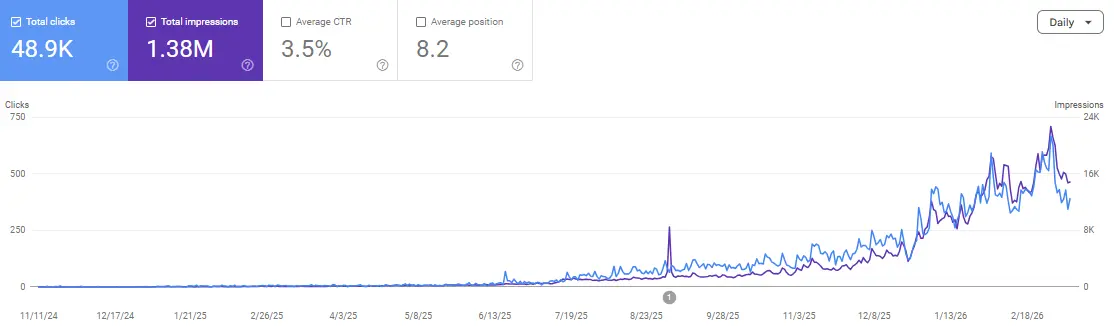
Google documents AI feature traffic within Search Console’s Web reporting. Do not label an aggregate traffic chart as a direct measurement of this interface test. Use analytics to examine what visitors actually do after arriving. Google’s measurement guidance.
Search Console counts an external-page click in AI Mode as a click, and follow-up responses are associated with the new query. Google also states that Search Labs experiments are excluded from Search Console data. A screenshot from an experiment therefore should not automatically be expected to produce a corresponding report entry. Search Console metric definitions.
For your own analysis, compare similar periods and segment by landing page, country, device, and query where available. Inspect high-impression, low-click pages alongside changes in demand, rankings, titles, and other SERP features. A CTR decline alone cannot identify which interface element caused it.
For Scale Xpert, track a Discord invitation click as an outbound action. Count a confirmed join separately only when the community measurement setup supports it. Do not rename invitation clicks “members acquired” to make the campaign look stronger.
A practical two-week response
In the first week, establish your query sample and record link destinations. Identify two or three pages where the evidence is weak, outdated, or difficult to verify. Select changes you can explain clearly, such as adding a method or correcting an unsupported claim.
In the second week, publish those improvements and repeat the observations. Log deployment dates and concurrent changes so later comparisons have context. Two weeks can establish a workflow; it is not a deadline by which Google must recrawl, cite, or reward a page.
If you share findings with the Scale Xpert Discord community, include the observation conditions and limitations. A reproducible example gives other practitioners something useful to check. An alarming screenshot without context does not.
Frequently asked questions
Do all AI Overview links now open AI Mode?
The reports reviewed do not establish that. Classify each observed interaction by its destination rather than applying one label to every link in the answer.
Is an AI Mode transition a backlink to my website?
No. It takes the user to a Google experience. A separate link from that experience to your page would create a route to your website.
Does a citation guarantee traffic?
No. A reader may see a source without opening it. Keep citation observations separate from measured visits and conversions.
Can better formatting guarantee that my page is cited?
No. Clear structure can make your evidence easier to understand, but no formatting recipe guarantees selection. Test improvements for usefulness rather than treating them as an inclusion switch.
Should I publish a separate page for each follow-up question?
Only when the question warrants a distinct, substantial resource. Otherwise, answer it within the page that already serves the reader’s task.
Does this test prove that Google reduced my organic traffic?
No. You need evidence about your own queries, exposure, and traffic changes. Even then, observational comparisons can leave several possible explanations unresolved.
Conclusion
Google AI Overview links to AI Mode make destination tracking an important part of a publisher’s search audit. Count the paths to your website, document the paths that stay inside Google, and avoid treating every visible link as equivalent. Build evidence that readers can verify and measure the business actions that follow actual visits.
The strongest response is a repeatable process: observe, classify, improve, and check again. That creates useful information for your team and a more credible resource for others to reference.