AI Overviews and News Boxes can compete for the space a reader encounters before clicking a result. For a publisher, that raises a concern beyond traditional rankings: does the story still appear in a prominent news feature, and can people find a reason to open it?
A recent analysis documents a shift in the search layouts it tracked. The practical response is to examine your own important queries, feature appearances, and business outcomes before changing your content strategy.
A disappearing News Box, a lower-positioned News Box, and falling website traffic are three different observations. They can occur together, but one does not automatically establish the cause of another.
What the AI Overviews and News Boxes Study Found
In an October 30 report for Search Engine Land, Trisolute News Dashboard strategist Joy Johnston analyzed a U.S. SERP dataset covering October 2025 through August 2026. She disclosed working for the data provider.
In that sample:
- Results featuring only a News Box declined from 75% to 34%.
- Results featuring only an AI Overview increased from 5% to 33%.
- When both appeared, AI Overviews were above News Boxes 96% of the time on desktop and 87% on mobile across the study period.
“Only” matters: those percentages describe mutually exclusive feature states, not all appearances. The first change is a 41-percentage-point decline, not a measured 41% traffic loss.
The analysis tracks search layouts. It does not establish a controlled causal effect on an individual publisher’s clicks or a representative rate for every Google query. It also does not confirm that Google will retire Top Stories; that remains a possibility discussed by the author, not an announced product decision.
Separate Feature Availability From Position and Traffic
For an SEO audit, ask three questions in order.
Was the feature present? If a News Box was absent, your publication could not occupy that particular feature in the observed result.
Where did the feature appear? A news module below other large components offers a different screen experience from one near the top. Count its position and inspect its actual placement rather than assuming a ranking number describes the visible area.
What happened to your site? Your publication might appear elsewhere on the same page, receive an AI citation, or lose a previously valuable placement. Record those outcomes separately.
This distinction also helps explain why a stable organic position does not guarantee stable click opportunity. The difference between layout change and search intent drift matters: a query can still call for an explanatory article even when Google presents that article differently.
Does This Matter to Businesses That Are Not News Publishers?
Yes, if the affected queries are relevant to your customers. It does not mean every business should start competing for Top Stories.
A publisher depends on story discovery and reader relationships. A small business may depend on service inquiries, product evaluation, or accurate information about a local event. Those are different objectives.
Before adding “news SEO” to a business’s workload, inspect the searches that already support it. A news-feature change on a broad industry query may be less important than a missing service detail on a buying query.
Also separate your own content from third-party coverage. A newspaper article mentioning your business can appear in a news module without your website receiving the visit. The exposure may still be useful, but it is not owned-site traffic.
For queries about the company itself, an audit of branded AI Overviews addresses a different question: whether the answer and its sources represent your business accurately.
Build a Four-State SERP Log
Choose a manageable set of important queries and classify each recorded result into one of four states:
- A News Box appears, but no AI Overview is observed.
- An AI Overview appears, but no separate News Box is observed.
- Both appear.
- Neither appears.
Record what your classification includes. If an AI Overview contains news cards, track those as a separate field rather than automatically counting them as the standalone News Box.
For every observation, save:
- Exact query and topic group.
- Country, language, device, date, and time.
- The feature state and order of the visible modules.
- Your publication or business’s actual presence.
- The linked URLs and visible source attribution.
- Whether an expansion or carousel interaction was needed to reveal a link.
Repeated observations are more informative than a single screenshot. For breaking news, align checks with the event’s lifecycle; a generic monthly comparison can mix a quiet period with a major event.
Report the sample honestly. “We inspected these queries on these dates” is more defensible than claiming to have measured the entire market.
Connect the Layout Log With Your Own Search Data
Use the layout log to describe the result page. Use Search Console to investigate your website’s recorded performance.
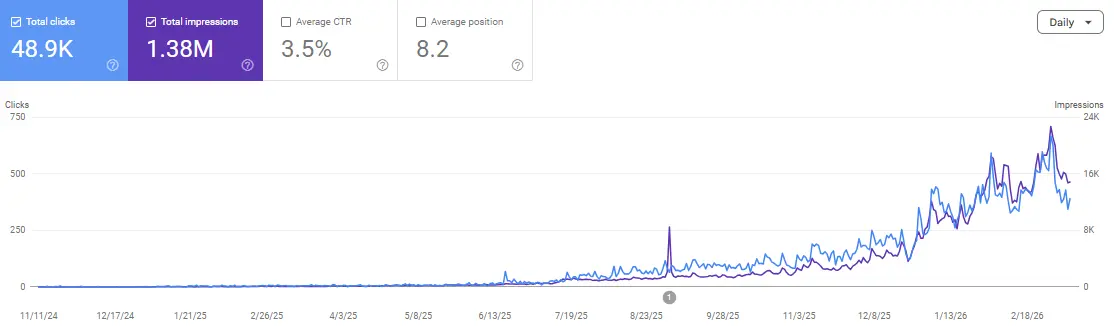
Google’s Search results performance documentation describes clicks, impressions, CTR, average position, and dimensions such as queries, pages, countries, and devices. Results depend on the searcher’s context, so a manual check may differ from the results contributing to the report.
A practical review sequence is:
- Choose the relevant page or topic group.
- Compare suitable date ranges, accounting for the news cycle.
- Split the review by country and device where useful.
- Inspect query mix alongside clicks, impressions, CTR, and position.
- Compare those patterns with your dated SERP observations.
Our approach to Search Console keyword research helps turn that review into a defined question set.
Do not equate Search Console’s News search type with Top Stories in ordinary web results. Google’s search-metrics documentation distinguishes search surfaces and counting rules. Choose the report that matches the surface you are analyzing.
Track generative visibility separately
Google’s Generative AI performance report describes link impressions within AI Overviews and AI Mode, with page, country, date, and device dimensions. It is not a transcript explaining which passage supported an answer.
Use it alongside exact-source observations. A rise in generative impressions does not by itself establish more visits, a positive recommendation, or an accurate summary.
Keep analytics and reader actions alongside those visibility records. A newsletter signup, subscription, inquiry, or relevant product action answers a business question that a feature count cannot.
Diagnose the Pattern Before Assigning a Fix
Different patterns justify different investigations.
Clicks decline while impressions are broadly stable. Inspect the query mix, competing results, title presentation, and changed layouts. An AI Overview could be relevant, but the metric alone cannot identify its contribution.
Clicks and impressions both decline. Investigate demand, coverage timing, indexing, lost placements, and competitors. A story moving out of the active news cycle can change demand substantially.
Ordinary search clicks hold while generative visibility changes. Inspect the affected pages and queries before declaring an overall visibility crisis.
Desktop changes while mobile holds. Keep the device analysis separate. Combining the two may conceal the pattern you need to explain.
These are diagnostic prompts, not automatic causes. Preserve unresolved questions rather than forcing every decline into an AI explanation.
What Publishers Should Change First
Start with the material that gives readers a reason to seek out your reporting.
An original document, a verified interview, a local observation, or a carefully explained dataset provides something beyond a summary of other coverage. Make that contribution visible near the relevant claim.
Google’s generative search optimization guidance recommends useful, non-commodity content and retains foundational SEO requirements. It also warns against creating pages for every query variation merely to manipulate generative results.
That supports a focused editorial response:
- Identify which stories contain reporting you uniquely obtained.
- Make the source, scope, and limitations clear.
- Add useful analysis where the audience needs interpretation.
- Provide a sensible next step for readers who want ongoing coverage.
- Review generic coverage whose production costs exceed its demonstrated usefulness.
Do not assume every short factual article should disappear. A concise update may serve a newsletter, live coverage, or an existing readership even if its search contribution is limited.
Maintain the technical foundation
Check that important articles can be accessed, their main content is available, and their publication details are accurate.
Google’s Article structured-data documentation says markup can help explain article information, but it is not required for eligibility in news features such as Top Stories. Adding NewsArticle markup is therefore not a promise of placement or an AI citation shortcut.
Validate the implementation against the visible article instead of using schema to describe content that is absent.
What Small Businesses Should Change First
Focus on the decision customers need to make after encountering a headline or summary.
Consider a hypothetical repair company publishing updates about a manufacturer recall. Rewriting the announcement alone gives people little additional reason to visit. A useful page could explain which products the company services, how customers can identify the relevant model, and where to verify the manufacturer’s current instructions.
The company must verify its service scope and cite the authoritative notice. It should not invent recall eligibility, claim authorized status it does not hold, or promise a remedy the manufacturer has not confirmed.
This example is illustrative, not an observed Scale Xpert campaign.
The editorial opportunity is to add supported, business-relevant information. The principles behind non-commodity content apply without turning every small business into a newsroom.
Make the Evidence Easy to Check When Pursuing Citations
There is no reliable formatting trick that guarantees selection. You can, however, make a resource easier for a reader or editor to assess.
Identify the claim. Use a descriptive heading and answer the actual question directly.
Attach the source. Link to the original document, official statement, research, or clearly identified reporting behind the claim.
Preserve the conditions. Keep the relevant market, time period, product version, or limitation beside the answer.
Label the contribution. Distinguish your observation from a quoted statement, a hypothetical example, or an inference.
Keep changing facts current. Correct substantive errors and explain meaningful updates rather than refreshing a date without reviewing the material.
These practices improve verification. They do not establish a ranking recipe. After publication, open actual citations and inspect whether the generated claim is supported and accurately attributed.
Decide Whether to Update, Repurpose, or Stop a Content Assignment
Use a content audit to connect performance with purpose before making production cuts.
Update when the page still answers a relevant question but lacks current evidence, a useful explanation, or a clear next step.
Repurpose when the subject serves an existing audience better through another format, such as a newsletter briefing, video explanation, or maintained resource.
Reconsider the assignment when the page repeats widely available information, has no distinct audience role, and does not justify ongoing production and maintenance.
Avoid deleting a useful archive or original report purely because direct traffic fell. Check inbound references, returning-reader use, business relevance, and retention needs.
Likewise, do not keep producing a daily summary only because competitors publish one. Define who it helps and what evidence supports continuing.
A Practical First Review
Begin with one topic rather than a site-wide overhaul.
Establish the baseline: Select representative queries and relevant URLs. Record current layouts, site performance, and the reader or customer actions that matter.
Classify the exposure: Separate feature absence, feature position, your own inclusion, and answer accuracy.
Choose one action: Improve the missing evidence, repair a technical problem, revise the page’s next step, or adjust an unproductive assignment.
Review comparable observations: Repeat the checks over a suitable period and document other changes. A breaking story may need frequent checks; an evergreen topic may require a longer evaluation window.
This is a proposed workflow. It does not promise a ranking, citation, or traffic recovery within a fixed number of days.
Frequently Asked Questions
Are AI Overviews replacing every News Box?
No. The analysis does not establish universal replacement or an announced retirement of Top Stories. Inspect the features appearing for your own important queries.
Does the reported decline mean publishers lost the same percentage of traffic?
No. Feature shares and website visits are different measurements. Your traffic impact requires your own performance and audience data.
Does appearing inside an AI Overview mean my article was recommended?
Not necessarily. A link may support a particular fact without endorsing your publication or recommending your business. Inspect the answer and exact source URL.
Can Article schema guarantee Top Stories inclusion?
No. Google says Article markup is not required for eligibility in those news features. Correct markup is useful context, not a placement guarantee.
Should small businesses publish more news to get AI citations?
Only when the coverage serves a relevant audience and the business can add verified value. More articles alone do not establish a stronger citation opportunity.
How do I investigate stable rankings with falling clicks?
Compare demand, query mix, devices, countries, competing results, and observed layout changes. A stable average position does not describe every search experience or establish the cause of lower CTR.
Measure the Opportunity Your Audience Actually Sees
Track where your content appears, what the surrounding result page offers, and what readers do next. That gives you a clearer basis for editorial investment than treating every feature change as either a disaster or a guaranteed AI opportunity.
If you want to connect that review with a manageable SEO and Reddit visibility plan, you can connect with Paul Gautheron on LinkedIn. Scale Xpert combines technical priorities, useful content, and measured discovery within a monthly workflow.