An article that once brought in steady enquiries now attracts fewer visitors. Your first instinct may be to update the year, add several headings, and publish a longer version.
That can be the right response to outdated information. It can also waste a week when the real problem is lower seasonal demand, a changed search results page, or a technical restriction.
Content decay describes a sustained loss of a page’s search performance as its usefulness, accuracy, or competitiveness falls behind. Marketers sometimes use the term more broadly for declining traffic. For practical SEO work, the distinction matters: falling clicks are a symptom; a content problem is a diagnosis you still need to establish.
This guide explains how to find the affected pages, test alternative explanations, choose an appropriate action, and assess whether the work helped.
What Is Content Decay in SEO?
A page can remain readable and factually correct while becoming less useful for the decision its readers need to make.
A software tutorial may show an interface that no longer exists. A comparison may omit a feature buyers now consider essential. An installation guide may explain the theory but leave out the compatibility check that newer resources handle clearly.
Those are concrete content gaps. They give you something to investigate and improve.
Age alone is less informative. An older explanation can still answer a stable question well. A recently published page can already be inaccurate. Nor does every article follow an inevitable growth-peak-decline curve on a predictable schedule.
The useful question is: what changed between the page’s earlier success and its current performance, and does that change require a content edit?
How Content Decay Differs From Other Traffic Problems
Google’s guidance on diagnosing search traffic drops identifies several possible causes, including technical issues, ranking-system changes, seasonality, and changing interests. A decline does not establish which one applies.
Outdated Information or a Weaker Answer
The page still serves the right kind of intent, but important information has become stale, incomplete, or less useful than competing answers. A targeted refresh may be appropriate.
Search Intent Drift
The expected answer itself may have changed. A query once dominated by tutorials may now return product categories or interactive tools. Expanding the tutorial might leave it serving a different purpose from what the searcher wants.
Check whether competitors offer better versions of your format or fundamentally different formats. Our explanation of search intent drift develops that separate diagnosis.
Lower Demand or Seasonality
A holiday guide can lose impressions after the holiday without becoming worse. Compare equivalent seasonal periods and review interest in the topic. A quiet period may be normal.
A Technical or Tracking Failure
An unintended noindex directive, redirect, server problem, or analytics change can interrupt performance. A technical issue can also produce a gradual decline, so the shape of the graph alone is not enough to classify it.
Changes in the Search Results Page
Ads, answer features, videos, forums, and other results can change the path to a click. Check the actual query experience before assuming your title or article has become ineffective.
Several causes can overlap. The aim is to identify what the evidence supports rather than force every page into one label.
How to Find Content Decay Candidates in Search Console
Use the report to build an investigation list, not an automatic rewrite queue.
Start With Pages That Previously Served a Useful Purpose
Choose pages with an established baseline: meaningful search visits, qualified enquiries, sales assistance, or another documented role. Separate these from new pages that never gained traction.
The wider content audit process helps organize that inventory. This narrower review asks why a previously useful page is losing performance.
Compare Equivalent Periods
Begin with equal-length periods, such as a completed 28-day period against the previous 28 days. For seasonal subjects, add a comparable period from the previous year when available. These are investigation choices, not universal decay thresholds.
Avoid comparing a promotional peak with an ordinary month and calling the difference a content failure. Note unusual launches, press coverage, outages, and reporting changes alongside the comparison.
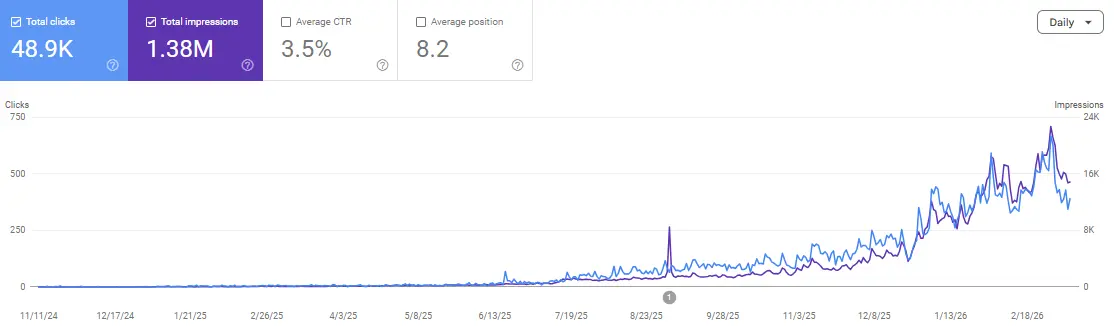
Examine Clicks, Impressions, CTR, and Position Together
Google’s Performance report documentation defines these metrics and supports analysis by pages, queries, countries, and devices.
Use them to form hypotheses:
- Clicks and impressions both fall: investigate demand, query coverage, rankings, access, and indexing.
- Clicks fall while impressions remain similar: investigate CTR, query mix, position changes, and the current results layout.
- One query group declines while another holds: investigate the lost use case rather than assuming the entire page needs replacement.
- Several pages sharing a template decline together: investigate shared changes as well as individual content quality.
Average position combines observations. It is not the fixed rank of every keyword. Keep important query groups, device types, and markets visible where possible instead of relying only on a sitewide average.
Check Whether the Pattern Persists
One weak week can be noise. An extended decline deserves attention, but there is no universal percentage or duration that proves decay.
Choose review triggers that fit the page’s volume and business role. A low-traffic specification page may deserve immediate correction when a material fact becomes wrong, even before its traffic trend is statistically informative.
An Example: Traffic Fell 37.5%, but the Cause Is Still Unknown
Consider a hypothetical page with 20,000 impressions and 800 clicks in one period. Its CTR is 4%.
In the next comparable period, it receives 20,000 impressions and 500 clicks. CTR is now 2.5%, and clicks have fallen by 37.5%.
Those figures establish a click decline. They do not prove that the content became outdated. The page could appear for a different query mix, face a different result layout, or occupy different positions within important query groups.
Before rewriting, review the queries that lost clicks, the current results, and any relevant site changes. Then inspect the content for a specific gap.
This prevents a common mistake: using the size of the loss as evidence of its cause.
Choose the Fix That Matches the Evidence
Every candidate should receive a brief decision note: observed change, likely cause, supporting evidence, proposed action, and what would challenge the diagnosis.
Refresh When the Page Still Fits the Need
Update incorrect facts, replace obsolete screenshots, clarify missing steps, and add evidence where readers need it. Preserve useful sections and query coverage that still serve visitors.
Write an edit brief such as “replace the unsupported compatibility claim and add the current setup limitation.” That is more useful than “make this article fresher.”
The implementation steps belong in our separate resource on refreshing old content for better rankings.
Reposition When the Page Serves the Wrong Intent
Decide whether the existing URL can meet the current need without losing a valuable purpose. A broad guide may still help informational queries even if a commercial query now needs a category page.
Creating a separate page can be appropriate when the intents are distinct. Creating another near-identical article simply because the first one declined is not a diagnosis.
Consolidate When Two Pages Duplicate the Same Job
Review the useful material and query coverage of both pages. Choose the destination that best serves the combined need, then plan the consolidation and link updates.
Multiple URLs appearing for related queries do not automatically prove harmful cannibalization. Establish whether they genuinely compete for the same purpose before merging similar blog posts.
Retain When the Page Remains Useful
A page may attract fewer casual visitors while continuing to support qualified prospects, existing customers, or other important pages.
Check those roles before reducing its priority. If it remains accurate and useful, monitoring may be a better decision than a major rewrite.
Retire When the Purpose Has Disappeared
An expired announcement or obsolete resource may no longer justify maintenance. Assess links, users, historical value, and any relevant replacement before removal.
Do not bulk-delete every URL with zero recent clicks. A quiet page can have a legitimate function outside organic acquisition.
Prioritize by Business Value, Evidence, and Effort
The largest traffic loss is not always the best recovery opportunity.
Compare a broad-interest article losing thousands of low-intent visits with a small product guide losing a few qualified enquiries. The second may deserve attention first if the gap is clear and the repair is straightforward.
For each candidate, record:
- The reader or customer task the page supports.
- Evidence that its performance or accuracy has deteriorated.
- The specific gap you can repair.
- The likely effort and dependencies.
- The uncertainty around the expected benefit.
Use these fields to order work rather than producing a precision score from guessed conversion rates. Estimated upside should remain visibly estimated.
What Counts as a Meaningful Content Update?
A meaningful update helps someone complete the page’s purpose more accurately or effectively.
Examples include correcting a price condition, documenting a changed workflow, replacing an unsupported statistic, adding an overlooked limitation, or testing an example that previously relied on assumptions.
Google’s people-first content guidance cautions against changing dates merely to appear fresh and rejects writing to a supposed preferred word count. A larger article is not automatically a better answer.
For a hypothetical integration guide, the missing value might be a short explanation of which account permissions are required. Adding five generic sections about the history of integrations would not address that gap.
Where evidence is missing, consider original, non-commodity content: a documented test, an expert explanation, or an example with stated conditions. Do not manufacture experience or results to make a refresh look substantial.
Can Content Decay Affect AI Citations Too?
Outdated information deserves correction whether a reader reaches it through Google, a link, or an AI answer. However, declining search clicks and disappearing from a sample of AI answers are different observations.
Google’s AI features guidance says supporting links require indexing and eligibility to appear with a Search snippet. It does not prescribe special AI markup or guarantee selection.
For citation monitoring, keep a small set of relevant questions and save dated answers with their sources. Check which claim each source actually supports. A missing citation in one run does not prove the page has decayed, and a new citation does not prove your update caused it.
Make important claims easy to verify: name the subject, state the conditions, link supporting evidence where appropriate, and distinguish tested findings from estimates. These improve source usefulness without creating a guaranteed citation formula.
How to Measure Whether a Refresh Helped
Create a before-and-after record while the reasons for the edit are still clear.
Save the original page or a change summary, affected query groups, baseline metrics, edit date, and expected reader benefit. Record concurrent changes to internal links, templates, products, or promotional activity.
After publication, confirm the page still works and that the intended changes are visible. Then review search and business outcomes over a period appropriate to the page’s volume and seasonality.
Keep three conclusions separate:
The edit was implemented: the inaccurate information or missing step has been corrected.
Performance changed: comparable observations show movement in relevant queries, visits, or outcomes.
The edit caused the change: this requires stronger evidence than timing alone. Similar untouched pages can provide context, but differences in demand or intent may still limit the comparison.
For low-volume pages, avoid declaring success from one additional sale or failure from one quiet week. State when the available data is insufficient.
A Maintenance Schedule Based on What Can Change
Different pages have different expiry risks.
Pricing, product availability, interface instructions, and regulatory references need review when their underlying facts change. Stable explanations can be reviewed less often unless performance or reader feedback flags a problem.
Assign an owner and the next reason to review: a product release, a policy change, a recurring accuracy check, or a sustained performance shift. A review date is a workflow reminder, not an obligation to change the publication date.
This approach makes maintenance more useful than a blanket rule to rewrite everything every six months.
Frequently Asked Questions
Is content decay an automatic Google penalty for old pages?
No. Content decay is an SEO diagnosis, not proof of an age-based penalty. Investigate usefulness, competition, demand, technical conditions, and search changes before choosing a remedy.
What percentage traffic drop proves content decay?
No universal threshold proves it. Compare relevant periods and query groups, then look for evidence of a content gap. A large loss can still have a noncontent cause.
Will changing the date improve rankings?
Changing the date alone does not improve the answer. Correct substantive information where necessary and describe updates honestly.
Should I change the URL when refreshing content?
Usually there is no need to change a suitable URL merely because its information was updated. A new address should follow a real structural or purpose change, with an appropriate migration plan.
Should I delete pages with no recent organic clicks?
Not automatically. Check customer usefulness, links, seasonal demand, and the page’s role before choosing removal, consolidation, or continued maintenance.
How long does content decay recovery take?
There is no guaranteed recovery period or outcome. Confirm implementation first, then evaluate comparable search and business data. Revisit the diagnosis if the evidence does not support the expected improvement.
Fix the Gap, Not Just the Graph
Content decay becomes actionable when you can explain what a page no longer does well and how the proposed change addresses it. Until then, a downward line is a reason to investigate rather than a brief for a rewrite.
Keep useful content, repair verified gaps, and measure against the reader’s task and the page’s business role. That makes maintenance a series of informed decisions instead of an endless demand for more words.
If you want content reviews, technical fixes, and visibility work to become a consistent monthly process, connect with Paul Gautheron on LinkedIn. Scale Xpert brings those activities together with progress reviewed against meaningful site outcomes.