SEO content prioritization means choosing which existing pages and new opportunities deserve your limited production time. Start with the work that protects customers and important business outcomes, then compare the remaining opportunities using evidence, effort, and readiness.
A declining article does not automatically need a rewrite. A high-volume keyword does not automatically deserve a new page. Both are candidates for investigation.
This framework helps turn those candidates into an actionable queue: correct urgent problems, establish what needs to change, and assign only the work you can justify.
Research checked: October 23, 2026. The workflow and capacity example below are editorial planning tools, not a validated ranking model or a Scale Xpert case study.
Prioritize Interventions, Not Just URLs
“Update our pricing guide” is a topic-level request. “Replace the discontinued plan comparison and explain the current limits using verified product information” is an intervention.
That distinction changes how you estimate time and evaluate the result.
One URL might need a factual correction today and a larger structural review later. Another might need no content changes because the actual problem is an accidental indexing restriction.
Build the backlog around specific jobs. Each should identify:
- The customer need or business problem.
- Evidence supporting the proposed change.
- What will be delivered.
- Dependencies and estimated effort.
- The signal you will review afterward.
If you have not assembled your page inventory, our content audit guide provides the starting process. Prioritization begins when you decide what to do with the findings.
Separate Urgent Corrections From Growth Opportunities
Do not force every task into one weighted score.
An inaccurate price, a broken enquiry path, or an unavailable core service page can need attention even when search traffic is low. Correcting those problems protects the usefulness of the site.
Use three work queues:
| Queue | What belongs here | Decision rule |
|---|---|---|
| Correct or restore | Verified factual errors, broken journeys, accidental access problems | Assess customer and business consequences promptly |
| Improve or expand | Supported opportunities to improve a page or serve a distinct need | Compare expected usefulness, evidence, effort, and dependencies |
| Investigate or monitor | Unexplained changes, uncertain gaps, healthy pages without a specific defect | Gather the missing evidence or set a review condition |
These queues are a planning recommendation. They are not Google ranking categories.
They prevent an attractive traffic forecast from pushing a necessary correction to the bottom of a spreadsheet.
Diagnose Declines Before Scheduling Rewrites
Google’s traffic-drop guidance lists several possible causes, including technical problems, changing demand, and ranking changes. It also advises against radical edits when a page is already performing well and has only a small position fluctuation.
Treat a decline as an observation first.
A practical diagnosis can begin with this table:
| Observation | Check before assigning content work |
|---|---|
| Clicks fall across many sections | Site availability, reporting issues, demand, and broader changes |
| One URL loses visibility | Indexability, canonical behavior, internal links, and query relevance |
| Clicks fall while impressions hold | Query mix, position, device, country, and current results |
| Visits remain steady but enquiries decline | Tracking, offer changes, contact flow, and visitor quality |
| Performance weakens during a familiar season | Comparable seasonal periods and demand patterns |
These checks identify alternative explanations. None proves a cause by itself.
For example, a seasonal guide losing visits after its relevant event may need accurate dates for the next cycle. It may not need a comprehensive rewrite to “recover” demand that has temporarily disappeared.
Use Search Console Without Turning Averages Into Certainty
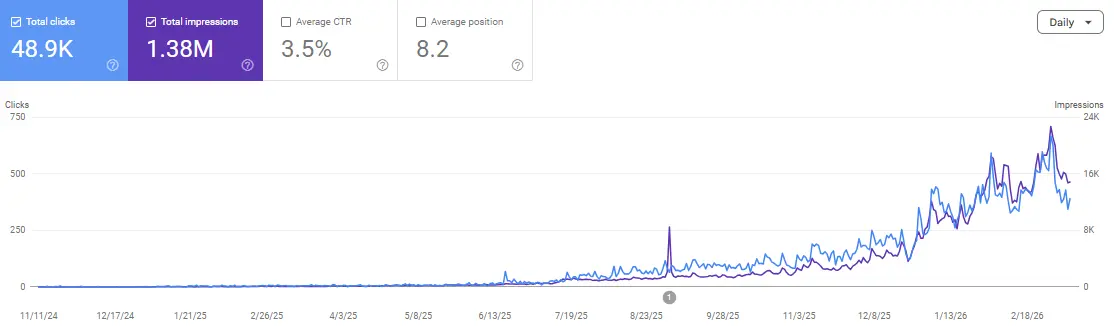
Google’s Performance report documentation explains clicks, impressions, CTR, and average position, with dimensions such as queries, pages, countries, and devices.
Use a consistent reporting scope when comparing periods. Note changes in filters, geography, device mix, or the queries contributing to the total.
A page-wide average position can conceal different movements across query groups. A generic CTR benchmark can also miss differences in brand familiarity, result layout, and the type of question being answered.
For a suspected click opportunity, record:
- The relevant page and query group.
- Comparable reporting periods.
- The observed change.
- What the search result currently promises.
- What the destination actually delivers.
A low CTR makes a page worth inspecting. It does not establish that a title rewrite will recover a predictable number of visits.
Decide Whether the Existing Page Can Serve the Need
Before approving a new URL, ask whether a current destination can answer the question well.
Our keyword mapping guide helps connect related search needs with existing or proposed pages.
Use the reader’s task to choose the action:
| Situation | Suitable next action |
|---|---|
| The existing page serves the right purpose but contains a verified gap | Update the relevant material |
| A new question fits naturally within that purpose | Add a useful section |
| The question requires a distinct decision, format, or substantial workflow | Evaluate a separate page |
| Two pages substantially duplicate the same reader task | Investigate consolidation |
| The page is accurate and performs its intended role | Monitor without a speculative rewrite |
A comparison guide and a product documentation page may share terminology while serving different needs. Two URLs appearing for the same query do not automatically prove harmful cannibalization.
Conversely, changing a title slightly is not enough to establish a distinct purpose for a new article.
Require Evidence Before Calling Something a Content Gap
A competitor publishing a page proves that the competitor published it. It does not prove that your audience needs the same page or that you can improve on it.
Build a short opportunity brief:
Audience: Who needs the information?
Task: What are they trying to decide or accomplish?
Evidence: What queries, customer questions, support records, or observed workflows support the need?
Existing coverage: Which current pages were checked?
Contribution: What can you verify, explain, demonstrate, or provide that adds useful value?
Destination: Where will the page fit, and which relevant pages will link to it?
Keyword metrics can inform this assessment. Our guide to prioritizing keywords covers that input. The production decision also needs evidence that a page can help the intended audience.
Use Reddit Questions as Research Leads
A relevant discussion can expose confusing terminology, practical constraints, or a missing comparison.
Read the thread in context. Record the question and distinguish one person’s situation from recurring demand. Check whether the issue applies to your actual offer.
Then verify the answer with appropriate evidence. A forum complaint can suggest what to investigate; it is not a substitute for product documentation or a reliable test.
This approach can improve the brief without inventing customer research or turning community participation into promotion.
Make Business Value Explicit
“Commercial keyword” is too vague to explain why one task matters more than another.
Describe the business connection:
- Helps an appropriate buyer evaluate a current service.
- Prevents customers from acting on an obsolete instruction.
- Resolves a recurring support question.
- Improves a route to a booking or purchase.
- Provides evidence needed during a comparison.
A low-traffic compatibility page may be useful if it prevents unsuitable purchases. A high-traffic definition page may have a longer and less measurable path to revenue.
Do not assign a fictional lead value to make the opportunity appear precise. If the conversion path is uncertain, record that uncertainty.
Compare Effort and Evidence Without Inventing Precision
For each candidate, write four short assessments:
Value: What useful outcome could improve?
Evidence: What observation supports the intervention, and what remains unknown?
Effort: What research, writing, review, design, technical work, and quality checks are required?
Readiness: Can someone begin now, or does the task depend on missing expertise, data, or approval?
These notes make tradeoffs visible without implying that a score predicts rankings.
A numerical model can help a team organize a large backlog, but its weights are management choices. Test whether small changes to the assumptions reverse the order. If they do, the ranking is fragile.
Do not directly subtract a domain authority metric from a keyword difficulty metric and treat the result as a proven feasibility threshold. Inspect the actual results, page types, evidence requirements, and the contribution your business can make.
A Worked Example: Allocate 16 Hours of Capacity
The following backlog is hypothetical. The estimates illustrate resource allocation, not standard production times.
| Candidate job | Evidence available | Estimated effort | Decision |
|---|---|---|---|
| Correct an obsolete pricing explanation | Current offer has been verified | 2 hours | Correct now |
| Repair an accidental restriction on a core page | Restriction confirmed by inspection | 3 hours | Restore access |
| Improve a comparison page’s missing limitation section | Recurring buyer question and documented product limits | 4 hours | Update |
| Create a distinct compatibility guide | Existing coverage checked; technical reviewer and verified details available | 5 hours | Create |
| Rewrite a high-impression article’s title | CTR looks weak, but query mix is unexplained | 2 hours | Investigate first |
| Merge two related guides | Shared queries, but reader tasks have not been compared | 6 hours | Hold for review |
The first four jobs use 14 hours. Reserve the remaining two hours for checking changes and documenting follow-up evidence.
This allocation contains both updates and new content. It follows the evidence rather than a fixed refresh-to-publishing ratio.
The investigation tasks still matter. Give them an owner and a review condition so that “hold” does not become a permanent forgotten status.
Make the Refresh Worth Doing
A refresh brief should explain what will become more useful.
Google’s people-first content guidance asks publishers to assess original information, reliable sourcing, and whether readers can achieve their goal. It also questions changing dates without substantial changes.
Useful refresh work might include:
- Replacing an outdated procedure with verified current steps.
- Explaining a limitation that changes the recommendation.
- Adding a reproducible example and its assumptions.
- Removing a claim that cannot be supported.
- Improving a decision table with evidence from a subject expert.
Our guide to creating non-commodity content develops that contribution further.
Adding headings, length, or a recent date can make a page look maintained without solving the reader’s problem.
Where Does AI Citation Potential Fit?
Treat AI visibility as another outcome to investigate, not a reason to abandon the same evidence standards.
Google’s AI features guidance says established SEO practices remain relevant for AI Overviews and AI Mode. It does not prescribe special markup or an additional optimization requirement.
For a citation-oriented opportunity, ask:
- Is the source page accessible and eligible?
- Does it answer a distinct question with verifiable information?
- Are conclusions, dates, limitations, and supporting evidence clear?
- Would the work still help the intended reader without an AI citation?
A useful table or method may make an answer easier to understand and reference. It does not guarantee selection.
If monitoring AI answers, record the platform, question, date, and observed result. Do not label one missing mention as a proven site-wide content defect.
Measure the Intervention, Then Revisit the Queue
Save a baseline before editing. Record the change date, scope, intended outcome, and relevant external changes.
Choose evaluation signals that fit the intervention:
| Intervention | Useful evidence afterward |
|---|---|
| Correct a factual claim | Published information matches the approved source |
| Restore access | The intended page works and subsequent crawler evidence reflects the repair |
| Clarify a comparison | Relevant visitor behavior and qualified questions |
| Publish a new guide | Discovery, indexing, relevant visibility, and its customer purpose |
| Simplify a conversion path | Successful completions and business-quality outcomes |
For search changes, the updated page must be processed before the later report can reflect it. Our guide to Google crawl timing explains why a completed edit and a visible search outcome occur at different stages.
A before-and-after increase is an observation. Demand, other site changes, and search-result changes can influence the same period. Use comparable segments and note these limitations before attributing all growth to the edit.
Refresh the backlog when evidence, business priorities, or dependencies change. A monthly review is a practical starting cadence for many small teams, with urgent corrections handled sooner.
Frequently Asked Questions
Should I update old content before publishing new articles?
Prioritize whichever intervention has stronger evidence and business value. Some existing pages need urgent corrections; some new needs justify a separate destination.
Are pages near the first page always the best opportunities?
They are candidates for inspection. Position alone does not establish the defect, the likely improvement, or the value of the traffic.
How do I know whether declining traffic means content decay?
Check demand, technical access, query mix, and other changes before concluding the content has become less useful or accurate.
Should every opportunity receive a numerical score?
No. Small backlogs can use explicit value, evidence, effort, and readiness notes. Scores should organize decisions rather than imply a validated forecast.
Does publishing a competing article create cannibalization?
Shared vocabulary is not enough to decide. Compare the reader tasks, current destinations, and whether each page has a distinct useful purpose.
Can content updates guarantee AI citations?
No. Improve accuracy, accessibility, and original usefulness, then monitor citation outcomes separately.
Give Every Assignment a Reason to Exist
Before committing production time, name the problem, show the supporting evidence, and define the finished intervention. Protect customers from known errors, make room for genuine new needs, and leave useful pages alone when no specific improvement is justified.
If you want to connect that queue with a broader visibility plan, you can compare your content priorities with Paul Gautheron. Scale Xpert focuses on SEO and Reddit visibility, bringing technical maintenance, useful content, and discovery into the same planning conversation.