How to do a content audit for SEO means reviewing your existing pages to decide what should be updated, merged, redirected, noindexed, or removed. This matters because weak, outdated, thin, or overlapping content can reduce content performance and make your website harder to improve.
In this guide, you will learn how to use Google Search Console, keyword checks, internal linking, and a simple content audit checklist.
What Is a Content Audit for SEO?
A content audit for SEO is a structured review of your website content. Instead of publishing more articles without direction, you check what already exists and decide what each page needs.
A good SEO content audit helps you answer:
- Which pages get clicks and impressions?
- Which pages have high impressions but low CTR?
- Which pages rank on page two or three?
- Which pages are outdated or thin?
- Which pages overlap with similar topics?
- Which pages need better internal linking?
Because of this, a website content audit is not only about traffic. It is also about quality, search intent, topical authority, crawlability, and user value.
Why a Content Audit Matters for SEO
A content audit matters because old content can quietly hold your site back. For example, a guide from two years ago may still get impressions, but the title, examples, screenshots, and recommendations may no longer match what users need.
Google says its ranking systems prioritize helpful, reliable, people-first content, not content created mainly to manipulate rankings. Therefore, your audit should focus on usefulness, not only keyword count or word count.
In addition, Google Search Essentials recommends using words people would search for in important places like titles, main headings, alt text, and link text. Because of this, a content audit for SEO should check whether each page clearly targets the right topic.
How to Do a Content Audit for SEO With a Spreadsheet
Start your audit with a simple content inventory. This gives you one place to track URLs, data, issues, and actions.
Use these columns:
| Items | Purpose |
|---|---|
| URL | Page being reviewed |
| Page title | Current SEO title or H1 |
| Content type | Blog post, guide, landing page, category page |
| Primary keyword | Main keyword target |
| Clicks | Organic visits from Google Search |
| Impressions | Search visibility |
| CTR | How often users click |
| Average position | Ranking range |
| Last updated | Freshness check |
| Main issue | Thin, outdated, duplicate, low CTR |
| Action | Keep, update, merge, redirect, noindex, delete |
This spreadsheet makes decisions easier. As a result, you avoid guessing and can prioritize pages with the highest SEO opportunity.
Step 1: Export Data From Google Search Console
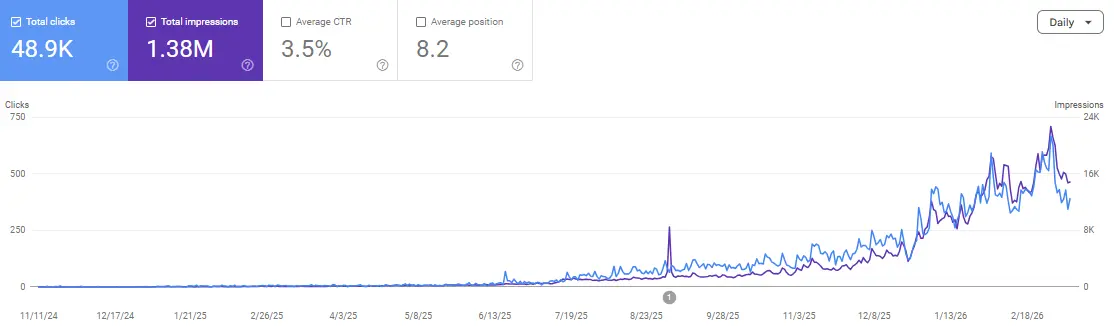
Google Search Console should be your first data source because it shows real search performance. The Performance report helps you review search traffic, queries, pages, clicks, impressions, CTR, and average position.
Use this process:
- Open Google Search Console.
- Go to Performance.
- Select Search results.
- Choose the last 3 or 6 months.
- Activate clicks, impressions, CTR, and average position.
- Export page data.
- Export query data for important pages.
After that, sort pages by impressions, clicks, CTR, and position. This helps you find pages that are visible but not getting enough traffic.
Step 2: Find Weak Pages and SEO Opportunities
Next, group pages based on performance. This makes your SEO content audit easier to act on.
| Page type | What it means | Likely action |
|---|---|---|
| High clicks, high impressions | Strong page | Keep and refresh |
| High impressions, low clicks | Visible but weak CTR | Improve title, meta, intro |
| Position 8 to 30 | Almost ranking | Update content and add links |
| No clicks, no impressions | Weak or undiscovered | Improve, merge, or remove |
| Similar pages | Possible keyword cannibalization | Merge or separate intent |
For example, a page with 10,000 impressions and 5 clicks may need a better title and meta description. Meanwhile, a page in average position 12 may need stronger content optimization and internal links.
Step 3: Review Content Quality Manually
Data shows where to look, but it does not explain everything. Therefore, open each priority page and review it like a reader.
Check these points:
- Does the introduction answer the query quickly?
- Does the page match search intent?
- Are the headings specific and useful?
- Is the content outdated?
- Are examples practical?
- Is the article too thin?
- Are claims supported?
- Are screenshots or visuals needed?
- Are FAQs included?
- Does the page link to related guides?
If the page feels vague, rewrite the opening and add clearer sections. However, if the topic no longer fits your site, consider merging, noindexing, or deleting it.
Step 4: Check Search Intent and Keyword Match
Search intent is one of the most common reasons content underperforms. A page can target the right keyword but answer the wrong need.
Use this table:
| Keyword | User wants | Better format |
|---|---|---|
| content audit | Definition and process | Beginner guide |
| content audit checklist | Action steps | Checklist article |
| content audit template | Download or spreadsheet | Template page |
| SEO audit service | Help from provider | Service page |
Because of this, do not force every keyword into one article. Instead, check the SERP and decide whether the page should be updated or whether a separate page is needed.
Step 5: Check Thin Content and Outdated Content
Thin content is content that gives little value compared with what the searcher needs. It may be short, vague, copied, outdated, or missing important subtopics.
Look for pages that have:
- very little useful information
- repeated advice with no examples
- outdated screenshots
- old pricing, tools, or policies
- missing FAQs
- no internal links
- no clear primary keyword
- weak title and headings
In addition, check whether the page still supports your current SEO content strategy. If not, a content refresh may be better than keeping it unchanged.
Step 6: Find Keyword Cannibalization
Keyword cannibalization happens when multiple pages compete for the same keyword or search intent. This can confuse your content strategy and split ranking signals.
Use this simple Google Search Console method:
- Open the Performance report.
- Click Queries.
- Select an important query.
- Click Pages.
- Check which URLs get impressions for that query.
- Compare the pages manually.
If two pages target the same intent, merge content into the stronger page and redirect the weaker URL. However, if the pages serve different intent, keep both and improve internal linking between them.
Step 7: Decide the Best Action for Each Page
Now choose one action for every audited page. This is where the content audit checklist becomes useful.
| Action | When to use it |
|---|---|
| Keep | Page performs well and is still useful |
| Update | Page has potential but needs improvement |
| Merge | Several weak pages cover the same intent |
| Redirect | Old URL should point to a stronger URL |
| Noindex | Page is useful for users but not search |
| Delete | Page has no traffic, links, purpose, or value |
Be careful before deleting content. First, check organic traffic, backlinks, internal links, conversions, and business value.
Step 8: Handle Duplicate Content and Canonical URLs
Duplicate content and very similar pages need careful decisions. Google explains that canonicalization is the process of choosing the representative URL from a set of duplicate pages.
If you keep similar pages, make sure each page has a clear purpose. In addition, link internally to the canonical URL when you want Google to understand your preferred page. Google recommends linking consistently to the URL you consider canonical.
For merged pages, use a 301 redirect from the weaker URL to the stronger URL. For near-duplicate pages that must stay live, use canonical tags carefully.
Step 9: Improve Internal Linking
Internal linking is a key part of how to do a content audit for SEO because it helps users and search engines move through your site. Google also says links help it find pages and understand relevance.
Check whether important pages have enough internal links. Also, update old articles so they link to newer and more complete guides.
For example, a content audit article can link to related posts about thin content, keyword cannibalization, merging blog posts, Google Search Console, and internal linking. As a result, your topic cluster becomes stronger.
How to Do a Content Audit for SEO: Final Checklist
Use this checklist before finishing the audit:
- Export GSC page and query data
- Build a content inventory spreadsheet
- Find high-impression, low-CTR pages
- Find almost-ranking pages
- Review thin content and outdated content
- Check search intent
- Identify keyword cannibalization
- Review duplicate content and canonical URL signals
- Improve internal linking
- Assign one action to each page
- Track results after updates
After making changes, wait a few weeks and review clicks, impressions, CTR, and average position again. This helps you see whether your content optimization is working.
FAQs About Content Audits
What is a content audit for SEO?
A content audit for SEO is a review of existing website content to decide what should be kept, updated, merged, redirected, noindexed, or deleted.
How often should I do a content audit?
For small sites, do a light audit every 3 to 6 months. For larger sites, review important sections monthly and run a full audit at least once or twice a year.
What tools do I need for a content audit?
Start with Google Search Console and a spreadsheet. In addition, you can use Google Analytics, Screaming Frog, Ahrefs, Semrush, or your CMS export.
Should I delete low-traffic content?
Not always. First, check search intent, backlinks, internal links, conversions, and business value. Then, decide whether to update, merge, noindex, redirect, or delete content.
What is the difference between updating and merging content?
Updating improves one existing page. Merging combines two or more similar pages into one stronger page, usually with a redirect from the weaker URL.
How do I measure content audit results?
Track clicks, impressions, CTR, average position, indexed pages, internal links, and conversions. Also, review whether updated pages better satisfy user intent.
Conclusion
How to do a content audit for SEO starts with collecting page data, checking quality, and choosing the right action for each URL. A strong audit helps you find weak pages, improve content performance, reduce keyword cannibalization, and build a cleaner website structure.
Instead of only publishing new content, use a content audit for SEO to update old content, merge similar posts, fix internal linking, and remove pages that no longer help users. Over time, this supports better topical authority and a more useful website.
Want help reviewing your SEO content audit, weak pages, ooor content audit checklist? Join the Scale Xpert community here.