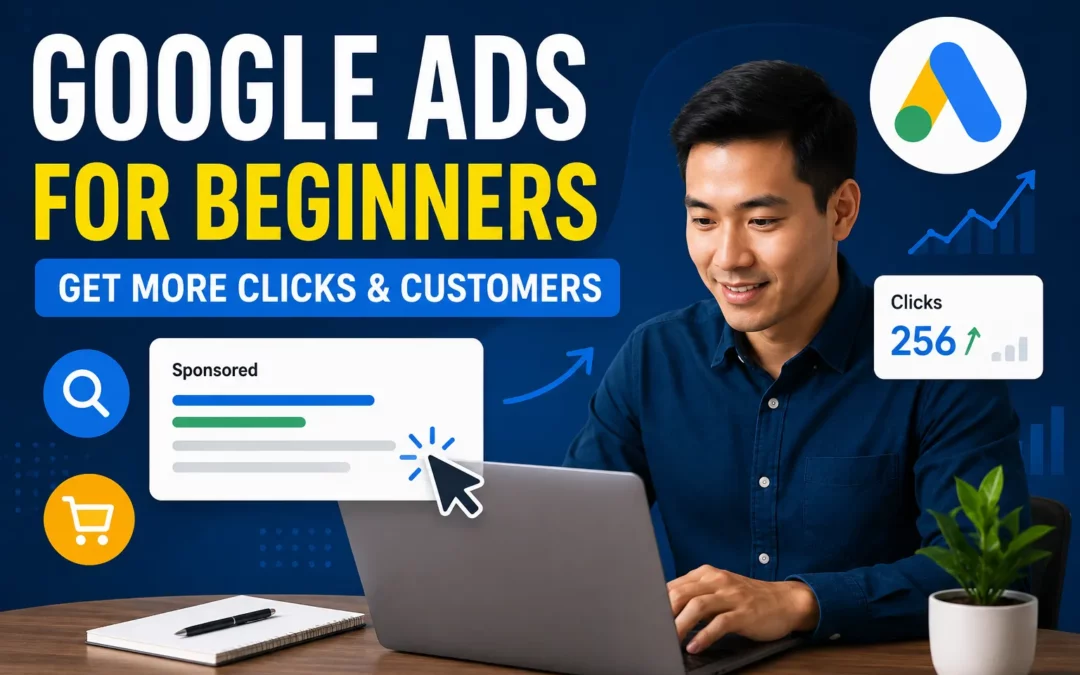
Google Ads is Google’s online advertising platform that allows businesses to create ads and show them across Google Search, YouTube, Gmail, Maps, and millions of partner websites. It is the world’s most widely used digital advertising system, handling over 8.5 billion searches per day and giving advertisers access to users at the exact moment they express intent through a search query.
For most businesses, Google Ads is the primary tool for executing Search Engine Marketing (SEM) campaigns. When you see results labeled “Sponsored” at the top of a Google search, those are Google Ads. The platform operates on a Pay Per Click model you only pay when someone clicks your ad, not simply when it is displayed. Setting up Google Ads for the first time and feeling overwhelmed? Our community includes practitioners who have built and scaled campaigns from zero ask your questions here.
What Is Google Ads?
Google Ads (formerly known as Google AdWords until 2018) is an online advertising platform developed by Google that enables businesses and individuals to create ads displayed across Google’s vast network of properties and partner sites.
At its core, Google Ads is an auction-based system. Advertisers bid on keywords, and Google uses those bids alongside Quality Score — a measure of ad relevance and landing page quality to determine which ads appear and in what order. This system is what powers every sponsored result you see at the top of Google Search.
Google Ads is the primary execution platform for SEM campaigns. Understanding what SEM is and how it works as a broader strategy provides essential context before diving into the specific mechanics of the Google Ads platform itself.
How Does Google Ads Work?
Google Ads works through a structured hierarchy of campaigns, ad groups, keywords, and ads. Every time a user performs a Google search, an instantaneous auction runs among all advertisers bidding on relevant keywords. The auction determines which ads appear and where.
Here is the flow from setup to result:
1. Account and Campaign Setup You create a Google Ads account, set your campaign goal (sales, leads, website traffic, brand awareness), and configure your campaign settings budget, geographic targeting, language, and bidding strategy.
2. Ad Groups Within each campaign, you create ad groups that cluster related keywords and ads together. Each ad group should focus on a tightly related theme.
3. Keyword Targeting You choose the keywords that trigger your ads. The match type you assign — broad, phrase, or exact — controls how closely a user’s search must match your keyword.
4. Ad Creation You write your ads — headlines, descriptions, and display URL. Google recommends using Responsive Search Ads (RSAs), where you provide up to 15 headlines and 4 descriptions and Google tests combinations to find what performs best.
5. Bid and Budget You set a maximum CPC bid per keyword or campaign, plus a daily budget cap. Google’s auction uses your bid alongside Quality Score to calculate Ad Rank.
6. Ad Auction Every search triggers the auction. Your Ad Rank determines your position. You pay only when someone clicks. The full mechanics of how the ad auction and ranking system works are worth studying in depth because winning the auction efficiently is the foundation of profitable Google Ads campaigns.
Google Ads Campaign Types
Google Ads offers multiple campaign types, each designed for different advertising goals and placements:
Search Campaigns
Text ads that appear on Google’s search results page. These are the most direct SEM format triggered when users search for your keywords. Best for capturing high-intent users who are actively looking for your product or service.
Shopping Campaigns
Product listing ads showing product images, names, prices, and store names. Triggered by product-related searches. Essential for e-commerce retailers. Managed through Google Merchant Center.
Display Campaigns
Visual banner ads shown across Google’s Display Network over 2 million websites, apps, and Google properties. Best for brand awareness and remarketing. Can be targeted by audience demographics, interests, or browsing behavior.
Video Campaigns
Video ads on YouTube and across Google’s video partner network. Formats include skippable in-stream ads, non-skippable ads, bumper ads (6 seconds), and discovery ads. Charged per view or per click depending on format.
App Campaigns
Ads designed to drive app installs or in-app actions across Google Search, Google Play, YouTube, and the Display Network. Google automates ad creation from your app store assets.
Performance Max Campaigns
Google’s newest AI-powered campaign type that automatically optimizes ads across all Google Ads channels simultaneously. Uses Smart Bidding and requires minimal manual management. Best suited for advertisers with clear conversion goals and sufficient historical data.
For SEM beginners, Search campaigns are the recommended starting point. They are the most transparent, most directly controllable, and most aligned with the intent-based principles that make SEM powerful.
Google Ads Account Structure
Understanding the Google Ads account structure is fundamental to organizing campaigns that are easy to manage and optimize.
Account Level The top level. Contains all your campaigns, billing information, and account settings. One Google account can manage multiple Google Ads accounts through a Manager Account (formerly MCC).
Campaign Level Each campaign has its own budget, bidding strategy, geographic targeting, and network settings. A well-structured account separates campaigns by product line, geography, or keyword intent type.
Ad Group Level Within each campaign, ad groups cluster related keywords and their corresponding ads. A tightly themed ad group — where every keyword closely relates to the same user intent — produces higher Quality Scores and lower CPCs.
Keyword Level Individual keywords within each ad group trigger ads when matched to user searches. Each keyword has its own bid, match type, and Quality Score.
Ad Level The actual creative headlines, descriptions, URLs that users see on the search results page. Multiple ad variations within each ad group allow Google to test which performs best.
The principle of SKAG (Single Keyword Ad Group) where each ad group contains only one keyword — was popular for years and maximizes relevance control. Modern Google Ads management leans toward slightly broader, tightly-themed ad groups of 5–15 related keywords, which gives Google’s algorithms more data to optimize with.
Google Ads Bidding Strategies
Google Ads offers both manual and automated bidding strategies. Choosing the right one depends on your campaign maturity and data availability.
Manual Bidding
You set individual CPC bids at the keyword level. Maximum control, but time-intensive and requires constant adjustment as the competitive landscape changes.
Best for: New campaigns, limited budgets, advertisers who want full bid control while gathering data.
Smart Bidding (Automated)
Google’s machine learning adjusts bids in real time based on auction signals including device, location, time, user demographics, and search query context.
Target CPA: Google optimizes bids to achieve your target cost per acquisition. Requires at least 30–50 conversions per month.
Target ROAS: Google optimizes bids to hit your target return on ad spend. Best for e-commerce with clear revenue per conversion data.
Maximize Conversions: Google spends your daily budget to get as many conversions as possible. Useful when you want volume over a specific CPA target.
Maximize Clicks: Google sets bids to maximize click volume within your budget. Use only for top-of-funnel traffic goals.
Enhanced CPC (eCPC): A hybrid you set manual bids and Google automatically adjusts them up or down by up to 30% based on conversion likelihood signals.
For most beginners, starting with Maximize Clicks or Manual CPC allows data collection without algorithmic interference. Transitioning to Target CPA or Target ROAS once you have 30–50 monthly conversions unlocks Google’s AI optimization capabilities.
Google Ads Quality Score: The Key to Lower Costs
Quality Score is Google’s internal rating (1–10) of the relevance and quality of your keywords, ads, and landing pages. It is one of the most important concepts in all of Google Ads because it directly affects both your Ad Rank and your actual CPC.
A higher Quality Score means:
- Better ad positions for the same or lower bid
- Lower actual CPC compared to competitors with worse relevance
- Eligibility for ad extensions that increase CTR further
Quality Score has three components:
Expected CTR: How likely Google thinks users are to click your ad, based on historical data for that keyword and ad combination.
Ad Relevance: How closely your ad copy matches the meaning and intent of the keyword. Your headline should directly reflect the user’s search query.
Landing Page Experience: How relevant, useful, and user-friendly your landing page is relative to the keyword and ad. Page speed, mobile responsiveness, and content relevance all contribute.
Improving these three factors is the most cost-effective optimization in Google Ads. Understanding the principles of what makes content genuinely relevant and useful applies directly to landing page optimization because Google evaluates landing pages with many of the same quality signals it uses for organic search.
Google Ads vs. Microsoft Advertising (Bing Ads)
Google Ads dominates paid search with approximately 92% of global search market share, but Microsoft Advertising (Bing Ads) represents a meaningful secondary channel for many advertisers.
| Factor | Google Ads | Microsoft Advertising |
|---|---|---|
| Search volume | Massive (8.5B+ daily searches) | Smaller (~900M daily searches) |
| CPC | Higher due to competition | Typically 20–35% lower |
| Audience | Broadest possible reach | Older demographic, often higher income |
| Interface | More complex, more features | Simpler, imports from Google Ads |
| Market share | ~92% | ~3–5% (US and UK higher) |
For most SEM beginners, starting with Google Ads is the right choice for reach and data volume. Microsoft Advertising becomes valuable as a secondary channel once Google Ads is profitable it often delivers cheaper clicks to an engaged, slightly older audience.
Setting Up Your First Google Ads Campaign: What You Need
Before launching your first campaign, have these elements ready:
A clear conversion goal. Know exactly what action you want users to take — purchase, form submission, phone call, or newsletter signup.
Conversion tracking installed. Set up Google Ads conversion tracking linked to Google Analytics 4 before spending any money. Without this, you cannot measure ROI.
A dedicated landing page. Never send paid traffic to your homepage. Build or designate a page that directly continues the message of your ad and makes conversion frictionless.
Keyword research completed. Know your target keywords, their estimated CPCs, and their intent before building your campaign. Using keyword research tools and methods helps identify terms with the right intent and manageable competition.
A realistic starting budget. Minimum $500–$1,000 per month to generate enough data for meaningful optimization within 4–6 weeks.
Competitor ad research. Use Google’s Auction Insights report and manually search your target keywords to see what competitors are saying and how they structure their offers.
FAQs
Is Google Ads free to use?
Creating a Google Ads account is free. You only pay when someone clicks your ad (PPC model) or when your ad reaches a set number of impressions (CPM model for Display). There is no minimum monthly spend requirement, though very small budgets generate insufficient data for effective optimization.
How much does Google Ads cost per month?
There is no fixed cost. You set your own daily budget and pay per click. Small businesses commonly spend $500–$2,000 per month. Mid-sized businesses often spend $5,000–$20,000 monthly. Enterprise advertisers can spend millions. Your actual cost depends on your industry’s average CPC and your campaign volume.
What is the difference between Google Ads and Google AdSense?
Google Ads is for advertisers — businesses paying to show ads. Google AdSense is for publishers — website owners who earn money by displaying Google ads on their sites. They are two sides of the same advertising ecosystem.
How long does it take to learn Google Ads?
The basics — setting up a Search campaign, writing ads, and reading key reports — can be learned in a few days. Running campaigns profitably and consistently takes several months of hands-on experience. Google’s own certification program (Google Ads certifications, free via Skillshop) provides structured learning for beginners.
Does Google Ads work for small businesses?
Yes. Google Ads can be highly effective for small businesses that target specific, high-intent local or niche keywords. The key is starting with a narrow focus, a realistic budget, and tight keyword targeting rather than broad campaigns competing against large advertisers on expensive keywords.
Can I run Google Ads without a website?
Google requires a destination URL for most ad formats — typically a landing page or website. However, Call-Only campaigns allow ads that drive phone calls directly without requiring a website visit. For any serious SEM effort, a dedicated landing page is strongly recommended.
What happens if I pause or stop my Google Ads campaigns?
Your ads immediately stop showing. Traffic from paid search stops instantly. This is the primary difference from SEO organic rankings persist even when you are not actively working on them. SEM traffic is entirely dependent on continued budget allocation.
Conclusion
Google Ads gives businesses unparalleled access to users at the exact moment of active search intent. No other advertising platform delivers this combination of scale, targeting precision, and measurability. For businesses that need traffic quickly, want to test offers efficiently, or operate in markets with high purchase intent, Google Ads is typically the highest-ROI advertising platform available.
Success on Google Ads requires more than simply creating campaigns and adding budget. It demands understanding the auction system, maintaining high Quality Scores, writing relevant ads, building effective landing pages, and continuously optimizing based on conversion data.
The difference between SEM as a strategy and SEO as a strategy becomes clearest when you understand what Google Ads enables immediate, measurable, scalable paid traffic versus what SEO builds durable, compounding, cost-free organic authority. The businesses that win in search use both channels deliberately. Working through your first Google Ads setup and want a second pair of eyes? Our community includes experienced practitioners who enjoy helping beginners avoid costly early mistakes join us here.