In the high-velocity search environment of 2026, the difference between a market leader and a struggling site is often foresight. Most SEOs spend their time reacting to yesterday’s data, chasing keywords that have already peaked in competition. However, by integrating AI-driven predictive analytics into your strategy, you can anticipate search trends before they manifest in standard tools. This proactive approach allows you to build authority in emerging niches while the “cost of entry” is still low.
Predictive analytics uses machine learning to process historical search patterns, social media sentiment, and seasonal data to forecast future user behavior. For a technical specialist, this means your content calendar is no longer a guessing game; it is a strategic roadmap. By aligning your publication schedule with these AI insights, you ensure that your site is already ranked and indexed by the time the massive wave of search volume arrives.
If you are a developer or SEO architect looking to build custom forecasting models, you should join the Scale-Xpert growth community on Discord. We share the latest scripts and data science workflows to help you stay ahead of the curve.
The Shift from Historical to Predictive SEO
Traditional SEO is inherently reactive. You analyze what worked last month to decide what to do next month. While this is foundational, it doesn’t account for the rapid “acceleration of interest” seen in modern digital culture. AI models, however, can detect subtle “signals” in social data and news cycles that indicate a topic is about to explode.
When you use these signals, you can establish topical authority months before your competitors even notice the trend. Furthermore, because search engines like Google now prioritize “first-mover” original sources, being the first to provide a comprehensive answer to a rising query gives you a permanent ranking advantage that is difficult to disrupt.
1. Identifying “Future” Keywords with Machine Learning
Standard keyword research tools are excellent for identifying current demand, but they often lag behind real-time shifts. AI-driven predictive tools can fill this gap by analyzing the semantic “proximity” of topics. For example, if interest in “AI Agents” is rising, predictive models can forecast a subsequent spike in “AI Agent Security” or “Agentic UI Frameworks.”
In addition, understanding the trajectory of a keyword allows you to decide which assets deserve the most resource allocation. Instead of spreading your budget thin, you can focus on the clusters that show the highest projected growth. This data-backed precision is exactly how to use AI in SEO without hurting rankings, as it emphasizes quality and relevance over blind volume.
2. Optimizing the Content Lifecycle
Predictive analytics doesn’t just help with new content; it tells you when to refresh your old assets. Every piece of content has a “decay rate.” AI can predict when a specific article will start losing its ranking due to “content freshness” issues. By refreshing the page just before the predicted drop, you maintain a stable traffic flow.
This lifecycle management is a sophisticated part of a proven SEO content marketing strategy. Consequently, your content calendar becomes a dynamic entity that balances new “trend-capturing” pieces with the strategic maintenance of your existing authority.
Benefits of Predictive Calendars:
-
First-Mover Advantage: Rank #1 before the keyword becomes high-difficulty.
-
Resource Optimization: Spend time only on topics with high growth potential.
-
Better Link Attraction: Original “trendsetter” content naturally attracts more backlinks.
3. Integrating Data Science into SEO Workflows
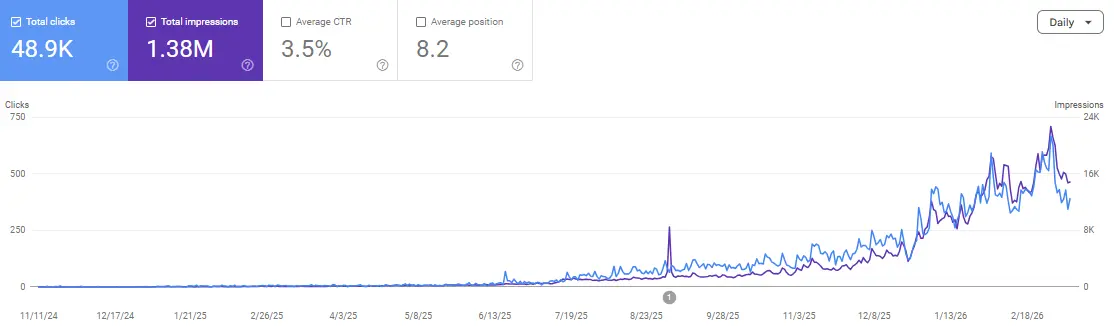
For professionals like Arya, who bridge the gap between IT and Marketing, predictive SEO is where technical skills truly shine. Using Python libraries or custom-built GPTs, you can automate the analysis of GSC data to find “anomalies” that suggest a new trend is forming. This level of technical depth separates average SEOs from growth engineers.
If you are currently experimenting with Python for SEO or building custom data pipelines, connect with our technical team on Discord. Sharing logic and automation scripts is the fastest way to refine your predictive engine.
FAQs
1. Is predictive SEO the same as trend spotting?
Trend spotting is often manual and subjective. Predictive SEO is data-driven, using statistical models like Prophet or LSTM to quantify the probability of a trend.
2. Can small sites use predictive analytics?
Yes, by using social listening tools and Google Trends data to identify “rising stars” in their specific niche.
3. Does this require a deep knowledge of coding?
While helpful, many modern AI tools provide predictive “insights” without requiring you to write your own code. However, custom models offer more accuracy.
4. How does this affect search intent?
Predictive models can also forecast changes in intent. For example, a topic might start as “Informational” but quickly shift to “Transactional” as a new product category matures.
Conclusion
AI-driven predictive analytics is the ultimate weapon for the modern SEO specialist. It allows you to step out of the cycle of constant “catch-up” and move into a position of leadership. By leveraging data to see where the market is going, you can build a content calendar that is both resilient and highly profitable.
Ready to see the future of your niche? Join the Scale-Xpert Discord today and let’s build a data-driven growth strategy together.