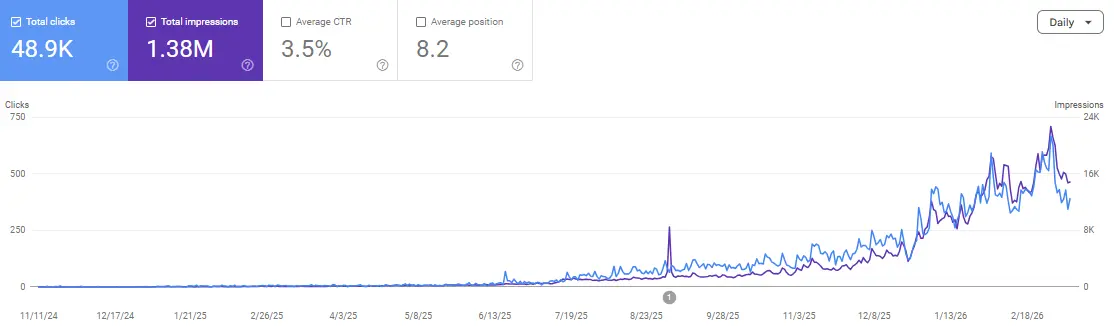
Understanding what Hybrid Engine Optimization is, is one thing. Actually implementing it is another. Many marketers grasp the concept but struggle to translate it into real actions they can apply to their content and website today.
This guide solves that problem. Below, you will find a complete, actionable step-by-step framework for implementing HEO — from the technical foundation all the way through to AI citation monitoring. Want to implement HEO with a community behind you? Get peer feedback, share results, and learn from others already making this transition join us here.
Step 1: Audit Your Current SEO Foundation
Before adding any AI optimization layers, you need to know where your traditional SEO stands. HEO builds on SEO fundamentals — it does not replace them. A weak foundation means AI optimization will not deliver meaningful results.
Run a full technical audit covering:
- Page speed and Core Web Vitals scores
- Mobile responsiveness across all key pages
- Crawl errors, broken links, and redirect chains
- XML sitemap health and robots.txt configuration
- Existing schema markup (and gaps in it)
In addition, review your content library for quality signals: thin content, duplicate pages, pages with poor E-E-A-T signals, and any content that has not been updated in 12 or more months.
Understanding what technical SEO covers will help you prioritize which issues to fix first before moving into AI optimization.
Step 2: Conduct Dual-Intent Keyword Research
Traditional keyword research identifies what people type into Google. HEO keyword research adds a second layer: identifying what people ask AI tools conversationally.
Here is how to approach both:
Traditional Keyword Research
- Use Semrush, Ahrefs, or Google Keyword Planner
- Target keywords with clear informational, navigational, or commercial intent
- Look for question-based keywords with featured snippet opportunities
Conversational AI Keyword Research
- Ask ChatGPT, Gemini, and Perplexity your core topic and see what related questions they surface
- Use AlsoAsked.com to find question clusters around your topic
- Review Google’s People Also Ask (PAA) boxes for your target keywords
The goal is to build a keyword list that covers both traditional search queries and the natural language questions AI users are asking. A thorough keyword research process forms the backbone of any effective HEO content strategy.
Step 3: Build a Pillar-and-Cluster Content Architecture
One of the most powerful HEO tactics is building content clusters that signal deep topical authority to both Google and AI platforms. A single well-optimized article will not outperform a network of ten interconnected, expert-level pages on the same topic.
Here is how to structure your cluster:
Pillar Page: A comprehensive guide covering your core topic at a high level. This page links to all cluster articles.
Cluster Articles: Individual articles that dive deep into specific subtopics, each linking back to the pillar page and to relevant cluster articles.
For example, if your pillar topic is “Hybrid Engine Optimization,” your cluster might include:
- What is HEO?
- HEO vs Traditional SEO
- How to implement HEO
- HEO content strategies
- HEO tools and metrics
- HEO for specific industries
Strong internal linking between these pages helps search engines and AI models understand the full scope of your topical expertise. Building topical authority this way is one of the highest-leverage activities in HEO.
Step 4: Restructure Content for Answer-First Formatting
This is one of the most impactful changes you can make, and it applies to both new and existing content.
AI models extract first-paragraph responses most reliably. Therefore, every section of your content should open with a direct, concise answer to the question implied by that section’s heading — before expanding into detail.
Follow this structure for each section:
- Direct answer (1–2 sentences)
- Supporting explanation (3–5 sentences)
- Examples or data (as needed)
- Practical application (how the reader can use this)
For example, instead of opening a section with background history or context, lead with: “Hybrid Engine Optimization works by combining traditional SEO tactics with AI-specific content formatting and entity building to maximize visibility across all modern search surfaces.”
Then expand from there.
This approach serves both AI extraction and human reading behavior — most users scan before they read deeply.
Step 5: Implement Full Schema Markup
Structured data is the machine-readable layer that helps search engines and AI systems understand exactly what your content is about. In an HEO strategy, schema markup is not optional it is a core technical requirement.
Implement the following schema types across your content:
- Article schema on all blog posts and guides
- FAQ schema on pages with question-and-answer sections
- HowTo schema on step-by-step guides
- Organization schema on your homepage and About page
- Author schema on all content pieces with attributed authors
After implementation, validate your markup using Google’s Rich Results Test tool. Errors in schema can prevent your structured data from being recognized by either Google or AI citation systems.
Step 6: Build Your Entity Presence
AI language models do not just read pages they recognize entities. Your brand, your authors, and your business need to exist as verified, consistent entities across the web in order for AI systems to reliably cite you.
Here is how to build entity presence:
- Google Business Profile: Claim and fully optimize your listing with consistent NAP (Name, Address, Phone) data.
- Social media profiles: Ensure all profiles reflect the same brand identity, description, and contact information.
- Author profiles: Create detailed author bios that include credentials, experience, and links to published work.
- External citations: Get your brand mentioned on reputable third-party sites, directories, and industry publications.
- Wikipedia or Wikidata entries: Where appropriate, creating or contributing to entries about your brand or key concepts can strengthen entity recognition.
Consistent brand mentions across the web help AI systems connect your content across platforms and increase the likelihood of being cited in AI-generated answers.
Step 7: Optimize for Voice Search and Conversational Queries
Voice search queries are fundamentally different from typed queries. They are longer, more conversational, and almost always phrased as complete questions.
To optimize for voice search within your HEO strategy:
- Use natural, conversational language throughout your content
- Include question-format headings (Who, What, How, Why, When)
- Write concise answers that can be read aloud clearly within 30–40 words
- Aim for a Flesch Reading Ease score above 60 for maximum AI compatibility
- Target featured snippets, as voice assistants most commonly read from these
Step 8: Build an AI-Optimized Link Profile
Backlinks remain an essential authority signal for both traditional search engines and AI systems. However, HEO requires thinking about link building in a broader context.
In addition to traditional backlinks, focus on:
- Unlinked brand mentions: When other sites mention your brand without linking to it, these citations still carry weight with AI language models. Monitor and try to convert these into linked citations.
- Authority domain mentions: Getting mentioned on high-authority, well-known sites signals credibility to AI systems even without a direct link.
- Contextual relevance: AI platforms favor citations from topically relevant sources. Focus link building on niche-relevant websites.
Understanding how search engines evaluate backlinks remains relevant in HEO the evaluation criteria have expanded, not disappeared.
Step 9: Create an AI-Optimized Content Refresh Strategy
AI models have recency preferences. Content that has not been updated in 12 or more months gradually loses citation authority with AI platforms, even if Google rankings remain stable.
Build a rolling content refresh schedule:
- Audit your top-performing content every 6 months
- Update statistics, examples, and outdated references
- Add new sections addressing questions that have emerged since original publication
- Re-optimize answer-first formatting where needed
- Update internal links to include newer cluster content
Regular content refreshes signal to both Google and AI systems that your content is actively maintained and authoritative.
Step 10: Monitor HEO Performance with a Dual Dashboard
Traditional SEO performance is measured through Google Search Console, rankings, and organic traffic. HEO requires an additional measurement layer that covers AI platform visibility.
Your dual dashboard should track:
Traditional SEO Metrics:
- Keyword rankings (tracked weekly)
- Organic traffic (Google Search Console)
- Click-through rates by page
- Featured snippet capture rate
- Core Web Vitals scores
AI Visibility Metrics:
- Manual AI citation checks (search your target topics on ChatGPT, Gemini, and Perplexity monthly)
- Brand mention monitoring using tools like Brand24 or Mention
- AI Overview appearance tracking
- Voice search result inclusion
Combining both sets of metrics gives you the complete picture that HEO performance requires.
FAQs
How long does HEO implementation take?
The initial setup audit, schema implementation, content restructuring typically takes 4 to 8 weeks depending on the size of your content library. Results from traditional SEO components appear within 3 to 6 months. AI citation presence can build more quickly, sometimes within weeks, once entity signals are in place.
Do I need a developer to implement HEO?
Some aspects of HEO (schema markup, technical SEO fixes) benefit from developer support. However, content restructuring, keyword research, and entity building can be handled by a skilled content marketer or SEO specialist without coding knowledge.
Which content should I prioritize for HEO restructuring first?
Start with your highest-traffic pages and pillar content. These are your highest-leverage assets. Restructuring them for AI-readability will deliver the most immediate impact on both AI citations and user experience.
Does HEO work for local businesses?
Yes. Local businesses benefit from HEO through Google Business Profile optimization, local entity building, FAQ schema on local-intent pages, and voice search optimization for location-based queries. Local HEO is particularly effective for service businesses.
How do I know if AI is citing my content?
Manually search your target topics on ChatGPT, Gemini, and Perplexity monthly. Note whether your brand or specific content is referenced. Some third-party tools are beginning to offer automated AI citation monitoring, though manual checks remain the most reliable method.
Can I implement HEO without changing my existing site structure?
You can implement many HEO tactics answer-first content formatting, schema markup, entity signals without restructuring your site. However, building a proper pillar-and-cluster content architecture often requires some reorganization to maximize topical authority signals.
Is schema markup enough for AI optimization?
Schema markup is one important component, but it is not sufficient on its own. AI citation optimization also requires answer-first content formatting, entity presence building, E-E-A-T signals, and consistent brand mentions across the web.
Conclusion
Implementing Hybrid Engine Optimization is not a project with a finish line — it is an ongoing practice that compounds in value over time. Each step you complete strengthens the next, and each content cluster you build adds to your topical authority across both Google and AI platforms.
Start with the foundation: technical SEO, dual-intent keyword research, and content structure. Then layer in schema, entity building, and AI citation monitoring. Refresh your content regularly and measure results across both traditional and AI channels.
The brands that treat HEO as a continuous discipline rather than a one-time project are the ones that will dominate search visibility in 2026 and beyond. Ready to take the next step? Our community of SEO and AI search practitioners is here to help you implement, iterate, and grow connect with us here.