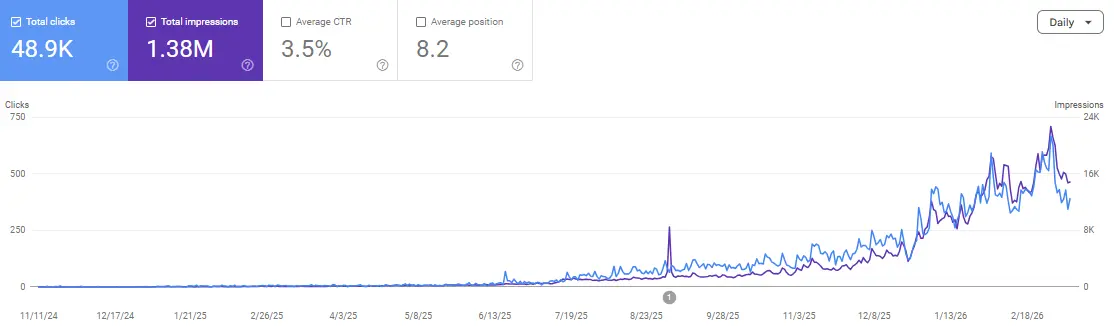
Backlink velocity is the speed at which your website gains or loses backlinks over time. It matters for SEO because healthy backlink growth can support a stronger backlink profile, while sudden low-quality spikes can signal link spam risk.
In this guide, you will learn how backlink velocity SEO works, what safe link growth looks like, and how to monitor new backlinks, lost backlinks, referring domains, and anchor text distribution.
What Is Backlink Velocity?
Backlink velocity measures how quickly a website gains or loses links during a specific period. For example, you may track new backlinks every week, month, or quarter.
A simple backlink velocity table can look like this:
| Month | New backlinks | Lost backlinks | New referring domains |
|---|---|---|---|
| January | 12 | 3 | 5 |
| February | 18 | 4 | 7 |
| March | 90 | 8 | 42 |
The March spike is not automatically bad. However, you should check why the spike happened and whether those links came from relevant websites.
Why Backlink Velocity Matters for SEO
Backlink velocity matters because links help search engines discover pages and understand page relevance. Google says links can help it find new pages and can be used as a signal when determining page relevance.
However, backlink growth should still look reasonable when compared with your content activity. For example, a link spike after publishing original research may make sense, but a sudden spike from unrelated domains needs a backlink audit.
In addition, backlink velocity SEO is useful for spotting problems early. If many new backlinks appear with the same exact-match anchor text, the issue may not be speed alone, but anchor text distribution and source quality.
Backlink Velocity vs Link Velocity
Backlink velocity and link velocity are often used in the same way. Both describe the speed of link growth or link loss.
However, you can make your tracking more useful by separating the metrics:
| Metric | Meaning | Why it matters |
|---|---|---|
| Backlink velocity | Speed of total backlink changes | Shows link volume growth |
| Link velocity | General speed of link acquisition | Often used as a broader SEO term |
| Referring domain growth | Speed of new unique domains | Shows link diversity |
| Lost backlink velocity | Speed of link loss | Shows link decay |
| Anchor text velocity | Change in anchor patterns | Helps detect over-optimization |
Because of this, do not only count backlinks per month. Instead, compare backlinks, referring domains, lost links, and anchor text together.
Is Fast Backlink Velocity Bad?
Fast backlink velocity is not always bad. A website can gain many links quickly for natural reasons.
Fast link growth can be normal when:
- your content goes viral
- a journalist cites your data
- a newsletter shares your guide
- your free tool becomes popular
- a product launch earns coverage
- original research gets cited
- a template or checklist is shared widely
The better question is not “how fast did I get links?” Instead, ask “why did I get these links?”
If the spike has a clear reason, relevant linking pages, and natural anchor text, it may be normal. In contrast, if the spike comes from automated backlinks, paid dofollow links, or unrelated sites, review it carefully.
What Risky Backlink Velocity Looks Like
Risky backlink velocity usually has no clear reason behind it. In many cases, the links appear from weak domains, unrelated sites, or repeated link building patterns.
Watch for these signs:
- many links from unrelated websites
- many links from the same weak domain
- repeated exact-match anchor text
- backlinks from link farms or spam pages
- links pointing only to money pages
- sudden links from foreign-language spam sites
- links that appear and disappear quickly
- paid backlinks that pass ranking signals
Google’s spam policies warn against link spam, including links created mainly to manipulate rankings. The policy also includes paid links that pass ranking signals, excessive link exchanges, and automated link building as risky examples.
Safe vs Risky Backlink Velocity
Use this table when reviewing a link spike:
| Poattern | Usually safer | Riskier |
|---|---|---|
| Source | Relevant websites | Spam domains |
| Timing | Matches content launch or PR | No clear reason |
| Referring domains | Diverse and topical | Many links from few weak sites |
| Anchor text | Branded, natural, varied | Repeated exact-match anchors |
| Link type | Editorial, resource, citation | Paid dofollow or automated |
| Destination | Useful pages and guides | Only sales or money pages |
| Retention | Links stay live | Links disappear quickly |
As a result, link quality matters more than link building speed. A slow pattern can still be risky if the links are manipulative, while a fast pattern can be safe if the links are earned naturally.
How to Check Backlink Velocity
Use a backlink checker to review link growth over time. Tools like Google Search Console, Ahrefs, Semrush can help you monitor backlink growth and link profile changes.
Start with Google Search Console if you need a free option. The Links report shows external links, top linked pages, top linking sites, and linking text, which helps you review backlink sources and anchor text.
Use this simple workflow:
- Check new backlinks by date.
- Review lost backlinks.
- Compare new referring domains.
- Check anchor text distribution.
- Match spikes with content launches or campaigns.
- Manually inspect suspicious linking domains.
- Track the pattern every month.
This process keeps your backlink audit simple. In addition, it helps you avoid reacting to normal link growth as if it were a penalty risk.
How Fast Should You Build Backlinks?
There is no universal safe number of backlinks per month. A small blog getting 300 unrelated backlinks overnight may look suspicious, while a statistics page earning 300 editorial links after a PR campaign may look normal.
A better rule is this:
Build backlinks at a speed your content quality, brand activity, and promotion can justify.
For example, if you publish a useful guide and promote it to relevant communities, gradual link growth from niche sites can make sense. However, buying a package of 500 links with repeated anchor text creates a different risk profile.
How to Improve Backlink Velocity Safely
Safe link building should create a real reason for people to link. Therefore, focus on linkable assets and relevant outreach.
Good methods include:
- publish original statistics
- create free templates
- write practical beginner guides
- build simple tools or calculators
- pitch relevant resource pages
- reclaim unlinked brand mentions
- use broken link building
- do digital PR
- collaborate with niche websites
- promote useful content in real communities
Built backlinks are not automatically bad. However, they should be relevant, transparent, and useful for real readers.
Common Backlink Velocity Mistakes
Many beginners think fast backlink growth is always dangerous. In contrast, the real issue is link quality, source relevance, and manipulative intent.
Avoid these mistakes:
- counting backlinks but ignoring referring domains
- ignoring lost backlinks
- ignoring anchor text spikes
- buying link packages
- building links only to money pages
- copying competitor link velocity blindly
- treating all fast growth as risky
- treating all slow growth as safe
- never reviewing backlink source quality
Instead, use backlink velocity as a monitoring signal. Then, combine it with backlink quality, link relevance, and anchor text review.
FAQs About Backlink Velocity
What is backlink velocity?
Backlink velocity is the speed at which your website gains or loses backlinks over time. It helps you monitor backlink growth, link loss, and possible link spikes.
Is high backlink velocity bad for SEO?
High backlink velocity is not automatically bad. However, it can become risky when links come from irrelevant, paid, automated, or spammy sources.
How many backlinks per month is safe?
There is no fixed safe number. A safe link building speed depends on your niche, content quality, brand activity, and whether the links are relevant.
How do I check backlink velocity?
Use a backlink checker like Google Search Console, Ahrefs, Semrush, Moz, Majestic, or SE Ranking. Then, review new backlinks, lost backlinks, referring domains, and anchor text patterns.
What causes backlink spikes?
Backlink spikes can come from PR campaigns, viral content, statistics pages, tool launches, newsletters, or spam links. Therefore, always check the source and reason behind the spike.
How can I improve backlink velocity safely?
Create linkable assets, promote them to relevant sites, use safe link building methods, avoid paid dofollow links, and review your backlink profile regularly.
Conclusion
Backlink velocity is not a fixed speed limit. It is a pattern that helps you understand how quickly your backlink profile is growing, shrinking, or changing.
For better backlink velocity SEO, track new backlinks, lost backlinks, referring domains, link building speed, and anchor text distribution together. Then, focus on natural backlink growth, safe link building, useful content, and regular backlink audits instead of chasing backlinks per month.
Want help reviewing your backlink velocity, backlink profile, or link building plan? Join the Scale Xpert community.