The days of “keyword stuffing” are long dead. In 2026, search engines have moved entirely into the era of Semantic Search. This means that Google and other AI-driven engines no longer just look for strings of text; they look for entities, intent, and contextual relationships. Understanding semantic search is no longer an “advanced” tactic it is the baseline requirement for anyone who wants to rank in the age of Generative Engine Optimization (GEO).
For a developer and SEO specialist, this shift requires a move toward structured data and “topical mapping.” Instead of asking “what keyword should I use?”, you should be asking “what entities are related to this topic and how can I demonstrate my expertise on all of them?” Mastering this allows you to rank for thousands of related queries, even if you never explicitly target them on the page.
If you want to dive deep into the technical architecture of semantic SEO and entity mapping, you should join the Scale-Xpert growth community on Discord. We discuss everything from Knowledge Graph optimization to advanced Schema markup.
What is Semantic Search?
Semantic search is the search engine’s ability to understand the meaning behind a query rather than just the words. This is powered by AI models like BERT and MUM, which analyze the relationships between words. For example, if a user searches for “the best framework for fast web apps,” the search engine knows they are likely looking for things like Next.js, Nuxt.js, or Svelte, even if those specific names weren’t in the search bar.
To win in this environment, you must build topical authority. This means creating a cluster of content that covers a subject from every angle. When you provide a comprehensive web of information, search engines recognize your site as an “entity” of authority within that niche.
1. Moving from Keywords to Entities
In the semantic era, search engines build a “Knowledge Graph” of entities (people, places, things, concepts). Your goal is to associate your brand with high-value entities in your niche. Furthermore, you should focus on what are keywords in SEO from a semantic perspective—treating them as entry points into a larger conversation rather than isolated targets.
Using Schema markup (JSON-LD) is the technical way to “speak” to the semantic engine. By explicitly defining your content’s entities and their relationships, you remove the guesswork for the search engine, making it much more likely that you will appear in AI-generated summaries and rich snippets.
2. Optimizing for User Intent and Context
Semantic search is heavily focused on context. The search engine looks at the user’s location, search history, and the “implied” meaning of their query. This is why understanding search intent in SEO is the most critical part of your content strategy.
If your content doesn’t align with the meaning of the user’s search, it won’t rank, no matter how many backlinks you have. Consequently, you must design your pages to answer not just the “what,” but also the “how,” “why,” and “what next.” This creates a “satisfaction signal” that AI search engines prioritize.
3. Semantic Content Structuring
To help AI understand your content better:
-
Use Clear Hierarchies: H2 and H3 tags should follow a logical flow of information.
-
Incorporate LSI Keywords: Use terms that are naturally related to your main topic (e.g., if writing about “React,” mention “hooks,” “virtual DOM,” and “components”).
-
Define Terms: Explicitly define complex concepts to establish your site as a primary source of truth.
If you are a developer looking for tools to help map out these semantic relationships, join our Discord for a list of SEO automation tools. We share the best resources for visual entity mapping and content gap analysis.
FAQs
1. Does semantic search make keywords obsolete?
No, but it changes how we use them. Keywords are now “signals” that help the AI identify the topic, rather than rigid targets to be repeated.
2. How does semantic search help with voice search?
Voice queries are naturally more conversational and semantic. By optimizing for context and natural language, you automatically perform better in voice search.
3. What is the role of Schema markup in semantic SEO?
Schema provides the “tags” that tell search engines exactly what an entity is, helping them connect your content to their Knowledge Graph.
4. How can I measure semantic performance?
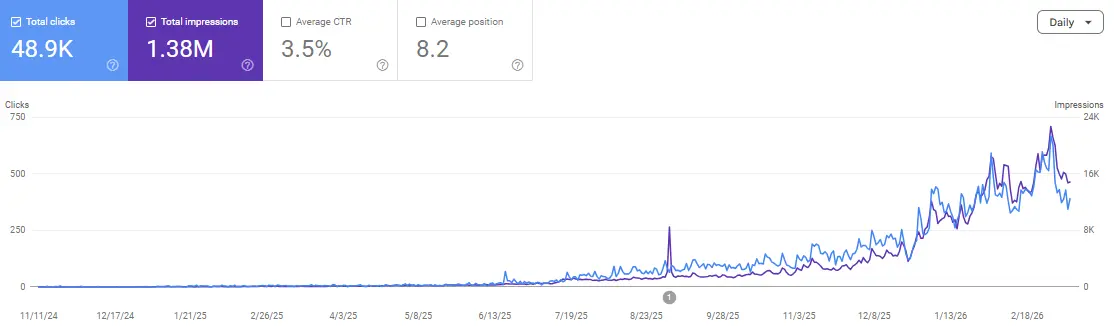
Look at your “impressions” for a wide variety of long-tail keywords. If your site is ranking for terms you didn’t specifically target, your semantic optimization is working.
Conclusion
Mastering semantic search is about understanding the “why” behind the “what.” It requires a shift toward quality, depth, and structured clarity. In the age of AI, being a “subject matter expert” is the only sustainable way to rank. By focusing on entities and intent, you ensure that your site remains relevant, no matter how much search technology evolves.
Ready to build your topical authority? Join the Scale-Xpert Discord today and start dominating the semantic web.