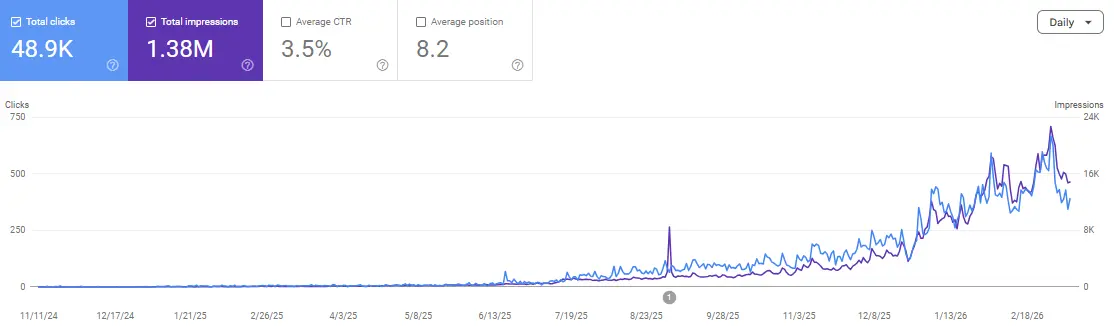
If several pages on your website target the same search term, they may end up competing with each other in Google. This SEO issue is called keyword cannibalization and it can quietly hurt your rankings over time.
But here is what most guides get wrong: not every overlap is a problem. Understanding when to act and when to leave pages alone—is what separates a thoughtful SEO strategy from one that accidentally destroys traffic it was trying to protect.
This guide covers everything: what keyword cannibalization really is, how to find it, how to confirm it is actually hurting you, how to fix it correctly, and what not to do.
Want help choosing better keywords before you publish? Join the Scale Xpert Discord community to discuss SEO strategy, backlinks, and content growth with other website owners and marketers.
What Is Keyword Cannibalization?
Keyword cannibalization happens when multiple pages on the same website target the same keyword (or the same search intent), causing those pages to compete against each other in search results.
Instead of working together to strengthen the site, competing pages split authority signals, confuse search engines about which URL is most relevant, and can suppress the performance of your best page.
Simple example: You publish one post titled “Best Email Marketing Tools” and another titled “Top Email Marketing Platforms for Small Businesses.” If both target nearly identical intent, Google must guess which one to show — and it may alternate between them unpredictably, or surface the weaker page.
Key distinction: The issue is not simply having two pages that mention the same keyword. It is when two or more pages target the same primary keyword and serve the same user intent, to the point that their combined existence hurts overall organic performance.
Keyword Cannibalization vs. Content Cannibalization
These terms are often used interchangeably, but there is a meaningful difference.
Keyword cannibalization refers specifically to multiple pages competing for the same search query.
Content cannibalization is broader: it refers to pages that are so similar in topic, structure, and message that they undermine each other, even if the exact keyword phrases differ slightly. A site could have ten posts about “healthy breakfast ideas” using different keyword variants — that is content cannibalization even if no two posts target the identical phrase.
Both issues weaken your site’s topical clarity and dilute the authority you could be concentrating on a single strong page.
Is Keyword Cannibalization Always Bad?
No — and this is the most important nuance most guides skip.
Two pages ranking for the same keyword is not automatically a problem. Pages commonly rank for hundreds of keywords simultaneously. If you have two pages that both appear in results for a shared keyword, but both pages are also driving significant traffic from other unique keywords, merging or deleting one could reduce your net organic traffic — not improve it.
You only have a real cannibalization problem when the existence of multiple pages is actively harming your site’s overall organic performance. The goal is to assess impact, not just count overlaps.
Ask: Would combining these pages produce more total organic traffic than keeping them separate? If the answer is yes, fix it. If not, leave it alone.
Why It Matters for SEO When It Is a Real Problem
When true cannibalization exists, here is what typically goes wrong:
- Split link equity — Backlinks point to two weaker pages rather than one authoritative one
- Ranking instability — Google alternates between URLs for the same query, causing fluctuating positions
- Wrong page surfaces — A thin or outdated page outranks your intended primary page
- Weakened crawl efficiency — Search engines spend crawl budget on redundant pages
- Lower CTR and conversions — Users land on the wrong page and do not find what they expected
- Diluted topical authority — Your site appears less focused and authoritative on the subject
What Causes Keyword Cannibalization?
Cannibalization usually develops gradually, not overnight. Common causes include:
Growing a blog without a content map. Publishing new posts without checking whether the topic is already covered creates the most common form of overlap. Over time, a site accumulates dozens of posts that circle the same subject.
Targeting keyword variations on separate pages. Search engines today understand that “keyword cannibalization meaning,” “what is keyword cannibalization,” and “keyword cannibalization explained” all express the same intent. Creating a separate page for each is unnecessary — and harmful.
Category and product page overlap on e-commerce sites. A category page for “running shoes” and individual collection pages for “men’s running shoes” or “trail running shoes” can overlap heavily if not structured with clear intent differentiation.
Legacy content left in place after a site refresh. An older post may silently compete with a newer, better page simply because no one deleted or redirected it when the new one launched.
Faceted navigation creating duplicate URLs. Filtered pages (e.g., /shoes?color=red&size=10) can generate hundreds of near-duplicate URLs that all target the same keyword, which is especially problematic on larger e-commerce sites.
Signs You May Have Keyword Cannibalization
Watch for these indicators:
- Two or more of your own pages appear in search results for the same query
- A page you consider secondary keeps outranking your intended primary page
- Rankings for an important keyword fluctuate between your URLs week to week
- Organic traffic for a keyword is spread thinly across multiple pages instead of concentrated on one
- Multiple pages share nearly identical title tags, H1s, or meta descriptions
- Internal links across your site point to different pages for the same topic inconsistently
How to Find Keyword Cannibalization
Method 1: Google Site Search (Free, Quick Start)
Type the following into Google:
site:yourdomain.com “your target keyword”
If multiple URLs from your site appear, you may have a cannibalization issue. This is the fastest free check, though it lacks depth.
Method 2: Google Search Console (Free, Most Reliable)
This is the most accurate method for confirming real-world cannibalization.
Step-by-step:
- Open Google Search Console and go to Performance > Search Results
- Click Queries and find a keyword you want to investigate
- Click the query to filter by it, then switch to the Pages tab
- If two or more URLs appear for the same query with meaningful impressions, that is a cannibalization signal
- Compare the click and impression data across those URLs — if one is significantly weaker, it is likely cannibalizing the stronger page
Pro tip: Export your full query and page data to a spreadsheet and use pivot tables or VLOOKUP to find queries where more than one URL appears.
Method 3: Content Audit Spreadsheet
Build a spreadsheet with these columns:
| URL | Page Title | Primary Target Keyword | Search Intent | Page Type | Notes |
Sort by the “Primary Target Keyword” column. Any duplicates signal potential cannibalization. This manual method is slower but gives you a complete picture and doubles as a content strategy document.
Method 4: SEO Tool Workflows
Using Semrush:
- Use Position Tracking to monitor which URLs rank for your target keywords over time
- Run a Site Audit and check for pages with similar on-page optimization signals (duplicate title tags, duplicate meta descriptions)
- Use the Organic Research > Pages report to see which pages compete for the same terms
Using Ahrefs:
- Go to Site Explorer > Organic Keywords
- Export keyword data and filter for queries where multiple URLs from your domain rank simultaneously
- Use the Content Gap tool to see where your pages overlap
Using Screaming Frog:
- Crawl your site and export title tags and meta descriptions
- Sort alphabetically to find near-identical meta data, which flags likely cannibalization candidates
How to Confirm It Is Really Hurting You
Before making any changes, verify that the overlap is actually reducing performance. Ask:
- Do both pages target the same primary keyword AND the same search intent? Two pages targeting “running shoes” (transactional) and “how to choose running shoes” (informational) serve different intents and are fine to keep separate.
- Is neither page performing as well as a merged version likely would? Check each page’s individual organic traffic, backlink profile, and average position. If both are weak, consolidation will likely help.
- Does the wrong page rank more often than the right one? In Search Console, check which URL receives more impressions for your target query. If it is not the page you want ranking, that confirms an issue.
- Would merging them create a significantly stronger, more comprehensive resource? If yes, merging will concentrate link equity and topical signals on one authoritative page.
- Do the pages have different backlink profiles? If one page has many external backlinks and the other does not, deleting the weaker one (with a 301 redirect) consolidates that link equity productively.
If most of these questions point toward real competition and diluted performance, take action. If the pages are each strong in their own right and ranking for many distinct keywords, leave them alone.
How to Fix Keyword Cannibalization
Use this decision framework to choose the right fix:
Fix 1: Merge Pages (Most Common Fix)
When two pages overlap heavily and neither is outstanding on its own, combine the best content from both into a single comprehensive page. Then 301 redirect the URL you are retiring to the surviving page.
This consolidates backlinks, concentrates on-page signals, and creates a stronger resource that is more likely to rank well.
Steps:
- Identify which URL is stronger (more backlinks, more organic traffic, better position)
- Migrate the best content from the weaker page into the stronger one
- 301 redirect the retired URL to the surviving page
- Update all internal links to point to the surviving URL
- Submit the updated URL in Google Search Console for reindexing
Fix 2: Reoptimize for Different Intent
Sometimes both pages are valuable but are competing unnecessarily because their intent is too similar. Differentiate them by giving each a clearly distinct focus:
- Page A targets informational intent: “What is keyword cannibalization?”
- Page B targets commercial/tool intent: “Best tools to detect keyword cannibalization”
Rewrite titles, H1s, introductions, and content to reflect the distinction clearly.
Fix 3: Strengthen Internal Linking
Internal links are a powerful signal to Google about which page you consider the primary authority for a topic. If your site sends mixed signals — some pages linking to URL A, others to URL B for the same topic — consolidate.
Steps:
- Choose your canonical/primary page for the topic
- Update all internal links across the site to point to that page with consistent, relevant anchor text
- Remove or re-anchor links that point to the competing page
This often improves rankings for the primary page without requiring any page deletion or merging.
Fix 4: Use Canonical Tags
If you have near-duplicate pages that must both remain live (common for technical or legal reasons), add a rel=”canonical” tag on the weaker page pointing to the preferred URL. This tells search engines which version to prioritize.
Important: Canonical tags are a signal, not a directive. Google may not always follow them. This fix is best for true duplicates, not for pages with distinct content.
Fix 5: Noindex Weaker Pages
For pages that must exist but should not compete in search (such as filtered category pages, paginated results, or print-friendly versions), adding a noindex meta tag removes them from Google’s index without deleting them.
This is especially useful on large e-commerce sites dealing with faceted navigation.
Fix 6: Delete Low-Value Pages (With 301 Redirect)
If a page has no backlinks, no organic traffic, no conversions, and its content is fully covered by a better page, deleting it may be the cleanest option. Always redirect the deleted URL to the most relevant surviving page to preserve any residual link equity.
Do not delete pages that:
- Have meaningful backlinks
- Drive any converting traffic
- Rank for secondary keywords that matter to your strategy
Bad Solutions to Avoid
Many SEOs make these mistakes when addressing keyword cannibalization:
Blindly deleting pages. Deleting a page without checking its backlink profile, traffic, and keyword rankings can eliminate traffic and link equity you were not aware you had. Always audit before deleting.
Merging pages that actually serve different intents. Combining a detailed how-to guide with a product comparison page because they share a keyword phrase creates a confusing, unfocused page that serves no reader well. Keep them separate and reoptimize each.
Using canonical tags as a lazy shortcut. Canonicals work for true duplicates. Applying them to pages with meaningfully different content is not the right tool and may confuse crawlers.
Renaming titles without changing content. Swapping a few words in a title tag does not create genuine topical differentiation. If the content and intent remain the same, the cannibalization issue remains.
Fixing overlap without 301 redirects. Any time you retire a URL, redirect it. Leaving a dead URL without a redirect wastes link equity and creates a poor user experience.
How to Prevent Keyword Cannibalization in the Future
Prevention requires a systematic approach built into your content workflow from the start.
Build and maintain a keyword map. A keyword map assigns one primary keyword and one search intent to each URL on your site. Before publishing anything new, check the map first. If the keyword is already assigned, either update the existing page or choose a distinct angle.
Conduct a content audit at least twice per year. Regularly review your existing content for overlap, outdated pages, and underperforming duplicates. A quarterly audit on large sites, or semi-annual on smaller ones, catches problems before they compound.
Use a content brief process. Before writing, research what already exists on your site for that topic. Make the new page’s unique angle explicit in the brief.
Establish a clear site architecture. Each level of your site — home, category, subcategory, post — should have a distinct keyword and intent focus. Overlapping levels are the structural root of many cannibalization problems.
Review internal linking regularly. Inconsistent anchor text and scattered internal links are often the first visible symptom of a cannibalization problem developing. Keep your internal linking structure clean and consistent.
FAQs
What is keyword cannibalization in simple words?
It is when two or more of your own pages compete against each other in Google for the same search term, weakening both instead of one of them ranking strongly.
Is keyword cannibalization always bad for SEO?
No. It is only a real problem when the competing pages are actively hurting each other’s organic performance. If both pages are strong and rank for many distinct keywords, the overlap may not need fixing.
How do I know if my site has keyword cannibalization?
Search Google for site:yourdomain.com “your keyword” and check if multiple pages appear. Then verify in Google Search Console whether those pages are splitting impressions and clicks for the same query.
Can keyword cannibalization lower rankings?
Yes — when it is a genuine issue. Splitting link equity and on-page signals across two weak pages instead of concentrating them on one strong page typically suppresses both pages below where either could rank alone.
Should I delete pages with keyword cannibalization?
Only delete if the page has no meaningful backlinks, traffic, or conversions, and its content is already covered by a better page. Always 301 redirect any deleted URL. In most cases, merging or reoptimizing is safer.
What is the best fix for keyword cannibalization?
Merging similar pages into one comprehensive resource (with a 301 redirect on the retired URL) is the most effective fix in most cases. Improving internal linking to signal a clear primary page is often the easiest quick win.
What is the difference between keyword cannibalization and duplicate content?
Duplicate content is when two pages have nearly identical text. Keyword cannibalization is when two pages target the same keyword intent, even if their text is different. Both are problems, but they are solved differently.
Conclusion
Keyword cannibalization is a real SEO problem, but it is often misunderstood. Not every overlap requires action. The goal is to identify cases where competing pages are genuinely diluting each other’s performance, then apply the right fix: merging, reoptimizing, improving internal linking, or in some cases simply doing nothing.
The most important habits are preventive: maintain a keyword map, audit your content regularly, and enforce clear topical separation in your site architecture. A site with a deliberate content structure rarely develops serious cannibalization problems in the first place.
Need feedback on your keyword list or SEO content plan? Join the Scale Xpert Discord community and connect with people working on SEO, backlinks, and website growth.