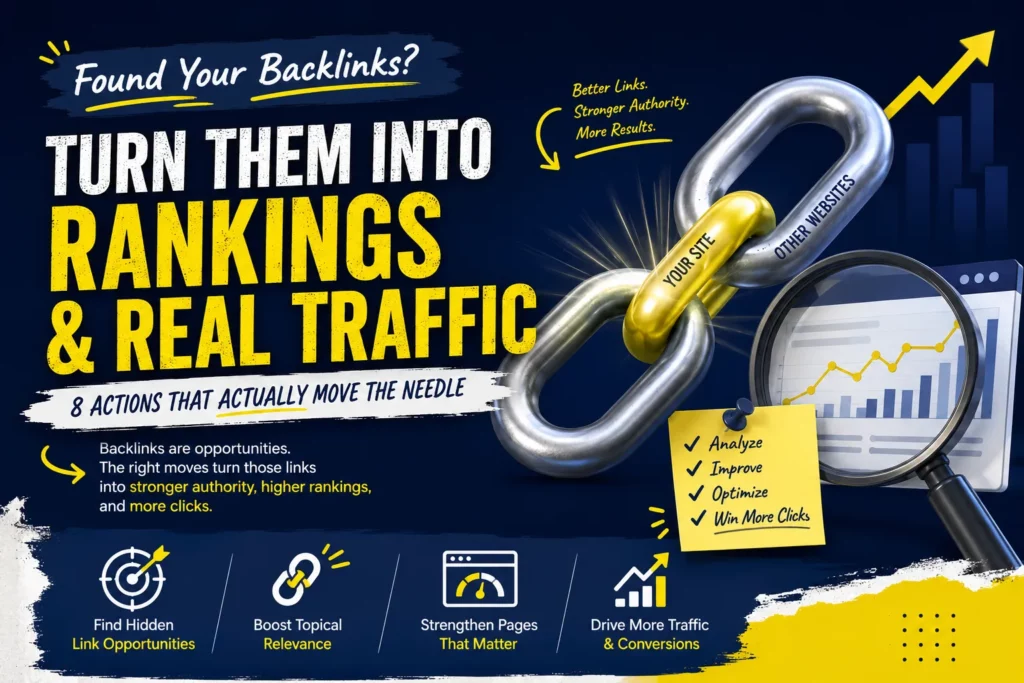
Finding your backlinks is only the beginning. Once you know which websites link to you, the next step is to understand whether those links are helping your rankings, creating risks, or revealing new opportunities.
Knowing what to do after you find your backlinks helps you turn a basic backlink list into a practical SEO plan. You can identify strong links, repair lost ones, improve internal linking, and discover websites that may link to you again.
However, not every backlink deserves the same attention. Some links build authority and referral traffic, while others provide little value. Therefore, you need a clear process for reviewing and using the data.
Want feedback on your backlink profile? Join our SEO community to discuss link quality, outreach opportunities, and practical SEO strategies with other website owners.
Why Finding Backlinks Is Not Enough
A backlink report usually includes the linking domain, target page, anchor text, and link status. Although this information is useful, it does not immediately explain which backlinks matter.
For example, one relevant editorial link may support your website more than dozens of low-quality directory links. In addition, a backlink may point to an outdated URL, use confusing anchor text, or disappear after a website update.
If you are still building your initial backlink list, start with this guide on how to find backlinks to your website for free.
Once you have the data, follow the steps below.
1. Organize Your Backlink Data
The first step in deciding what to do after you find your backlinks is to organize the results.
Export your backlink report into a spreadsheet and create columns for:
- Linking domain
- Linking page
- Target URL
- Anchor text
- Follow or nofollow status
- First-seen date
- Current link status
- Domain relevance
- Estimated traffic
- Notes and required action
Next, remove duplicate entries when several tools report the same link.
You should also separate backlinks from unique referring domains. A website may link to you 100 times, but it still represents one referring domain. Read this guide to referring domains for a clearer explanation of the difference.
2. Evaluate Backlink Quality
After organizing the data, review the quality of each important link.
A strong backlink usually appears on a relevant website, inside useful content, and in a natural editorial context. The linking page should also be accessible, indexed, and connected to a real audience.
Review these signals:
- Topical relevance
- Website traffic
- Content quality
- Link placement
- Anchor text
- Page indexation
- Outbound link patterns
- Website reputation
However, avoid judging quality through one authority score. Domain Rating, Domain Authority, and Authority Score are useful comparison metrics, but they do not show the complete picture.
For a more detailed evaluation process, review what makes a backlink high quality.
3. Check Which Pages Receive the Most Backlinks
Your backlink report can reveal which content formats attract links naturally.
Sort your data by target URL and identify pages with the most referring domains. These may include:
- Detailed guides
- Original research
- Free tools
- Statistics pages
- Templates
- Checklists
- Industry definitions
Next, ask why those pages earned links.
Perhaps they answer a specific question, include useful data, or provide a resource that other writers can reference. Therefore, you can use the same format when planning future content.
You should also identify valuable pages with few or no backlinks. These may need additional promotion, better internal links, or stronger content.
4. Review Anchor Text
Anchor text is the clickable wording used in a link. It helps readers and search engines understand the destination page.
When deciding what to do after you find your backlinks, review whether your anchor text profile looks natural.
Common anchor types include:
- Brand names
- Page titles
- Website URLs
- Descriptive phrases
- Partial-match keywords
- Exact-match keywords
- Generic terms such as “this guide”
A healthy backlink profile normally contains a mixture of anchor types. If most backlinks use the same exact keyword, the pattern may look unnatural.
However, you usually cannot control how another website links to you. Contact the publisher only when the anchor is misleading, incorrect, or harmful to the reader.
5. Find Broken and Lost Backlinks
Backlinks can disappear when a publisher removes a page, changes its content, or updates the destination URL.
A link may also point to a deleted page on your site. In that case, the backlink leads users to a 404 error instead of useful content.
Look for backlinks marked as:
- Lost
- Broken
- Redirected
- Removed
- Target not found
If a strong backlink points to an old URL, redirect that URL to the closest relevant page. Avoid redirecting every broken URL to the homepage because the destination may not satisfy the original context.
When a publisher has removed an important link, send a short and polite message. Explain where the original link appeared and provide an updated resource.
Recovering a valuable lost backlink may be easier than earning a completely new one.
6. Strengthen Backlinked Pages With Internal Links
One of the most useful answers to what to do after you find your backlinks is to improve internal linking.
Backlinks usually point to only a small number of pages. Internal links help distribute relevance and authority from those pages to other related content.
For example, if your backlink guide receives several external links, it could internally link to pages about:
- Backlink quality
- Guest posting
- Link-building outreach
- Referring domains
- Anchor text
- Competitor analysis
Use descriptive anchor text and link only to relevant pages. In addition, make sure the destination content is updated and useful.
This process allows one externally linked article to support a wider topic cluster.
7. Identify Outreach and Relationship Opportunities
A website that already links to you may be more likely to collaborate again.
Review your strongest referring domains and look for opportunities to:
- Thank the author
- Share updated data
- Suggest a related resource
- Contribute an expert quote
- Write a guest article
- Collaborate on research
- Replace an outdated source
Nevertheless, avoid asking for another backlink immediately. Start by building a genuine professional relationship.
You can also study websites linking to your competitors but not to you. If they regularly reference similar content, they may be suitable outreach prospects.
For additional tactics, see how to get more backlinks.
8. Track the Impact of Your Backlinks
A backlink is valuable only when it contributes to a useful outcome.
Track more than the total number of links. Monitor:
- Organic rankings
- Referral traffic
- New referring domains
- Indexed backlinks
- Target-page traffic
- Leads and conversions
- Lost links
- Brand mentions
Compare performance before and after important backlinks are discovered or acquired.
However, remember that rankings can change because of content updates, internal links, competitors, and search algorithm changes. Therefore, avoid attributing every improvement to one backlink.
Create a monthly backlink review process. This helps you detect lost links, new opportunities, and unusual changes before they become larger problems.
Should You Remove or Disavow Low-Quality Backlinks?
Many websites naturally receive irrelevant or low-quality links. A random backlink does not automatically mean you need to remove or disavow it.
Focus on patterns rather than individual links.
Potential warning signs include:
- Large numbers of paid links
- Repeated keyword-rich anchors
- Links from obvious link networks
- Manipulative backlink exchanges
- Links created specifically to influence rankings
If you purchased or created manipulative links, try to remove them first. The Google disavow tool should be used carefully because incorrect use may cause useful links to be ignored.
Do not panic simply because an SEO tool labels a link as toxic. Review the website and link manually before taking action.
Create a Simple Backlink Action Plan
After the review, assign each backlink or referring domain an action.
Use categories such as:
- Keep: Relevant and valuable link.
- Monitor: Link is acceptable but should be reviewed later.
- Recover: Lost or broken link worth restoring.
- Update: Link points to an old or redirected page.
- Build relationship: Strong website that may collaborate again.
- Investigate: Unusual or potentially manipulative pattern.
- Ignore: Low-value link that does not require action.
This system makes your backlink report easier to manage and prevents you from wasting time on links that have little effect.
Common Mistakes After Finding Backlinks
Avoid these mistakes:
- Focusing only on total backlink count
- Treating every low-authority link as harmful
- Ignoring broken target pages
- Forgetting to review anchor text
- Relying on one SEO metric
- Failing to track lost links
- Ignoring internal linking opportunities
- Contacting every linking website with the same message
- Disavowing links without proper investigation
Most importantly, do not build more backlinks until you understand the profile you already have.
FAQs
What Should I Check First After Finding My Backlinks?
Start with the linking domain, target page, anchor text, relevance, and current link status. These details help you identify which backlinks deserve closer review.
How Do I Know Whether a Backlink Is Good?
A good backlink usually comes from a relevant and trustworthy website, appears naturally inside useful content, and directs readers to a suitable page.
Should I Contact Every Website That Links to Me?
No. Contact websites only when you have a clear reason, such as thanking the author, correcting a broken link, or suggesting an updated resource.
Can I Change the Anchor Text of a Backlink?
You cannot change it directly because the link is on another website. However, you can politely request an update when the wording is inaccurate or misleading.
What Should I Do With Backlinks Pointing to Deleted Pages?
Redirect the deleted URL to the closest relevant page. If no suitable replacement exists, consider recreating the original resource.
Should I Disavow Spam Backlinks?
Not automatically. Most websites receive some spam links. Consider removal or disavowal only when there is a clear pattern of manipulative links or a manual action concern.
How Often Should I Review My Backlinks?
A monthly review is suitable for most websites. Larger websites or active link-building campaigns may need weekly monitoring.
Conclusion
Understanding what to do after you find your backlinks helps you turn raw link data into practical SEO improvements.
Start by organizing the report and evaluating relevance, traffic, anchor text, and link placement. Next, recover valuable lost links, fix broken target pages, and connect backlink-rich content to other useful pages through internal links.
In addition, track which content attracts links and build relationships with websites that already mention your work. By reviewing backlinks regularly, you can protect existing value and discover better opportunities for future growth.
Ready to review your backlink opportunities with other website owners? Join our SEO community to discuss link analysis, outreach, and sustainable backlink strategies.