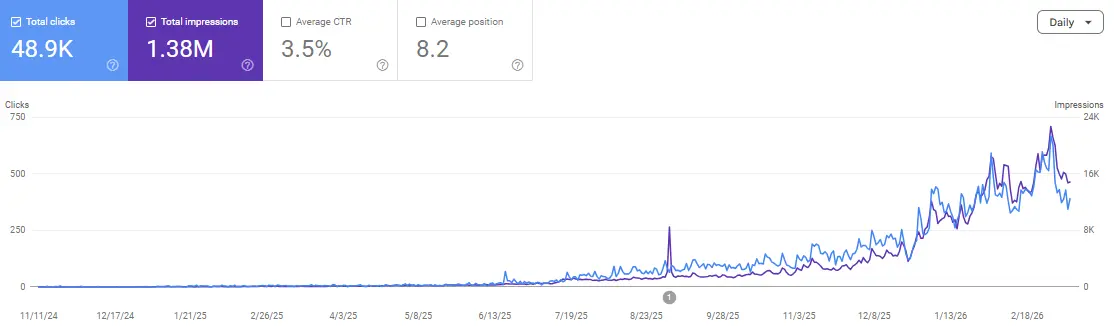
Programmatic SEO is the practice of creating many keyword-targeted pages at scale using templates and structured data instead of writing each page by hand. It can capture massive long-tail traffic if every page provides genuine unique value. It can also get your site demoted by Google if the pages are thin or duplicative. The single factor that decides which outcome you get is whether each generated page offers something users cannot easily find elsewhere.
This guide gives you the complete picture: how it works, when it makes sense, the risks most introductory articles ignore, and how to do it safely in 2026 when AI search is rapidly changing what counts as valuable content.
If you want feedback on a programmatic project from practitioners actually running these strategies, join the Scale-Xpert community on Discord. Members share real results, exchange backlinks, and discuss what is working in scaled content right now.
What Programmatic SEO Actually Means
Programmatic SEO generates large numbers of pages automatically from a single template and a structured dataset, with each page targeting a specific keyword variation. Instead of a writer producing one article at a time, the approach builds one well-designed template, connects it to a database, and creates hundreds or thousands of pages from that single setup.
A simple picture of how it works
A travel site wanting to rank for “best cafes in [city]” for every major city in the world cannot realistically write 2,000 individual articles. With programmatic SEO, the site builds one template, connects it to a database of cities and cafe data, and generates 2,000 pages at once. Each page is tailored to its city but shares the same underlying structure.
Why it is called programmatic
The pages are produced through a repeatable process driven by data, rather than written individually. As Ahrefs explains in their guide on the topic, programmatic pages are usually created from data in a database such as product prices, weather, or location information. The defining characteristic is scale achieved through systematization rather than manual effort.
This approach is not new
If you have ever browsed Amazon product pages, Yelp business listings, or TripAdvisor location pages, you have used programmatic pages. Large platforms have relied on this method for years because manually creating content for thousands of products or locations is not feasible. What has changed recently is that AI tools have made the approach accessible to much smaller operations, which is also why the associated risks have become more important to understand.
How Programmatic SEO Works
Programmatic SEO works by combining three elements: a keyword pattern, a page template, and a structured dataset. When these three come together, a single setup can generate a large volume of targeted pages, with the quality of the dataset determining whether the pages are genuinely useful or thin.
The three building blocks
The keyword pattern is a repeatable search structure with one variable element. Examples include “[product] alternatives,” “things to do in [city],” or “[software] vs [software].” The variable element changes across pages while the pattern stays constant.
The page template is the reusable layout that every generated page follows. It defines the structure, headings, where dynamic data appears, and which static content stays the same across all pages. A good template balances consistency with enough unique content per page to provide genuine value.
The dataset is the structured information that fills the template. This might be a spreadsheet of cities, a product database, an API feed of live prices, or any organized collection of data points. The quality and uniqueness of this dataset largely determines the success of the entire project.
The generation process is straightforward
For each row in the dataset, the system populates the template with the relevant data, creates a unique URL, and produces a finished page. A dataset of 1,000 rows produces 1,000 pages. This mechanism allows the approach to operate at a scale that manual content creation cannot match.
Where the data comes from matters significantly
The dataset can come from your product catalog, publicly available data, licensed datasets, APIs that provide live information, or original research you have conducted. The source has direct implications for both quality and risk, which connects to understanding what makes content genuinely SEO-friendly rather than just technically present.
Why Businesses Use Programmatic SEO
Programmatic SEO captures search traffic across thousands of related long-tail queries that would never justify individual content creation. This makes it valuable for specific business models, particularly those with naturally structured data and large product catalogs or location footprints.
Targeting the long tail is the core strategic value
Jeremy Tang, who runs the programmatic SEO platform CMAX and discussed his approach on the Channel Agency Podcast, frames this as a white space strategy. Rather than competing for highly contested head terms that every competitor is fighting over, the approach targets specific long-tail queries and underserved market areas that competitors typically ignore. These individually low-volume queries add up to substantial aggregate traffic when captured across thousands of pages.
Tang also emphasizes what he calls content momentum. By producing content at significant scale, a site signals consistent activity to search engines and builds coverage across an entire topic area rather than a handful of pages. His view is that volume and relevance across a broad long-tail footprint produce more stable traffic than relying solely on a small number of highly competitive keywords.
Some business models fit naturally, others do not
E-commerce sites with large catalogs, marketplaces with many listings, travel and local sites with location-based pages, comparison and directory sites, and software companies with integration or use-case pages all have natural programmatic opportunities. These businesses have inherent data structures that map cleanly onto keyword patterns, which is what makes the approach effective for them. Fitting this into a broader plan is part of building an SEO strategy designed for long-term growth.
Real Examples of Programmatic SEO
The clearest examples of successful programmatic SEO share one common trait: each page provides specific, genuinely useful information that users cannot easily get elsewhere in the same convenient form. Understanding this shared characteristic matters more than the surface details of each example.
Nomadlist location pages drive tens of thousands of monthly visits
Nomadlist helps remote workers decide which cities to live and work in. According to data cited by Ahrefs, the site has built tens of thousands of programmatic location pages, each covering a specific city with data on cost of living, internet speed, weather, and safety. The example works because each page contains genuinely useful, specific data that a digital nomad cannot easily find aggregated elsewhere.
Zapier integration pages capture millions of searches
Zapier built a massive programmatic footprint around the pattern “[app A] + [app B] integrations.” With thousands of apps in its ecosystem, the number of possible app-pair combinations runs into the millions. Each page targets a specific integration search and provides directly relevant information about connecting those two tools. This is a textbook case of a keyword pattern that maps perfectly onto an existing dataset.
Wise currency pages rank for vast numbers of conversion queries
Wise, the international money transfer company, ranks for currency conversion queries like “[amount] [currency] to [currency]” by generating pages that pull live exchange rate data. The pages are useful because they answer a specific, recurring question with current data, which is exactly the kind of genuine value that separates effective programmatic SEO from thin content.
The common thread connects every successful example
Each of these examples provides specific, genuinely useful information that users cannot easily get elsewhere in the same convenient form. This is the single most important factor that separates successful programmatic SEO from the kind that gets penalized.
The Risks of Programmatic SEO
Programmatic SEO carries real risk of demotion or penalty, and most introductory guides skip this entirely. The same technique that produces thousands of useful pages can just as easily produce thousands of thin, low-value pages, and Google has strong incentives to penalize the latter. Understanding the risks is more important than understanding the mechanics.
The approach is inherently risky according to expert practitioners
Lily Ray, a widely respected SEO practitioner, addressed this directly on Edward Sturm’s channel. Her view is that programmatic SEO always carries high risk. Even when it can be done wisely, the tactic is frequently viewed by Google as an attempt to manipulate search results for traffic or ad revenue. The core problem is that scale without unique value is exactly what Google’s helpful content systems are designed to identify and demote.
The thin content trap catches most failed attempts
A thousand pages that simply swap out a city name in otherwise identical content add nothing for users. Google’s helpful content systems are specifically designed to identify and demote this pattern. The penalty is not hypothetical, large sites have experienced significant traffic losses from exactly this kind of low-value scaled content.
Original value is the non-negotiable requirement
Ray’s central guidance is that anyone doing programmatic SEO must include original data or insights that Google did not previously have. If the content only repeats information that already exists elsewhere, or creates thousands of pages that provide no unique value, Google will likely penalize or demote the site. This is the most important principle in all of programmatic SEO. The connection to creating original, linkable content is direct, because the same originality that earns links is what makes programmatic pages survive.
AI Overviews raise the bar further
Ray also points out that the rise of AI Overviews changes the calculation. Google increasingly does not need thousands of automatically generated pages, such as thousands covering area codes or simple lookups, when its own AI can generate that answer directly. If your programmatic pages only provide information that an AI Overview can produce instantly, they offer little reason for Google to rank them or for users to visit them.
When Programmatic SEO Makes Sense and When It Does Not
The honest answer is that programmatic SEO makes sense only when you can provide genuine unique value at scale, and is a poor choice when your only goal is creating pages quickly to capture traffic. This single criterion separates projects worth pursuing from projects that put your site at risk.
Good candidates have proprietary or uniquely useful data
Programmatic SEO works when you have access to a genuinely useful dataset that is not easily available elsewhere, when each generated page can provide specific value to the user, when the keyword pattern reflects real search demand, and when you have the technical or tool-based capability to generate and maintain the pages. Proprietary data, live data that changes over time, or a uniquely useful aggregation of information all qualify as strong foundations.
Poor candidates are easily identified by one question
This approach is a poor choice when your only goal is creating pages quickly to capture traffic without offering unique value, when the information on each page is something an AI Overview can answer instantly, when you are simply duplicating data that is freely available everywhere, or when you lack the resources to maintain the pages over time.
The single honest self-assessment that filters most bad projects
Before starting a project like this, ask yourself one question: if a human looked at one of these pages, would they find something genuinely useful that they could not easily get elsewhere? If the answer is no, the project carries serious risk regardless of how many pages you can technically produce. This filter aligns with how search intent determines whether content actually deserves to rank.
How Programmatic SEO Connects to AI Search
Programmatic SEO and AI-powered search have a complicated relationship: structured programmatic content is easier for AI systems to parse, but AI Overviews are eliminating the need for many simple programmatic pages. Both forces are reshaping what kinds of programmatic projects will succeed going forward.
Query fan-out makes structured content more accessible to AI
Jeremy Tang describes how search engines like Google and AI engines like GPT-based systems are now interconnected through a mechanism called query fan-out, where a single user query is broken into multiple sub-queries answered from many sources at once. His argument is that a structured programmatic approach can make your content easier for these AI systems to discover and use as a credible information source. Well-structured, data-rich pages are more parseable by AI retrieval systems than unstructured content.
AI also reduces the value of thin programmatic pages
There is genuine tension here. On one hand, structured programmatic content can be more accessible to AI systems. On the other hand, as Lily Ray notes, AI Overviews reduce the need for thousands of simple lookup pages because the AI can generate those answers directly. The resolution of this tension is the same principle that runs through this entire guide: programmatic pages survive and thrive when they provide unique value that AI cannot simply generate on its own. Understanding how AI is changing search in 2026 is essential context for any programmatic decision made today.
The bar for programmatic SEO has risen permanently
The era of generating thousands of thin pages to capture easy traffic is ending, if it has not ended already. The programmatic strategies that will succeed going forward are those built on genuinely unique data, real user value, and content depth that justifies the page’s existence in an AI-saturated search environment.
Building programmatic SEO that survives this shift is challenging, which is exactly why connecting with others doing the same work is valuable. The Scale-Xpert community on Discord is a practical place to share strategies, exchange backlinks that build the authority programmatic sites need, and learn from real successes and failures.
Frequently Asked Questions
Is programmatic SEO against Google’s guidelines?
Not inherently, but it can easily cross into territory that violates them. Google’s guidelines specifically target scaled content created primarily to manipulate rankings rather than help users. Programmatic pages that provide genuine unique value are generally acceptable. Thin, duplicative pages created mainly to capture traffic violate Google’s spam policies on scaled content abuse and risk penalties. The determining factor is value to the user, not the method of creation.
Do I need to know how to code to do programmatic SEO?
Not necessarily in 2026. Traditionally, the approach required web development skills to connect databases to templates and generate pages. Today, no-code and low-code tools allow non-technical users to run programmatic projects using spreadsheets, page builders, and automation platforms. Understanding the underlying logic of templates, datasets, and keyword patterns remains essential regardless of whether you write code yourself.
How many pages can I create with programmatic SEO?
Technically there is no limit, but practically the right number is determined by how much genuine unique value your dataset can support. Some sites have created millions of programmatic pages, but creating more pages than you have real value to support is the primary cause of failures. Publishing 200 genuinely useful pages produces better results than publishing 20,000 thin ones. Quality and uniqueness should determine your scale, not technical capacity.
How long does programmatic SEO take to show results?
Typically three to six months, though this varies with domain authority and competition. Larger page sets also take time for Google to crawl and index fully. Sites with existing authority tend to see faster results than new domains, which often face additional scrutiny when publishing large volumes of pages quickly.
Can programmatic SEO hurt my existing rankings?
Yes, and this is one of the most underestimated risks. Publishing a large volume of thin or low-value pages can trigger site-wide quality signals that affect your entire domain, not just the programmatic pages. Google’s helpful content evaluation considers the overall quality of a site, so a significant portion of low-value pages can drag down rankings of your genuinely valuable content as well.
What is the difference between programmatic SEO and AI-generated content?
They are distinct concepts that sometimes overlap. Programmatic SEO is about generating pages at scale from structured data and templates, which may or may not involve AI. AI-generated content refers specifically to text produced by AI language models. You can do programmatic SEO using purely factual data without any AI-generated text at all, and you can use AI to generate content that is not programmatic.
Should beginners attempt programmatic SEO?
Yes, but start small and prioritize understanding the risks before scaling. A sensible first project is a small set of 50 to 100 pages built on a genuinely useful dataset, monitored carefully for indexing and ranking behavior before expanding. Attempting to generate thousands of pages as a first project, without understanding the value and risk principles in this guide, is the most common way beginners damage their sites.
Conclusion
Programmatic SEO is one of the most powerful and most dangerous techniques in SEO, and the difference between success and a penalty comes down to a single factor: genuine unique value on every page. The mechanics of templates, datasets, and keyword patterns are straightforward. The discipline required to apply them without crossing into thin-content territory is what separates the sites that win from the sites that get demoted.
In summary, programmatic SEO works by combining a keyword pattern, a page template, and structured data to generate many pages at once. It fits business models with natural data structures like e-commerce, marketplaces, and location-based services. The practitioners worth learning from, including Jeremy Tang on content momentum and white space, and Lily Ray on risk and original value, agree on one core principle even from different angles: scale only works when every page provides something genuinely useful that users cannot easily get elsewhere.
As AI search continues to reshape how content is discovered and evaluated, the bar for programmatic SEO is rising. The strategies that will win are built on unique data, real user value, and depth that justifies each page’s existence. If you can meet that bar, the approach remains one of the most powerful ways to scale organic visibility. If you cannot, it is a risk best avoided.
Join the Scale-Xpert community on Discord to discuss programmatic SEO strategies with practitioners, exchange backlinks that build the domain authority scaled content needs, and learn from real results rather than theory alone.