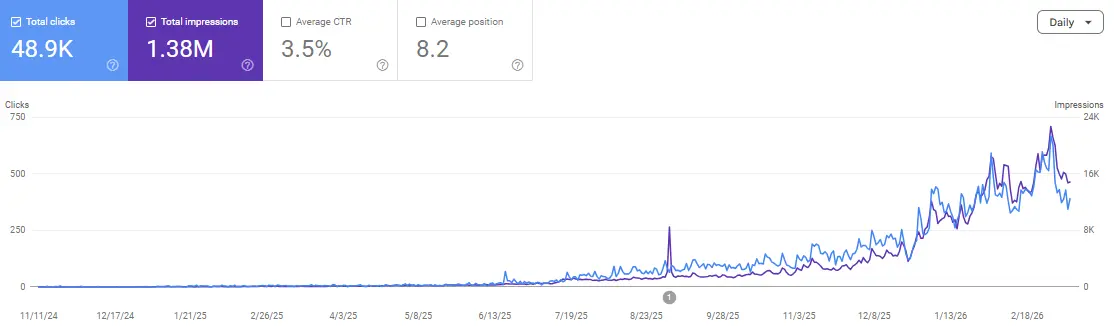
If you have been publishing blog posts and watching your traffic decline while AI Overviews absorb clicks, there is a strong chance your content falls into a category Google now explicitly deprioritizes: commodity content. In 2025, Google’s John Mueller and Search Liaison Danny Sullivan both made clear that Google wants websites to focus on non-commodity content. This is not vague advice. It represents a structural shift in how search visibility is earned in the age of AI search. This article explains exactly what commodity and non-commodity content are, why the distinction matters more than ever, and how to build content that AI search systems actually want to cite.
Want to discuss this with other SEOs navigating the same challenges? Join the Scale Xpert Discord community for real-time strategy conversations.
What Is Commodity Content?
Commodity content is information that is widely available, easily replicated, and provides no unique value beyond what already exists across dozens of other pages. The term “commodity” is borrowed from economics, where a commodity is a product that is interchangeable with identical products from other sources. The same logic applies here.
If you remove your website’s branding from an article and it could be mistaken for a competitor’s article on the same topic, your content is likely commodity content. It answers a question, but it answers it in exactly the same way thousands of other pages already do.
Typical characteristics of commodity content include:
- Definitions and overviews that restate what Wikipedia, vendor documentation, or major publications already cover.
- “Top 10” or “beginner’s guide” articles built entirely from secondary research, with no original data or experience.
- How-to guides that mirror the exact structure and advice found across multiple competing articles.
- Content produced primarily for search volume, not for genuine audience value.
- Articles that could be fully summarized by an AI in three sentences, leaving no reason for the reader to click through.
The last point is increasingly important. Google’s AI Overviews are specifically good at synthesizing commodity content into a short, direct answer. Therefore, if your article only contains information that AI can paraphrase from other sources, you lose the click entirely.
Why AI Can Generate Commodity Content Itself
One of the most significant shifts in 2025 and 2026 is that AI tools can now produce commodity content faster, cheaper, and at greater scale than human writers. A generative AI model can write a technically accurate 1,000-word overview of almost any widely documented topic in seconds.
This creates a direct competitive problem. If AI can produce commodity content and Google’s own AI Overviews can summarize it without citing your site, publishing commodity content is now close to worthless from an organic search perspective. You are competing against the machine that is better at producing the exact kind of content you are making.
Furthermore, Google’s ranking systems are designed to recognize when content adds genuine information gain to the web. Google has confirmed it uses an “information gain” score at both the query level and document level to assess how much unique value a piece of content contributes. Content that adds zero information gain relative to existing pages is increasingly filtered out of AI-cited results.
This is why understanding the difference between commodity and non-commodity content is not just useful for SEO strategy. It is now a survival requirement for organic visibility.
What Is Non-Commodity Content?
Non-commodity content is content that offers something the web does not already have. It is rooted in original experience, proprietary data, first-hand expertise, specific examples, or a distinct point of view that competitors and AI cannot easily replicate.
Google’s guidance is explicit on this point. John Mueller stated: “Focus on making unique, non-commodity content that visitors from Search and your own readers will find helpful and satisfying. Then you’re on the right path for success with our AI search experiences, where users are asking longer and more specific questions, as well as follow-up questions to dig even deeper.”
Non-commodity content is not necessarily longer or more complex. It is more original. Consider these comparisons:
Commodity: “Email open rates average around 20-25% across industries. To improve your open rate, write better subject lines, segment your list, and send at optimal times.”
Non-commodity: “After testing 147 subject line variations across a B2B SaaS email list of 12,000 subscribers over six months, we found that subject lines under 40 characters with a specific number (e.g., ‘3 mistakes costing you demos’) outperformed vague curiosity-bait subject lines by 34% on average. Here is what the data actually looked like.”
The second version adds information the AI cannot generate from existing sources. It is original, specific, and verifiable. That is what non-commodity content looks like in practice.
Examples of Commodity Content in the Wild
To make this concrete, here are real content categories that tend toward commodity status in 2026:
- “What is SEO?” articles that define search engine optimization without adding any original insight, case data, or expert perspective.
- Generic link building guides that list the same ten tactics (guest posting, skyscraper technique, broken link building) without any original experience or data to differentiate the advice.
- Social media marketing tips articles that repeat the same “post consistently, use hashtags, engage with your audience” advice found across thousands of other pages.
- Product review roundups assembled from brand websites and Amazon listings without independent testing or first-hand experience.
- Industry news summaries that simply restate what major publications already reported without analysis or original perspective.
These types of content are not inherently bad writing. The problem is that they are interchangeable. AI systems have no reason to cite one version over another because they all say the same thing.
Why Google Explicitly Prefers Non-Commodity Content
Google has multiple structural reasons to favor non-commodity content, beyond simply wanting quality.
First, AI Overviews and AI Mode depend on retrieving reliable, specific information. Generic content is harder to cite reliably because it often lacks specificity, citations, and verifiable claims. Original content with specific data points is much easier for an AI to use as a trustworthy source.
Second, Google’s business model depends on users finding search useful. If every AI Overview simply summarizes commodity content, users get less value than they would from a site with genuine expertise. Therefore, Google is structurally motivated to surface content that adds real information to the web.
Third, the E-E-A-T framework, which stands for Experience, Expertise, Authoritativeness, and Trustworthiness, explicitly rewards content that demonstrates first-hand experience. Commodity content, by definition, cannot demonstrate first-hand experience because it is assembled from other sources rather than lived expertise. Understanding how to apply AI search optimization strategies in a way that satisfies E-E-A-T requirements gives your content a structural advantage.
How to Identify If Your Content Is a Commodity
Before you can fix commodity content, you need to identify it. Here is a practical test:
Ask yourself three questions about each article on your site:
- Does this article include any information, data, or perspective that could not be found by reading our three closest competitors on the same topic?
- Is there any section of this article that could only have been written by someone with direct experience, access to original data, or specialized expertise in this area?
- If an AI summarized this article in five sentences, would the reader have any remaining reason to click through and read the full piece?
If you answer “no” to all three questions, the article is almost certainly commodity content. It may still rank in traditional search based on domain authority, but it is increasingly vulnerable to being bypassed by AI Overviews and to losing clicks even when it does rank.
How to Create Non-Commodity Content: A Practical Framework
Turning commodity topics into non-commodity content requires adding at least one element that is genuinely original. Here are the most reliable approaches:
Original research and data. Conduct surveys of your audience, analyze your own internal data, or compile aggregated data from original sources to produce statistics and benchmarks not available elsewhere. A single original data point that other sites link to is worth more than a hundred restatements of existing statistics.
First-hand case studies. Document real results from real work. Include specific numbers, timelines, what failed, what worked, and why. Generic case studies with vague outcomes are commodity. Specific case studies with measurable results and honest analysis are non-commodity.
Expert interviews and original quotes. Source original quotes from people with direct expertise in your topic area. An original interview with a practitioner adds a voice the AI cannot synthesize from existing sources. This also significantly strengthens your E-E-A-T signals.
Contrarian or nuanced perspectives. Most commodity content presents conventional wisdom. Non-commodity content challenges assumptions, presents alternative interpretations, or acknowledges complexity that simpler guides ignore. This kind of original thinking is exactly what high-authority content is built on.
User-generated content and community insights. Real questions, comments, and experiences from your actual audience contain perspectives that no AI can reproduce. Incorporating these signals into your content creates genuine differentiation.
Additionally, applying a sound SEO content marketing approach that starts with audience needs rather than keyword volume makes it structurally easier to produce non-commodity content from the start.
The Difference Between Commodity and Non-Commodity on Google
Google’s differentiation between these content types has become progressively more explicit since 2025. However, the distinction matters differently depending on the type of query.
For informational queries like “what is X,” commodity content still sometimes ranks because the query itself is essentially asking for a standard definition. However, even here, AI Overviews increasingly absorb the clicks and the blue-link result loses value.
For competitive, research-oriented, or decision-focused queries, non-commodity content has a clear and growing advantage. Queries like “which CRM is best for a 10-person sales team” or “how to reduce churn for a B2B SaaS product” require specific, experienced, original answers. AI systems naturally favor content that can provide that specificity.
Therefore, the strategic shift is to move your content production toward topics where original expertise creates a genuine moat, and to ruthlessly upgrade or remove commodity content that is diluting your topical authority.
FAQs
What is commodity content vs non-commodity content?
Commodity content is interchangeable information that already exists across many other pages in essentially the same form. Non-commodity content adds original value through first-hand experience, proprietary data, specific examples, or expert perspective that cannot be easily replicated by competitors or AI.
What is the difference between commodity and non-commodity?
The core difference is originality. Commodity content is replicated from existing sources and adds no new information to the web. Non-commodity content contributes something genuinely new, whether that is original data, a specific case study, an expert’s unique perspective, or a framework developed from direct experience.
What is commodity content?
Commodity content is generic, widely available information that could be found on many other sites in nearly identical form. It includes standard definitions, basic how-to guides assembled from secondary research, and listicles that repeat common knowledge without adding original analysis or experience.
What is the difference between commodity and non-commodity on Google?
Google explicitly prefers non-commodity content, particularly in its AI search products. Commodity content is easily summarized by Google’s AI Overviews, meaning it loses click-through value even when it ranks. Non-commodity content, because it contains original information AI cannot paraphrase from other sources, is more likely to be cited directly and to retain its click value.
Can AI-generated content be non-commodity?
AI-generated content is typically commodity by default because it synthesizes from existing sources. However, AI can assist in producing non-commodity content if the original research, data, expert input, and specific examples are provided by a human and the AI is used only for drafting and structuring, not for generating the original insights.
How does commodity content affect SEO in 2026?
Commodity content is increasingly ineffective in 2026 for two reasons. First, Google’s AI Overviews absorb the traffic by answering commodity questions directly without clicks. Second, Google’s ranking systems use information gain scoring to identify and deprioritize content that adds nothing new to the web. Sites with a high proportion of commodity content are losing organic visibility faster than those investing in original, specific content.
Conclusion
The distinction between commodity and non-commodity content is now one of the most strategically important concepts in SEO. As AI search systems become better at synthesizing generic information, the only content that retains long-term value is content that cannot be summarized, replaced, or bypassed by an AI. That means original research, specific case studies, first-hand expertise, and genuine perspectives that add something new to the conversation. The sites that understand this shift and act on it now will build a durable competitive advantage in AI search. Those that continue producing commodity content are, as Danny Sullivan put it, already invisible.
Start building your non-commodity content strategy with the support of a community that is already doing this work. Join us at Scale Xpert on Discord.