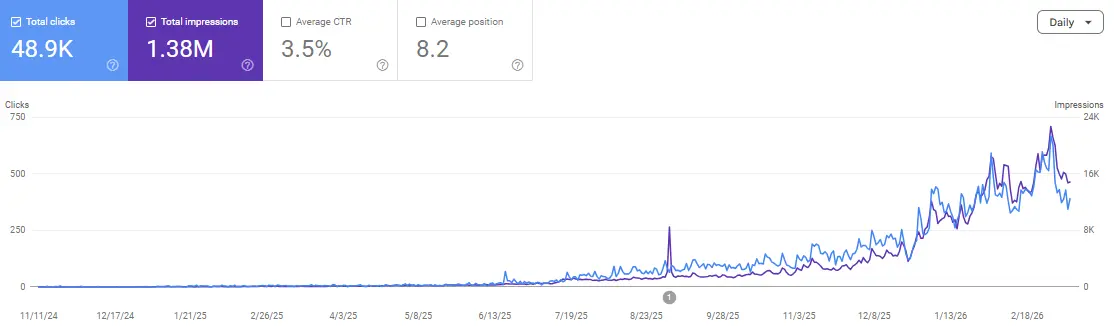
If you want to stay visible in Google’s AI Overviews and AI Mode in 2026, surface-level content is no longer enough. AI search systems use a process called query fan-out to retrieve multiple pieces of evidence from across the web before generating an answer. The sites that get cited are those with deep, specific, and authoritative content on their topic. This article explains why deep content matters more than ever, what concepts like topical authority, semantic SEO, and entity SEO actually mean in practice, and how to build articles that satisfy the full range of sub-queries AI search generates.
If you are building an SEO strategy for the AI era and want expert guidance, the Scale Xpert Discord community is a great place to start. Join thousands of SEOs sharing practical, tested strategies.
The Connection Between Query Fan-Out and Deep Content
When Google’s AI receives a question, it does not retrieve one page and call it done. Instead, it breaks the query into many related sub-questions and retrieves content to answer each one. This is query fan-out in action. As a result, content that only addresses the surface of a topic is structurally at a disadvantage.
Think about how this works in practice. If someone searches “how to improve email marketing performance,” the AI generates sub-queries covering subject lines, send timing, list segmentation, A/B testing, deliverability, and automation sequences all at once. A shallow article that mentions all of these topics in one sentence each is unlikely to be selected as a source for any of them. In contrast, a deep piece that covers segmentation in genuine detail, for example, has a much stronger chance of being retrieved for that specific sub-query.
Therefore, deep content is not just a quality preference. It is a structural requirement for AI search visibility.
What Is Deep Content, Really?
The term “deep content” does not simply mean long content. A 3,000-word article that repeats the same point twenty times is not deep. Depth refers to the degree of coverage, specificity, and original value a piece provides on its topic.
Deep content typically exhibits these characteristics:
- It answers not just the primary question but the follow-up questions a reader would naturally have.
- It includes specific data, examples, case studies, or comparisons rather than general statements.
- It addresses nuance, edge cases, and context that shallow content ignores.
- It is written with demonstrated expertise, not assembled from other summaries.
- It connects ideas across the topic in ways that require genuine understanding.
Importantly, AI search engines evaluate content at what researchers call “chunk level.” This means the AI assesses individual paragraphs or sections independently, not just the entire page. A well-structured article where each H2 section thoroughly addresses a specific sub-topic will therefore perform better than an equally long article that buries key information inside dense, unstructured text.
Topical Authority: Why Depth Across a Site Matters
Topical authority refers to how comprehensively a website covers a specific subject area. A site with deep coverage of a narrow topic is generally seen as more authoritative on that topic than a site with broad but shallow coverage of many topics.
This matters for AI search because when the system fans out a query, it often prefers to retrieve multiple pieces of evidence from the same trusted source. In other words, if your site has a detailed article on email subject lines, another on list segmentation, and a third on deliverability, you are more likely to be cited across multiple sub-queries on the topic “email marketing strategy” than a competitor who only has one generic overview article.
Building topical authority requires three things working together. First, you need content depth on individual topics. Second, you need content breadth across the full topic cluster. Third, you need strong internal linking that connects your content in a way that helps both human readers and AI crawlers understand the relationships between your articles.
Semantic SEO: Writing for Meaning, Not Just Keywords
Semantic SEO is the practice of creating content that is optimized for meaning and context rather than just individual keywords. It is one of the most important shifts in content strategy as AI search systems become dominant.
Traditional keyword optimization asked: “What exact phrase should I repeat to rank for this search?” Semantic SEO asks: “What does a thorough, expert understanding of this topic look like, and how do I communicate that to both a human reader and an AI system?”
In practice, semantic SEO means:
- Using related terms, synonyms, and conceptually connected phrases throughout your content naturally.
- Structuring content around ideas and questions, not just target keywords.
- Covering the entities (people, places, tools, concepts) that are genuinely associated with a topic.
- Writing in a way that demonstrates understanding of the topic’s nuances, not just its surface definition.
For example, an article about “link building” written with semantic depth would naturally include references to domain authority, anchor text, editorial links, digital PR, and niche relevance. It would not need to repeat “link building” fifty times. The AI understands from the surrounding context what the content is about.
Learning to apply this kind of thinking through a strong content strategy for SEO is one of the highest-leverage things you can do for your organic visibility in 2026.
Entity SEO: Helping AI Understand What Your Content Is About
Entity SEO takes semantic thinking one step further. An “entity” in SEO terms is any named concept that has a distinct, well-defined identity. People, brands, products, locations, tools, and technical concepts are all entities.
AI search systems like Google use entity relationships to understand what a piece of content is fundamentally about, not just which keywords it contains. If your article about “email marketing” mentions specific tools like Mailchimp and Klaviyo, specific concepts like sender reputation and bounce rates, and real benchmarks or case studies, the AI understands the entity relationships at play and rates the content as genuinely substantive.
Conversely, content that uses generic language without naming specific entities reads as thin and generic, even if it is technically long. Therefore, strengthening entity signals in your content is one of the most effective ways to improve your AI search visibility.
Practical ways to strengthen entity SEO include:
- Naming specific tools, platforms, frameworks, and methodologies rather than speaking in vague terms.
- Using structured data markup (Schema.org) to explicitly define entities on your pages.
- Citing real data, research, and named experts rather than anonymous “industry experts.”
- Building consistent entity mentions across your content cluster so AI systems recognize your site as genuinely authoritative on specific topics.
How to Write Articles That Cover Many Sub-Queries
Given how AI search works with fan-out, structuring your articles to address multiple sub-queries is a direct competitive advantage. Here is a practical framework for doing this:
Step 1: Map the full question cluster before you write. Before writing a single word, search your target topic and collect every “People Also Ask” question, every related search suggestion, and every sub-topic that appears in competitor articles. This gives you the full fan-out map for your topic.
Step 2: Use H2 and H3 headings as sub-query answers. Each major heading in your article should correspond to a question someone might search for independently. If your heading is a question that someone would actually type into Google, you increase the chance of being retrieved for that specific sub-query during fan-out.
Step 3: Answer completely, then elaborate. A pattern that works well for AI retrieval is to answer the sub-question directly in the first one or two sentences under each heading, then provide additional detail and context. This mirrors how AI systems prefer to retrieve information, with a direct answer followed by supporting evidence.
Step 4: Add original value to every section. At least one element of every major section should include something not easily found elsewhere. This could be a specific example from your own experience, an original comparison, a data point from your own research, or a perspective that contradicts the conventional wisdom. This transforms your content from commodity to non-commodity, which is exactly what AI search optimization rewards.
Step 5: Use FAQ sections deliberately. A dedicated FAQ section at the end of your article gives you the opportunity to cover additional sub-queries that did not fit naturally into the main body. These are directly retrieved by AI systems answering follow-up questions within a session.
Why Shallow Content Is Losing Ground Fast
The evidence that deep, specific content outperforms shallow content in AI search is growing. Several patterns explain this:
Homepages and general overview pages are among the biggest losers in AI search rankings. They cover too many topics too broadly to be selected as authoritative sources for any specific sub-query. Dedicated, focused, deep content pages on individual subtopics consistently outperform them.
AI systems also reward information density. A section of content that delivers a clear, specific answer in two well-written paragraphs can outperform a meandering 500-word section that says the same thing repeatedly. Therefore, editing for density and clarity is just as important as adding depth.
Additionally, Google’s Quality Rater Guidelines use E-E-A-T (Experience, Expertise, Authoritativeness, and Trustworthiness) as a framework for evaluating content quality. Deep content naturally demonstrates all four. Surface-level content demonstrates none of them reliably.
FAQs
What is deep content in SEO?
Deep content is content that goes beyond surface-level definitions to provide comprehensive, specific, and original coverage of a topic. It addresses multiple sub-questions within a topic, includes specific data or examples, and demonstrates genuine expertise rather than assembled summaries.
Why does deep content rank better in AI search?
AI search uses query fan-out to retrieve content for multiple sub-queries simultaneously. Deep content is more likely to be selected because it satisfies multiple sub-queries at once and provides specific, authoritative information that generalist content cannot match.
Topical authority is the degree to which a website is recognized as a trusted, comprehensive source on a specific subject. You build it by creating deep content across the full cluster of topics within your niche, connecting them with strong internal linking, and consistently publishing original and specific information.
How is semantic SEO different from regular keyword optimization?
Regular keyword optimization focuses on repeating a target phrase to signal relevance. Semantic SEO focuses on covering a topic’s full meaning using related concepts, entities, and natural language that demonstrates genuine understanding. AI search systems respond much better to semantic depth than to keyword repetition.
What is entity SEO and why does it matter for AI search?
Entity SEO is the practice of clearly defining and connecting the specific people, concepts, tools, and topics your content covers. AI systems use entity relationships to assess content quality and relevance. Content rich in clear entity signals is more likely to be retrieved and cited in AI search responses.
How long should a deep content article be?
There is no universal rule, but articles on complex topics typically need at least 1,500 to 2,500 words to achieve genuine depth. What matters more than word count is whether every section adds specific value and addresses a real sub-question within the topic cluster.
Conclusion
Deep content is not a nice-to-have in 2026. It is the minimum requirement for visibility in AI search. By understanding how query fan-out works, building topical authority across your content cluster, writing semantically rich articles that address entity relationships, and structuring content to satisfy multiple sub-queries at once, you position your site as a preferred source for AI synthesis.
The sites winning in AI search are not simply producing more content. They are producing more useful, more specific, and more original content than their competitors. That is the standard worth building toward.
Want help building a deep content strategy that actually gets cited in AI search? Join the conversation at Scale Xpert on Discord and connect with SEOs who are already doing this.