
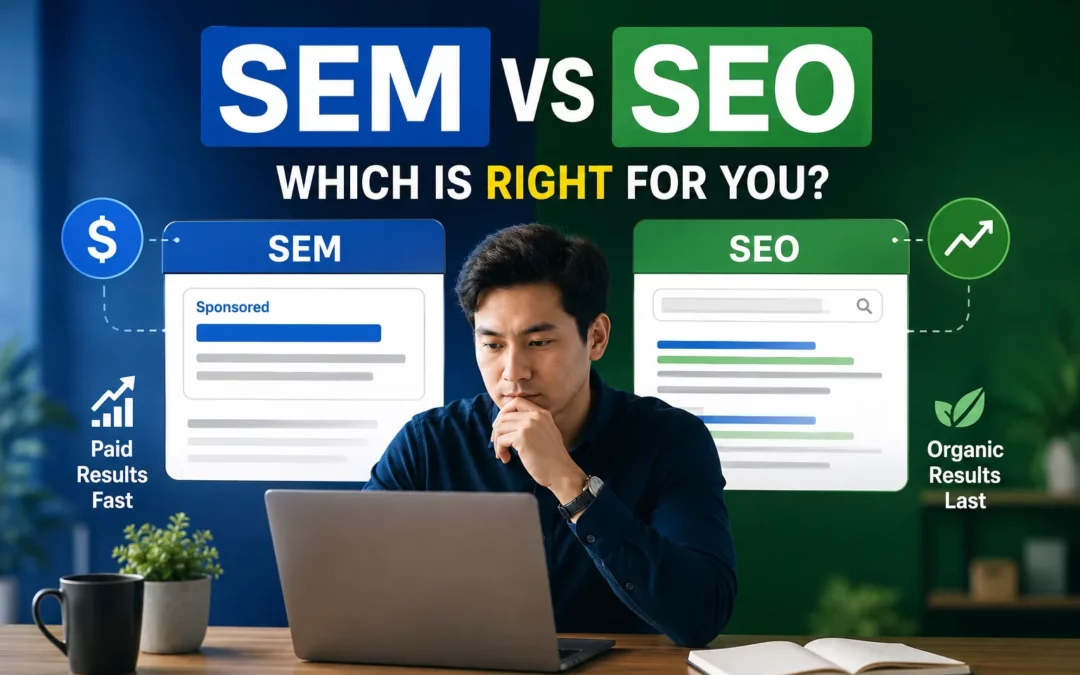
SEM and SEO are both strategies for appearing on Google search results, but they work in completely different ways. SEM (Search Engine Marketing) uses paid advertising to appear at the top of results immediately, while SEO (Search Engine Optimization) earns organic rankings over months through content and technical optimization.
Understanding the difference between these two approaches is the first strategic decision every business owner and marketer must make because choosing the wrong channel for the wrong situation wastes both time and money. Not sure whether SEM or SEO is right for your business right now? Our community of digital marketers can help you think it through join the conversation here.
What Is the Core Difference Between SEM and SEO?
The fundamental difference is simple: SEM is paid, SEO is organic.
When you run SEM campaigns, you pay Google every time someone clicks your ad. Your ad appears at the top of search results immediately, labeled “Sponsored.” When your budget runs out, the traffic stops.
When you do SEO, you earn your position through content quality, website authority, and technical excellence. Clicks are free, but building that authority takes time — typically 3 to 6 months before meaningful results appear. However, once established, organic rankings generate traffic without ongoing cost per click.
Both strategies aim for the same outcome visibility on Google but through entirely different mechanisms with different cost structures and timelines.
SEM vs SEO: A Direct Comparison
| Factor | SEM | SEO |
|---|---|---|
| How you appear | Paid ads, labeled “Sponsored” | Organic results, no label |
| Speed to results | Hours to days | 3 to 6 months minimum |
| Cost model | Pay per click (CPC) | No click cost, investment in content |
| Sustainability | Traffic stops when budget stops | Compounds and persists over time |
| Control | Full control over keywords and targeting | Limited control over Google’s algorithm |
| Best position | Top of page (above organic results) | Below ads (positions 1–10) |
| Click-through rate | Lower CTR (users know it is paid) | Higher CTR for top organic positions |
| ROI timeline | Immediate but ongoing cost | Slow start, high long-term ROI |
| Best use case | Product launches, quick wins, competitive keywords | Long-term brand authority, evergreen content |
Neither approach is universally better. The right choice depends on your goals, timeline, and budget.
When SEM Makes More Sense Than SEO
SEM is the better choice in several specific situations:
When you need traffic immediately. A new product launch, a seasonal promotion, or a time-sensitive offer cannot wait 6 months for SEO to take effect. SEM delivers visibility within hours.
When you are entering a highly competitive market. If you are a new brand in a space dominated by established players with years of SEO authority, competing organically immediately is extremely difficult. SEM lets you appear alongside or above those competitors right away.
When you have a high-margin product with a proven conversion rate. If you know that every 100 visitors generates a predictable revenue amount, SEM’s cost model is straightforward to manage and scale.
When you want to test messaging before investing in content. Running SEM on several keyword variants quickly tells you which messages convert best — data you can then use to guide your SEO content strategy.
When targeting very specific audience segments. SEM offers granular targeting by keyword, location, device, time of day, and audience demographics that organic search cannot match.
When SEO Makes More Sense Than SEM
SEO is the better long-term investment in these situations:
When you are building brand authority in a defined niche. Organic rankings signal trust and credibility that paid ads simply do not convey to many users.
When your content serves informational intent. Users searching “how does email marketing work” are in research mode, not buying mode. Paying for that click has poor ROI. SEO captures this audience cost-effectively.
When your budget is limited long-term. SEM requires continuous spend to maintain traffic. SEO requires upfront investment in content but generates traffic without ongoing per-click costs.
When you operate in low-CPC niches. Some industries have very affordable paid traffic but in others, CPCs are so high that SEO’s free traffic model delivers dramatically better ROI.
Understanding the fundamentals of what on-page SEO requires reveals why SEO is a longer-term but more sustainable investment than SEM alone.
How SEM and SEO Work Together (The Integrated Approach)
The most effective digital marketing strategies use SEM and SEO together, not as alternatives. Here is how they complement each other:
SEM informs SEO keyword strategy. Running SEM reveals which keywords actually convert not just which ones get searched. This data directly improves your SEO content priorities.
SEO reduces SEM costs over time. As your organic rankings strengthen for informational keywords, you can shift SEM budget toward high-intent, commercial keywords where paid ads deliver the highest ROI.
SEM protects brand presence on competitive SERPs. Even if you rank organically, competitors may run ads on your brand keywords. SEM brand campaigns ensure you dominate your branded search results.
SEO improves Quality Score for SEM. Better website content, faster page speeds, and stronger user experience signals — all core to good SEO — directly improve your Google Ads Quality Score, lowering your CPC.
For anyone starting from scratch, reviewing the beginner’s guide to SEO and how to start ranking your website alongside this SEM series creates a complete picture of how both channels work together.
The SERP Layout: Where SEM and SEO Results Appear
Understanding where each type of result appears on the search results page helps clarify how they interact:
Top of page: 2–4 SEM text ads (labeled “Sponsored”) Middle: Google AI Overview (for applicable queries) Below AI Overview: Shopping ads (for product searches) Organic positions 1–10: SEO results Bottom of page: Additional SEM text ads (1–3)
An important insight: organic position 1 (the top SEO result) typically appears below the paid ads on the page. However, users often scroll past paid ads for informational queries, giving organic results strong CTR despite their lower physical position. For commercial and transactional queries, the paid ad positions at the top of the page consistently capture higher click share.
Cost Comparison: SEM vs SEO
SEM costs are predictable and direct: you pay a specific CPC for each click, visible in real time. However, costs are ongoing — stop paying and traffic stops immediately.
SEO costs are less predictable and indirect: you invest in content creation, link building, and technical optimization, but clicks themselves are free. Initial investment is often high, but cost per click effectively trends toward zero as rankings compound.
A practical framework many businesses use: allocate SEM budget to generate immediate revenue while simultaneously investing in SEO content that will reduce paid traffic dependency over 12–24 months. This approach is why building organic traffic strategically matters even for businesses running active SEM campaigns.
SEM vs SEO: Which One Should You Start With?
The answer depends on three factors:
Your timeline: Need results in 30 days? Start with SEM. Building for 12 months? Prioritize SEO.
Your budget: Have $1,000+ per month for advertising? SEM is viable. Limited budget? Invest in SEO content for compounding free returns.
Your business model: High-margin products with known conversion rates? SEM’s ROI is straightforward. Content-driven brand building? SEO is the right foundation.
For most businesses, the honest answer is: start SEM for immediate revenue and simultaneously invest in SEO for long-term sustainability. The two strategies are not competitors they are complementary tools in the same digital marketing toolkit.
FAQs
Is SEM or SEO better for a new website?
New websites often benefit from SEM first, because they have no domain authority and SEO results will take months. SEM generates immediate traffic and revenue data while the SEO foundation is being built in parallel. Most experts recommend running both simultaneously from launch.
Does running SEM ads help my SEO rankings?
No. Google explicitly confirms that running paid Google Ads does not directly improve your organic search rankings. However, the indirect benefits are real: SEM-driven traffic can increase brand mentions, time on site, and engagement signals that indirectly support SEO over time.
Which has a higher conversion rate, SEM or SEO?
It depends on the keyword intent. For transactional, commercial keywords (“buy X now”), SEM ads typically convert well because users are in buying mode. For informational keywords, organic SEO results often convert at higher rates because users trust organic results more for research queries.
How much should I spend on SEM vs SEO?
A common starting allocation is 60% paid (SEM) and 40% content/SEO investment during the first 6 months for a new business that needs traffic quickly. As organic rankings build, many businesses shift toward 40% SEM and 60% SEO over the following year. The right ratio depends on your CPC economics and content ROI.
Can I do SEM without an SEO strategy?
Yes, but it is not optimal. Without SEO, you are 100% dependent on paid traffic. If ad costs rise or your budget shrinks, all traffic disappears. SEM without SEO is a tactical tool; the combination is a strategic advantage.
What is easier to learn, SEM or SEO?
SEM has a steeper upfront learning curve because you are managing auctions, bids, Quality Scores, and campaign structures simultaneously. SEO has a more gradual learning curve but requires longer patience before results appear. Most practitioners find SEO concepts more intuitive but SEM more immediately measurable.
Do I need separate tools for SEM and SEO?
Some tools serve both. Google Search Console is primarily for SEO. Google Ads dashboard is for SEM. Platforms like Semrush and Ahrefs cover both organic keyword research and paid keyword competitive analysis, making them valuable for integrated SEM and SEO strategy.
Conclusion
The SEM vs SEO debate sets up a false choice. The most successful businesses in search use both channels strategically SEM for immediate visibility and measurable short-term ROI, SEO for sustainable long-term authority that compounds over time.
Start by understanding what each channel does best. Then allocate your resources according to your timeline, budget, and business goals. If you need immediate traffic, SEM is your fastest path. If you are building a brand that will generate traffic for years without ongoing ad spend, SEO is your most valuable long-term investment.
The brands that consistently win in search are those that treat SEM and SEO as integrated tools using each where it performs best, with data from each informing the strategy of the other. Want to map out your SEM and SEO strategy with feedback from practitioners? Our community covers both channels in depth join us here.